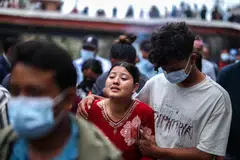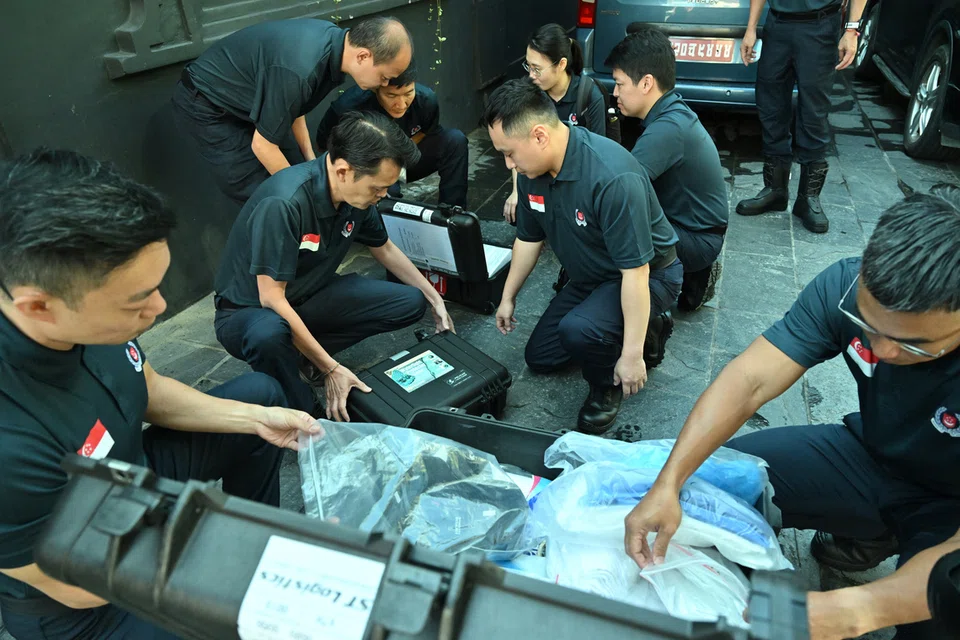
As rescue and relief operations continue in Nepal following the devastating Aug 26 flash flood, a 35-member team of the Singapore Police Force is on the ground to support the local authorities with aerial surveillance and especially disaster victim identification.
The team, which started arriving in Nepal from Sept 2, includes officers trained in fingerprint lifting and photography, as well as specialists in fingerprint examination from the Integrated Forensics Service under the Home Team Science and Technology Agency.
The team is still sizing up the ground situation, said Assistant Commissioner of Police Patrick Tan, the contingent commander of the Singapore Police Force (SPF) team in Nepal.
“For now, we are focusing on disaster victim identification as well as training Nepali police to operate drones to support their search and rescue operations,” he told The Straits Times.
Assistant Commissioner of Police Eugene Wang, the commander of the SPF’s Disaster Victim Identification (DVI) team in Nepal, said his team’s mission is to help identify victims across all nationalities and not just Singaporeans.
“We are not able to isolate and say we only target the Singaporeans. Since the victims are from many nationalities, it is a collaborative effort, involving many countries. We are here to help in the collective effort to identify the victims so that we can bring reconciliation and relief to the families,” he said.
Nine Singaporeans have been reported to be missing because of the Aug 26 flood in Nepal, which has killed at least 1,300 people, with around 5,000 people reported missing.
Mr Wang said he was most struck by the magnitude of the situation: “More than a thousand bodies have been recovered, but more than 4,000 are still missing. That’s over 5,000 people of different nationalities.”
The SPF team also comprises a forensic pathologist as well as a forensic technical officer from the Health Sciences Authority, who play a critical role in the post-mortem examinations, documentation and collection of samples for forensic identification.
These capabilities are particularly important where bodies are decomposed, fragmented or recovered far from the original disaster site, making visual recognition unreliable.
At hospitals in Nepal’s capital Kathmandu, Singapore’s DVI team is lifting the fingerprints of bodies taken into the mortuary, in coordination with the Nepal police, forensic and health officials. Back in Singapore, the SPF is taking antemortem information such as X-rays or medical records taken when the person was alive from the family of the missing persons, and getting samples of DNA.
Mr Wang explained that Singapore will provide the information to Nepal, which will do the matching. Under the DVI protocol of the INTERPOL, the country that faced the disaster carries out the DNA matching.
Besides Singapore, countries like India, China, Japan, South Korea, and Australia have also sent help ranging from forensic identification teams, specialised tunnel-rescue experts to rapid response teams and logistics coordinators.
While the SPF team comprises members who have experience in helping to identify victims in disasters in places such as Phuket, Thailand, which was hit by a tsunami in 2004, the massive flash flood in Nepal presents unique challenges.
“Typically in a flood situation, by this point in time, the bodies are quite badly decomposed. The state of the body can be quite severely damaged because they can come in fragments. So that creates a lot more challenges in terms of identification and fingerprint collection.
“But we have been quite successful in collecting information,” said Mr Wang.
Meanwhile, a crisis response team from Singapore’s Ministry of Foreign Affairs (MFA) has been in Nepal since Aug 27, a day after the flash food struck. The MFA team travelled to some affected areas with the Nepal authorities to assess the damage.
“I think one of the biggest challenges has been the absolute devastation of infrastructure. Forty to 50 km of roads have been washed away and at least 20 bridges were destroyed. That has hugely complicated rescue and recovery operations as authorities cannot access the actual flood affected areas,” said Abraham Tan, First Officer (Political), High Commission of the Republic of Singapore in New Delhi.
The Nepali police and armed forces have had to use helicopters and drones, but this too has been complex in the narrow valley below the Himalayas that has limited airspace for rescue and recovery operations.
“Our initial mission was to find information about missing Singaporeans who were caught up in the flash floods near the Nepal-China border. But we figured that we needed to support Nepal in rescue operations. This meant drones, supplies and information on last known locations or other data that could potentially help to narrow down the search,” said Mr Tan, who is leading the MFA’s crisis response team in Nepal.
The Singapore Government has arranged humanitarian aid of $560,000 including essential medicines, relief supplies and emergency survival items for the survivors as well as for Nepal government’s operations.
This will reach Nepal early next week.
Ten days after the flood, the priority for the Nepal authorities and international teams is two-fold. Even as they try to rescue people stuck in hydropower tunnels and those who made it to higher ground, they must simultaneously recover as many remains as they can.
Said Mr Tan: “The families of the missing Singaporeans can expect that both the MFA and the SPF teams are going to do everything they can to identify and recover, if unfortunately, any of the missing Singaporeans has passed away.
“We’d do everything we can to try and recover the remains and if requested, (we) can evacuate them back to Singapore so that the families can have closure,” he said.
THE STRAITS TIMES