
Imagine spending not one, but several birthdays hundreds of metres under water. And marking each of them with a frozen Sara Lee cake without the presence of your family and friends.
Not that Military Expert 3 Hariiheran Naidu minds too much. After all, he did have his “navy brothers” with him; men who put their lives in one another’s hands on board a warship.
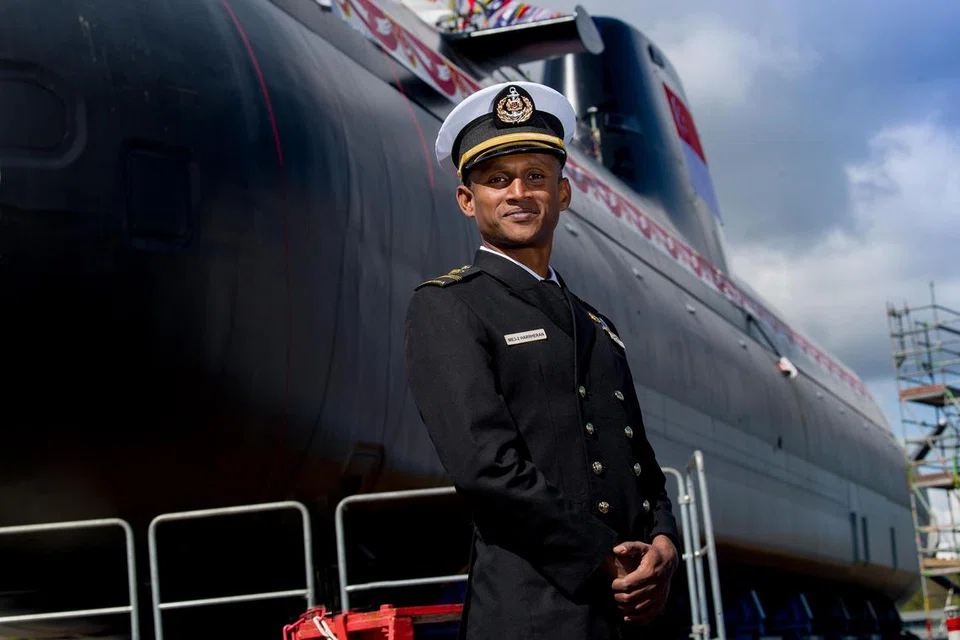
The 36-year-old naval submariner has been working in a submarine for the past 16 years – a job, he says, that often prompts a line of questions from curious friends and acquaintances.
“It was my father’s idea to get me into swimming, from there I just had an affinity with the water,” he tells tabla!
“After working as a lifeguard during my teens, I learnt about the navy and that it had everything to do with water, so I took a leap of faith and signed up – without knowing what to expect.
“I never thought I’d end up working in a submarine – and spending so many birthdays under water.”
ME3 Hari, who joined the navy in 2007 after graduating from ITE in Info-Communications Technology, recently returned from Kiel in Germany after a rigorous three-year training stint.
There, along with some 20 other navy personnel, he was trained to handle the new Invincible-class submarines, the last of which was launched in Kiel on April 22. The Singapore Navy has four submarines under the Invincible series.
There’s a certain mystery about submarines, I tell him – because no one ever sees them. He nods in agreement and tells me: “People ask me what it’s like in the submarine, and I just tell them, ‘Take your phone, put it outside, can you last one week without it?’
“Then there’s having to work in tight spaces, so you can’t be claustrophobic.”
ME3 Hari declines – as per Navy regulations – to disclose how long he spent underwater during his training stint. But camaraderie with your crew members, he points out, is crucial.
“That’s how we overcome everything. We do activities that look out for one another and to entertain ourselves, like challenging each other to do 100 push-ups and stuff like that.
“And though there’s limited space, we find a way to exercise. There’s no gym on board, so even a tiny corner for our yoga mat would do,” he says.
Quality-of-life improvements on the new submarines mean that naval officers now have built-in rice cookers, while crew members have their own beds instead of having to share bunks, which ME3 Hari is especially pleased about as he now has his own space to put up pictures of his family.
“There’s a chef on board and he’s very good,” he assures. “The food is a huge morale booster, and the days when the crew gets chicken rice and laksa are quite special. We’re Singaporeans, so we must have our food lah.”
A typical day on board the sub is split between six hours work and six hours of rest. ME3 Hari’s work deals with the ship’s sonar console, or what he refers to as the “eyes of the submarine”.
“My daughter once asked me if the submarine had windows. I explained that we operate the submarines by sonar, by listening.
“People who don’t know much about submarines think we can see outside, but you can’t, though we do have the periscope before we descend.”
Using advanced sonar systems, the submarine is capable of detecting all targets within its area of operations, ME3 Hari explains. The Underwater Warfare System Experts are able to “fingerprint” the target, well before it’s able to detect the submarine’s presence.
Aside from the sonar console, he also has to be adept with the manoeuvring control console, which, in simple terms, is the section that steers the boat.
“The ship also has day-night lighting to acclimatise your eyes,” he says. “Red light denotes night.”
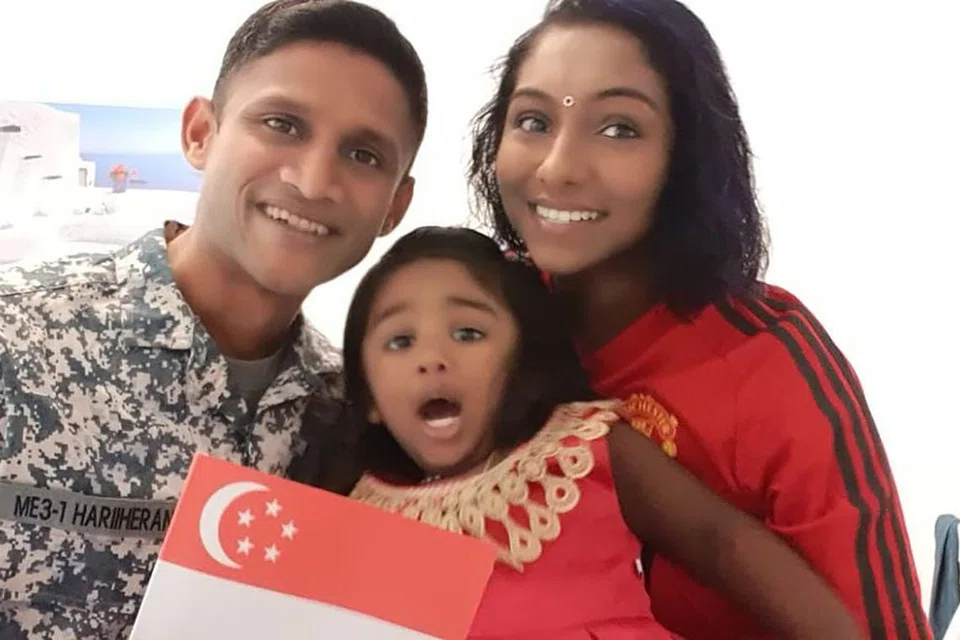
Married since 2013, ME3 Hari says he was fortunate enough to have his wife Malatthi and six-year-old daughter Sharvini with him in Germany.
Both wife and child picked up German during their stay, but not ME3 Hari – understandable as he was underwater most of the time.
“It was a tough decision for me,” said Ms Malatthi, referring to the choice of relocating to Germany for three years upon her husband’s posting.
“But when Hari was given a chance to go overseas, I took it as an opportunity for my family as well. Also, I wanted my daughter to have her father around during her prime growing up years.
“I don’t think my daughter actually remembers what Singapore is like. She was just 16 months (when we left), so we actually had to tell her what National Day and Deepavali were.”
Since he returned from Kiel last December, ME3 Hari has taken on the role of instructor at the navy training school at Changi Naval Base, where he teaches new submariners over a six-month course. “It’s a lot of theory and study before you qualify to get on board the submarine,” he says.
“Then you go through months of training on a submarine to understand how a submarine works and how to operate the onboard systems.
“It’s not important to know how to swim, although we will teach you that.”