Mother tongue languages connect Singaporeans to their roots, values and cultural heritage, said Prime Minister Lawrence Wong.
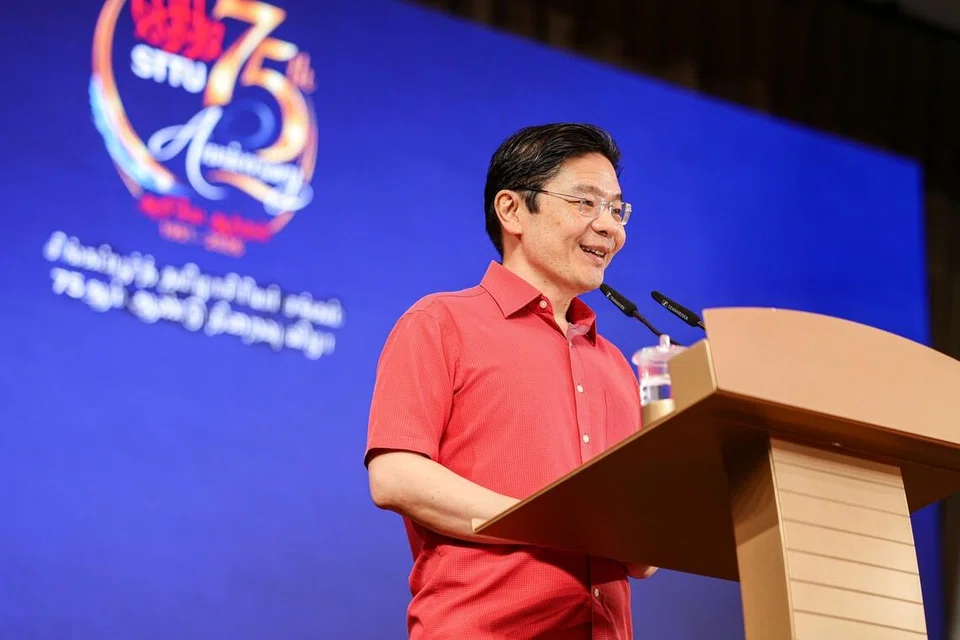
“They help us understand where we came from and they shape who we are,” he added in a speech on July 17 at the Singapore Tamil Teachers’ Union’s (STTU) 75th anniversary dinner.
PM Wong said mother tongue languages also reflect the Republic’s identity as a multiracial and multi-religious nation, where its citizens are “Singaporeans first and foremost” while remaining deeply connected to the rich traditions of their respective cultures.
That is why the learning of mother tongue languages is a cornerstone of Singapore’s education system, he said. However, he noted that mastering the languages is not an easy task.
“For Tamil, the challenge can be even greater – because students may have fewer natural opportunities to speak, read and use the language outside the classroom,” PM Wong said, adding that Tamil language teachers therefore play a critical role.
The Government is committed to working closely with STTU in its mission to support Tamil teachers and the teaching of Tamil, while continuing to bring together educators, families and community partners to celebrate the teaching and learning of mother tongue languages, he said.
The union also works closely with the Ministry of Education through mentorship and advisory programmes to support Tamil teachers, he added.
“Together, these efforts have helped attract new teachers, support younger educators and strengthen the profession for the longer term,” PM Wong said.
The union understands that language learning needs to go beyond the classroom, he said, citing the Tamizhil Yosi Tamizhil Vaasi (Think In Tamil, Read In Tamil) campaign as an example.
The campaign reminds young people that Tamil is not just a language for examinations, but a living language for communicating, creating and connecting with others.
“When every part of the community plays its role, Tamil will continue to flourish as a living language in Singapore,” PM Wong said.
At the celebrations, STTU also pledged $10,000 to the Singapore Indian Education Trust to support students pursuing Tamil at the tertiary level and beyond.
The memorandum of understanding was witnessed by labour chief Ng Chee Meng and Minister of State for Culture, Community and Youth Dinesh Vasu Dash, who serves as chairman of the Tamil Promotion Committee.
PM Wong also unveiled the union’s revamped website, a one-stop repository of research papers, seminar materials and teaching strategies. The website will be available to educators worldwide.
Also unveiled during the celebrations was an exhibition documenting the union’s journey and contributions, as well as STTU’s historical resource book, The Sanctuary Of Power. Authored by curator Nalina Gopal, it explores the key milestones in Tamil teaching and learning from 1951 to 2025.
The first half of the English-language book surveys the history of Tamil education and educators in Singapore from the early 19th century, providing the historical context for the emergence of STTU in the mid-20th century.
The second half traces the union’s history from its founding in 1951 to the early 2000s, drawing on STTU’s archival records and publications, oral history interviews from the National Archives of Singapore, and local newspaper archives from the Indian Daily Mail and Tamil Murasu.
Founded in 1951 with just under 100 members, the union has grown to about 630 members today, representing Tamil educators across pre-, primary and secondary schools, and other educational institutions.
The Straits Times