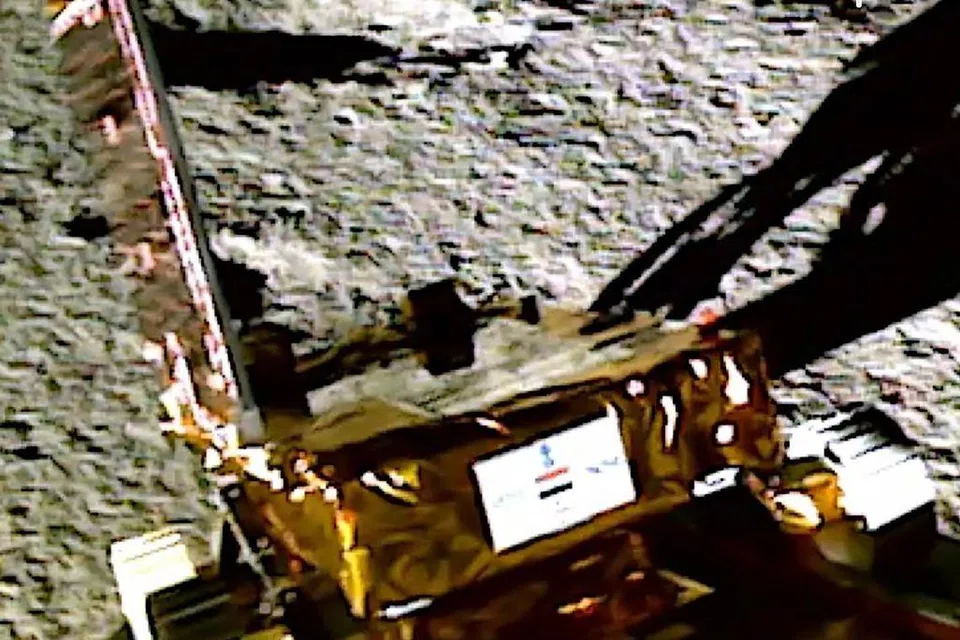

India’s moon rover confirmed the presence of sulphur and detected several other elements near the lunar south pole as it searches for signs of frozen water, nearly a week after its historic moon landing, the Indian Space Research Organisation (ISRO) said in a post on its website on Tuesday.
The rover’s laser-induced spectroscope instrument also detected aluminium, iron, calcium, chromium, titanium, manganese, oxygen and silicon on the lunar surface.
The Chandrayan-3 rovercraft landed last Wednesday and is expected to conduct experiments over 14 days, ISRO has said.
Its rover “unambiguously confirms the presence of sulphur” and is searching for signs of frozen water that can help future astronaut missions, as a potential source of drinking water or to make rocket fuel.
It will also study the moon’s atmosphere and seismic activity, ISRO Chairman S. Somnath said.
On Monday, the rover’s route was reprogrammed when it came close to a 4m-wide crater. “It’s now safely heading on a new path,” said ISRO.
The craft moves at a slow speed of around 10cm per second to minimise shock and damage to the vehicle from the moon’s rough terrain.
After a failed attempt to land on the moon in 2019, India last week joined the United States, the Soviet Union and China as only the fourth country to achieve this milestone.
India’s success came just days after Russia’s Luna-25, which was aiming for the same lunar region, spun into an uncontrolled orbit and crashed. It would have been the first successful Russian lunar landing in 47 years.
Russia’s head of the state-controlled space corporation Roscosmos attributed the failure to the lack of expertise due to the long break in lunar research. The last Soviet mission to the Moon was in 1976.
Indo-Asian News Service