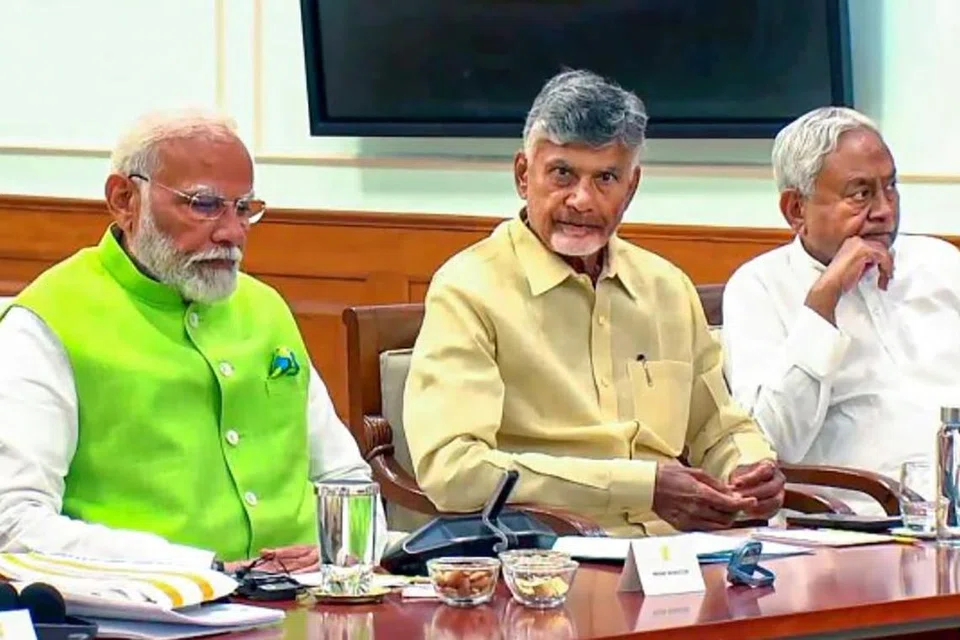
Indian Prime Minister Narendra Modi’s National Democratic Alliance (NDA) formally named him on Wednesday to lead a new coalition government for a third straight term, a day after it regained power with a surprisingly slim majority.
Mr Modi, a populist who has dominated Indian politics since 2014, will for the first time head a government dependent on the support of regional allies whose loyalties have wavered over time, which could complicate the new cabinet’s reform agenda.
A day after the humbling election outcome for his Bharatiya Janata Party (BJP), following a strong performance by the opposition INDIA bloc, the BJP’s biggest allies in the NDA, including the Telugu Desam Party (TDP) from Andhra Pradesh and the Janata Dal (United) – also known as the JD (U) – from Bihar, pledged support to Mr Modi.
The BJP-led NDA won 293 seats in the 543-member lower house of Parliament, more than the simple majority of 272 seats needed to form a government. The INDIA alliance led by Mr Rahul Gandhi’s centrist Congress party won 230 seats, more than expected.
Mr Modi is set to meet President Droupadi Murmu today to present his claim to form a government and the swearing-in could take place over the weekend, an NDA leader said. Local media earlier reported that the swearing-in ceremony was scheduled for tomorrow.
Following the closer-than-expected election, newspapers said Mr Modi’s aura had dimmed, with the Indian Express’s banner headline reading: “India gives NDA a third term, Modi a message.”
The BJP lost heavily in two bellwether states, its northern stronghold of Uttar Pradesh, which has 80 seats, and the western state of Maharashtra, which sends 48 members to the decision-making lower house of Parliament.
The result may not necessarily mean reform paralysis, the chairman of a government finance panel, Arvind Panagariya, wrote in an article in the Economic Times newspaper.
“Despite the reduced majority in Parliament, the necessary reforms are entirely feasible. Delivering sustained growth at a accelerated pace can only strengthen the government’s hand in the coming years,” he wrote.
However, one central question hovers over the formation of the next government: Can Mr Modi rule a government dependent on other parties, something he has never done before?
“This is an unknown,” said Mr Neelanjan Sircar, a political scientist at the Centre for Policy Research (CPR) in New Delhi. “Modi has only been known to work as a leader with absolute centralised power.”
“The ‘Modi phenomenon’ is based on a particular form of governance. Him having to compromise with allies is not a Modi we know, or a Modi he has sold.”
Speaking to party supporters at the BJP headquarters on Tuesday, Mr Modi credited Mr Nitish Kumar, the leader of the JD(U) for leading the ruling alliance to big wins in Bihar. Yet the two politicians have long navigated a love-hate relationship, with frequent break-ups and patch-ups. The JD(U) has won 12 seats.
The TDP too has dallied with both the BJP and the opposition Congress at different times. Unlike the BJP, both the JD(U) and TDP also tout their secular credentials, count on the support of Muslim voters and keep a distance from the BJP’s Hindu majoritarian politics. The TDP has won 16 seats.
With the election result, “Brand Modi” has suffered a setback, said political analyst Rasheed Kidwai. But the results have also made “the politics of alliance a compulsion for Modi”, he said, taking India back to the pre-2014 era when coalition governments were the norm.
“This will be difficult for Modi because allies come with certain expectations, including important positions,” said Kidwai, adding that Mr Modi’s bargaining skills would now be tested under a coalition government.
Those expectations, he said, could include demands from allies for the post of speaker in Parliament and important portfolios. Though the speaker mostly has a ceremonial role, it becomes critical if members of Parliament are looking to break a party.
Allies will also seek key cabinet positions, said analysts. “The game will be to keep allies happy and give up ministerial berths, however, ministers do not mean a lot in this government, as we have seen,” said the CPR’s Sircar.
Yet, Mr Modi will need to accommodate enough of those demands if he is to keep a governing coalition in place, said Modi biographer Nilanjan Mukhopadhyay.
“There is no other option for Modi – if he wants to behave the way he has behaved for the last 10 years, he will have to vacate office,” said Mr Mukhopadhyay. “Modi will need to come up with a personality that is humble and open to working with others – a side of him we have never seen.”
Within the BJP too, Mr Modi and Home Minister Amit Shah, his confidant, could face questions over the centralised hold over power, said Mr Kidwai. The TDP also reportedly wants Mr Shah removed from the Home ministry.
“The internal fissures will become triggers now – it is not the same India as before June 4,” said Mr Kidwai. “This will change contemporary politics fundamentally.”
Reuters