Singapore businesses are being encouraged to look beyond India at the national level and engage directly with individual states, as Haryana and Chhattisgarh made strong investment pitches at the inaugural Singapore-India Network for Growth (SING) Forum.
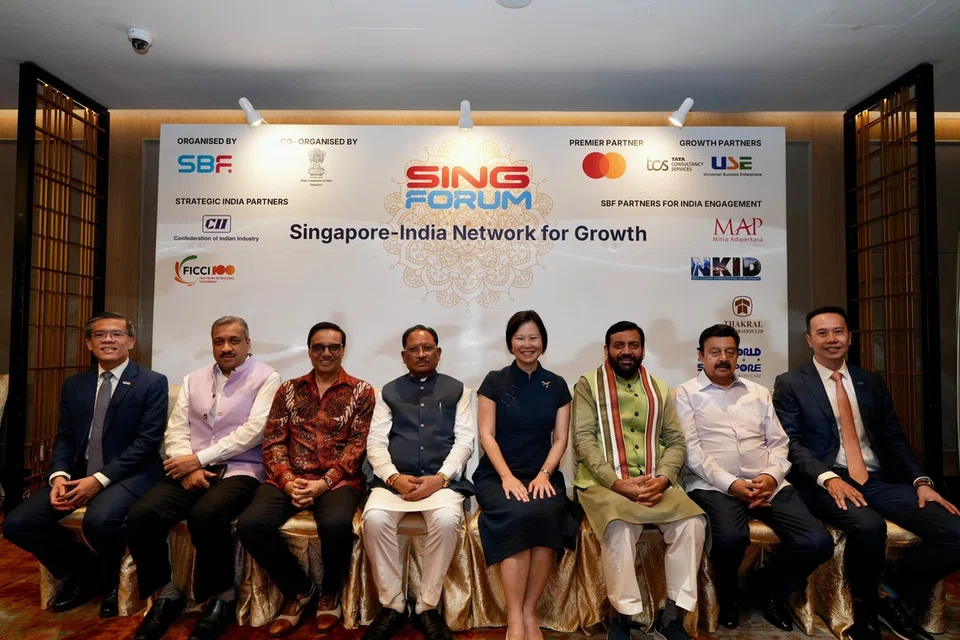
Hosted by the Singapore Business Federation (SBF) on Oct 5, the forum brought Haryana Chief Minister Nayab Singh Saini and Chhattisgarh Chief Minister Vishnu Deo Sai face-to-face with Singapore business leaders to explore opportunities spanning technology, manufacturing, infrastructure, logistics, and investment.
The event also featured Minister of State for Energy, Trade and Industry, and Foreign Affairs Gan Siow Huang, Indian High Commissioner Dr Shilpak Ambule, SBF chairman Mark Lee, and SBF-India Business Committee chairman Prasoon Mukherjee.
The forum comes as economic ties between Singapore and India continue to deepen. Bilateral trade in goods reached S$35 billion in 2025, while Singapore was the largest source of foreign direct investment into India in the latest Indian financial year, contributing US$19.8 billion.
Ms Gan said Singapore companies should make greater use of bilateral frameworks while recognising that opportunities differ considerably across India.
“Entering the Indian market is only the first step,” she said, noting that each state has its own priorities and strengths.
At the fourth India-Singapore Ministerial Roundtable in August, both governments agreed to deepen Singapore’s links with Indian states. Cooperation between the countries already covers areas including semiconductors, industrial parks, food security, digital payments and green shipping.
Mr Mukherjee summed up the importance of engaging individual state administrations: “Delhi sets the frame, the state sets the pace.”
State governments, he noted, have critical roles in areas such as land, infrastructure, utilities, labour, skills and local approvals.
Mr Saini positioned Haryana as a gateway to the major consumption and manufacturing markets of northern India, highlighting its economic corridors, expressways and freight connectivity.
He particularly urged Singapore companies to establish technology and professional capability centres in the state.
“Our goal is to create an ecosystem where businesses flourish while simultaneously generating opportunities for employment and innovation,” he said.
Haryana is seeking investment not merely for capital but also for technology, skilled employment and innovation. The state is also expanding cooperation with Singapore in education, including a partnership with a Singapore-based global school group to develop K-12 educational infrastructure.
Chhattisgarh, meanwhile, used the Singapore platform to make a major push into digital infrastructure.
The state secured investment proposals worth Rs43,250 crore, according to officials travelling with its delegation. The largest was a Rs41,750 crore proposal for a 100MW hyperscale data centre involving Singapore-headquartered Energy Capital Global.
Mr Sai handed an “Invitation to Invest” to company executives during the Singapore engagement.
The project is intended to help position Chhattisgarh as an emerging hub for cloud infrastructure, enterprise data storage and next-generation technologies. The remaining ₹1,500 crore in proposals covers areas including digital solutions, renewable-energy linkages and supporting IT infrastructure.
“Connect with our institutions, talent and opportunities,” Mr Sai told businesses. “Let us work together to build partnerships that create new opportunities for investment, innovation, employment and shared prosperity.”
Dr Ambule said stronger engagement with individual states had become an increasingly important element of Singapore-India economic relations.
“More importantly, what was identified was that we need greater engagement with the states,” he said.
The forum also included discussions on cross-border trade and payments and presentations involving Nestlé India, Transworld, Indian Hotels Company and Brakes India, covering trade, logistics, hospitality and the automotive sector.
While Singapore companies were encouraged to explore India’s diverse states, Ms Gan stressed that the relationship should work in both directions, with Indian businesses using Singapore as a springboard into Southeast Asia and international markets.
That two-way approach is increasingly shaping the economic relationship: national frameworks may provide the foundation, but the next wave of Singapore-India business partnerships could increasingly be built state by state.