


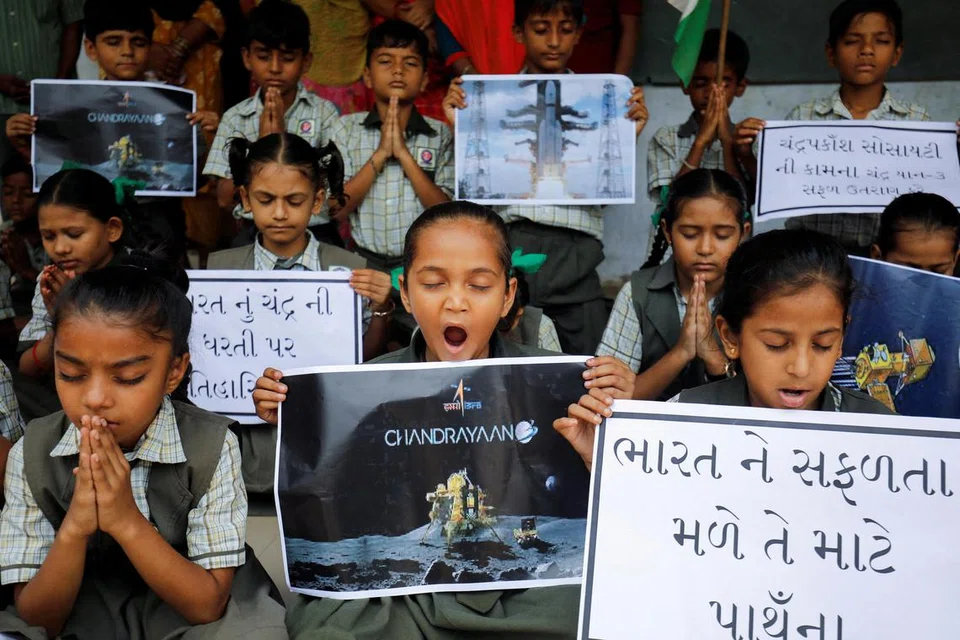
Chandrayaan-3’s successful landing brings to mind a childhood lesson in the power of a mother’s love.
A child lies in the mother’s lap, looks out the window, sees the crescent Moon, and asks for it. The mother smiles and says she has no way of giving the child the Moon. The child sees the mother’s bent smile, reaches out to touch her face and forgets about the Moon.
I do not know if the origin of this story is Indian, but I heard it when I was growing up in India.
Another memory is not as pleasant. There is a proverbial Bengali saying “chera kathai shuye chander shopno dekha”, which warns against the temptations of lying on a torn quilt and dreaming of the Moon.
I have always found this saying to be a vulgar attempt to rationalise class inequalities. Since only the poor are likely to lie on a torn quilt, they apparently have no right to fantasise about the Moon.
Chandrayaan-3 is testimony to the capacity of a developing nation to produce world-class scientific talent. Some claim that the lunar landing is India’s most significant achievement. That is debatable.
Pokhran I and Pokhran II – the nuclear tests of 1974 and 1998 – used indigenous scientific expertise to advance India’s security interests incomparably.
But I could be wrong. As the saturation of nuclear weapons on the Earth decreases, the strategic value of their destructive compass, the space race is adding a new dimension to warcraft.
Countries capable of colonising space will enjoy the advantages that colonial Europe once did.
Tired of incessant wars that had failed to produce a stable balance of power in Europe, those countries exported their rivalries to colonies in Asia and Africa, the squabble over whose distant fate refracted back on the position of the metropolitan powers in Europe.
Similarly, footholds on the Moon and Mars may well determine the standing of powers back on the Earth in the not-too-far future. That remains to be seen.
Meanwhile, what India has achieved with Chandrayaan-3 is the prestige of being the first country to land a spacecraft in the Moon’s south polar region – apart from being only the fourth country after the United States, China and the former Soviet Union to land on the Moon at all.
The Economist, not given to rapture, captured the moment poetically. It wrote: “The poise with which Chandrayaan-3’s ‘automatic landing sequence’ brought the spacecraft down on to the Moon’s surface was striking. The spacecraft’s trajectory dropped smoothly from thousands of kilometres an hour to walking pace, before a last little cheeky hover as the system checked the landing site and then settled itself down onto the lunar surface. India did not just land its robot on the Moon. It did it with style”.
The provenance of that “style” is important. It is Indian.
The Indian Space Research Organisation (ISRO) scientists responsible for the achievement are Indian. Of course, they studied and excelled at science, which has no nationality.
However, they did so with a clear eye to their responsibilities, which lie to India. Salaries account for only a small part of that dedication.
Former ISRO chairman G. Madhavan Nair said that the wages the scientists receive for working at the national space agency are hardly one-fifth of global standards.
Instead of being an impediment to research, the poor wages drive ISRO’s scientists to find low-cost ways of exploring space, Mr Nair said, adding that there are no millionaires among ISRO scientists, who live normal lives.
Those normal lives reflect the reality of mass India, where a handful of people command astronomical salaries pegged to global standards, a great number of people struggle to make ends meet and a middle class does what it can in its sandwiched circumstances.
I would imagine that most ISRO scientists are middle class, drawn from the cities, towns and villages that represent India’s demographic geography.
I am certain they could have found a calling in more prosperous fields. Yet, they decided to work for an organisation that embodies India’s reach into space, not in some fabled future promised to come but here and now.
I am mostquite certain that some of those scientists once lay in their mothers’ laps and asked for the Moon. If they ever lay on withered quilts, they did not stop dreaming of the silver light in the sky.
No mother could give her child the Moon.
But the children have grown up. They have brought the Moon to every Indian mother.
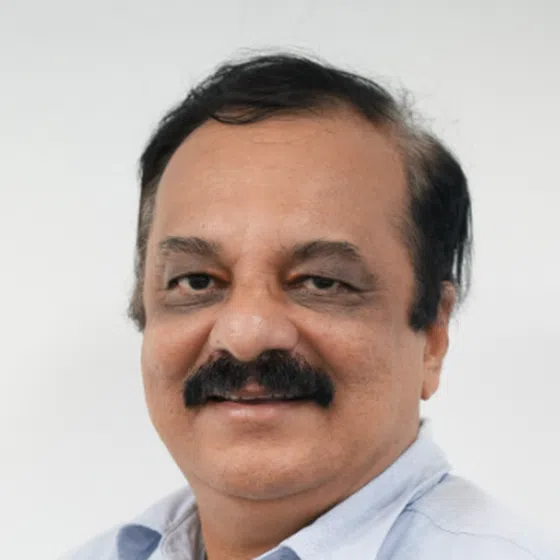
Asad Latif is an editorial writer for The Straits Times.
