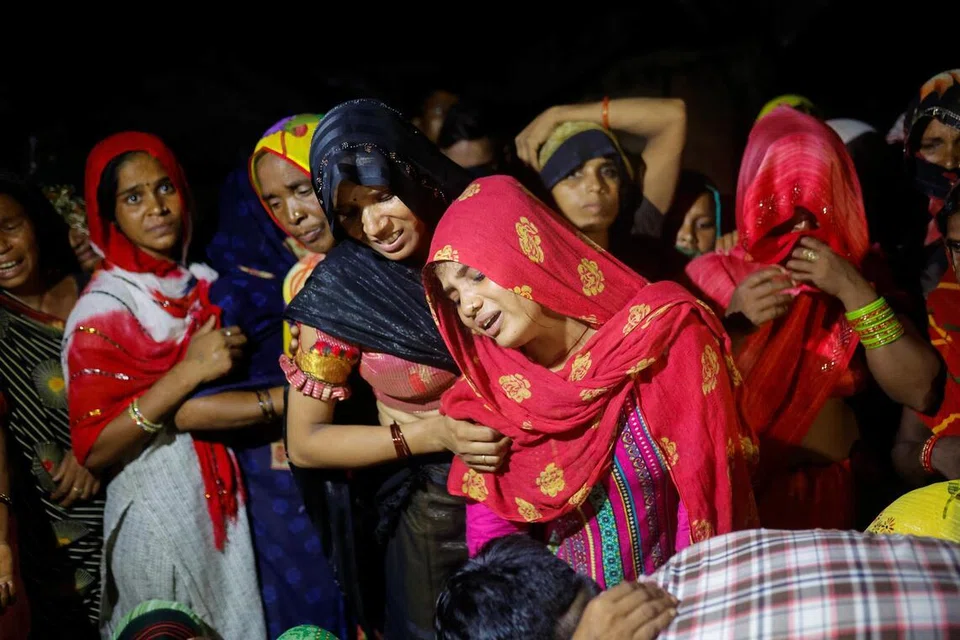
More than three times the permitted number of people attended a Hindu religious event in northern India that culminated in a stampede which killed at least 121 people, authorities said on Wednesday, adding that most of the victims were women.
About 250,000 people gathered for Tuesday’s event in Uttar Pradesh’ Hathras district, about 200km from New Delhi, despite permission being granted for only 80,000, a police report showed.
The preacher at the gathering Suraj Pal Singh, also known as Bhole Baba, said in a statement that the stampede was caused by “some anti-social elements” after the event concluded, without elaborating.
Police said they were trying to ascertain the whereabouts of the preacher. A group of devotees had organised the event, according to a poster at the site.
The preacher’s lawyer A.P. Singh said Baba had never asked anyone to touch his feet nor did he give anyone the dust touched by his feet, referring to reports in local media which cited these as reasons for the devotees running towards him.
Mr Singh also said Baba’s aides were ready to help those who suffered in the incident.
Most of the deaths resulted from suffocation, said doctors at a district hospital treating several victims. Among the 121 dead were 112 women and seven children, while 31 were injured, state authorities said.
In their First Information Report, police described a scene of chaos when the preacher was leaving in his car.
Thousands of devotees shouted and ran towards the vehicle, crushing others still seated, the report said. Some people were trampled after falling in an adjacent field of slush and mud.
In a letter seen by Reuters, a junior officer present at the event told the district administrator that the preacher’s security staff had stopped the devotees running towards the car and that many of them fell to the ground.
Some had run towards open fields nearby to escape the stampede but slipped and fell in the path of the rest of the crowd, the officer added.
People fell on top of each other as they tumbled down a slope into a water-logged ditch, witnesses told AFP.
“Everyone – the entire crowd, including women and children – all left from the event site at once,” said police officer Sheela Maurya, 50, who had been on duty on Tuesday.
“There wasn’t enough space, and everyone just fell on top of each other.”
Officials suggested the stampede was triggered when worshippers tried to gather soil from the footsteps of the preacher, while others blamed a dust storm for sparking panic.
Some fainted from the force of the crowd, before falling and being trampled upon, unable to move.
Ms Maurya was among the injured. “I tried to help some women, but even I fainted and was crushed under the crowd,” she said. “I don’t know, but someone pulled me out, and I don’t remember much.”
Ms Maurya said she had worked at several political rallies and large events in the past but had “never seen such huge numbers”.
“It was very hot, even I fell there and I survived with great difficulty”, she added.
Among the dead was Ms Ruby, 30, who had travelled more than 300km to attend the event, along with her father Chedilal.
Describing the stampede, Mr Chedilal, 68, told Reuters: “I heard terrifying screams from women and there were bodies piled up on the ground near the exit.”
“I was scared, I ran away and started calling my daughter on the phone.”
After an agonising night of hospital visits to locate his daughter, Mr Chedilal said he finally found her body at the Hathras district hospital in the morning.
The state’s Chief Minister Yogi Adityanath met some of the injured on Wednesday and inspected the site, which stands amid paddy fields beside a busy highway. Waste littered the site, which was partly inundated by rainfall.
Prime Minister Narendra Modi announced compensation of US$2,400 to the next of kin of those who died and US$600 to those injured in the “tragic incident”.
President Droupadi Murmu said the deaths were “heart-rending” and offered her “deepest condolences”.
Stampedes and other accidents are not uncommon at religious gatherings involving large crowds in India, with most being blamed on poor crowd management.
Reuters, AFP