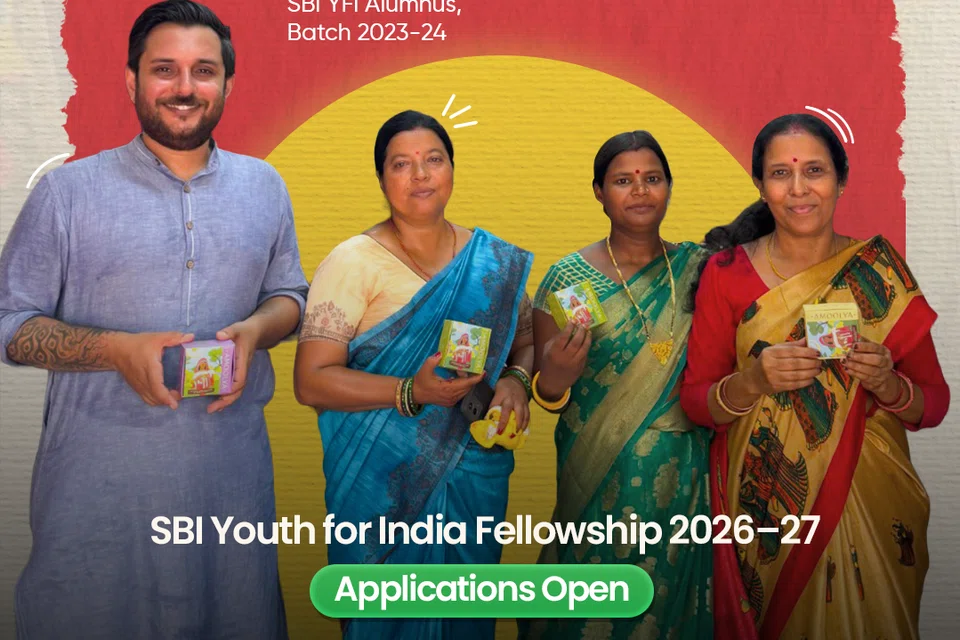
The SBI Foundation, the corporate social responsibility arm of the State Bank of India Group, has announced the opening of applications for the 14th edition of its flagship SBI Youth for India Fellowship, a 13-month immersive programme aimed at empowering young people to contribute to rural development.
Open to Indian citizens, Overseas Citizens of India (OCIs), and citizens of Nepal and Bhutan, as well as SBI employees, the fellowship targets graduates and young professionals aged between 21 and 32 who are keen to create meaningful social impact.
The programme offers participants an opportunity to live and work in rural India, collaborating with local communities and partner organisations to address grassroots challenges across diverse sectors. Applications are currently open through the official portal.
Describing the fellowship as a platform for nurturing future changemakers, Mr Swapan Dhar, Managing Director and CEO of SBI Foundation, said the initiative aligns with India’s long-term vision of inclusive development.
“Aligned with the vision of Viksit Bharat@2047, the SBI Youth for India Fellowship nurtures changemakers who bridge urban-rural divides through collaboration and empathy, not charity,” he said.
The fellowship focuses on 12 thematic areas, including education, women’s empowerment, rural livelihoods, health, food security, environmental protection, water, technology, social entrepreneurship and alternative energy.
Fellows are placed with one of 15 partner non-governmental organisations (NGOs) and work on projects that aim to deliver sustainable solutions to local communities.
Since its inception in 2011, the programme has built a network of more than 700 alumni and has facilitated interventions in over 250 villages across 22 states and Union Territories. According to SBI Foundation, these efforts have positively impacted more than 200,000 lives.
The current 13th batch of the fellowship (2025–26) comprises 94 fellows who are actively working on the ground across rural India.
Over the years, the programme has produced several notable success stories that demonstrate the long-term impact of grassroots innovation.
One such fellow, Mr Gautam Kumar, initiated four micro-forests in Madhya Pradesh in 2018. By 2025, the initiative had expanded to over 1,800 micro-forests across three states, contributing to ecological restoration and environmental awareness.
Similarly, Mr Shashank Singh launched a rainwater harvesting project in Tilonia, Rajasthan, in 2016, which collected 100 million litres of water in its first year. The project has since expanded to provide year-round water access to more than 1,000 families across three villages, significantly reducing water scarcity.
The fellowship not only offers hands-on exposure to rural challenges but also equips participants with critical skills in leadership, problem-solving and project management. These experiences often translate into long-term careers in the development sector.
SBI Foundation noted that over 70 per cent of alumni have gone on to work in fields such as rural development, public policy, governance and academia. Additionally, more than 50 social ventures have emerged from the programme, reflecting its role in fostering innovation and entrepreneurship.
The fellowship also maintains collaborations with leading institutions such as NITI Aayog, UN Women, the International Labour Organization (ILO) and J-PAL, further strengthening its impact and reach.
Inspired by global initiatives such as the US Peace Corps, the SBI Youth for India Fellowship was launched to provide a structured platform for young individuals to engage directly with rural communities, understand their challenges and co-create solutions.
By combining experiential learning with community engagement, the programme aims to build a generation of socially conscious leaders capable of driving inclusive growth.
With applications now open for its 14th batch, SBI Foundation is inviting young people to step out of their comfort zones and take part in a transformative journey that not only shapes their own future but also contributes to the development of rural India.