

In The New World: 21st‑Century Global Order and India, veteran Indian strategist and former BJP general secretary Dr Ram Madhav contends that humanity is witnessing the twilight of an older, Western‑led global consensus and the birth of something more complex and unsteady.
Across nearly 400 pages, published in June by Rupa Publications, he examines the rise and fall of historical powers, from Rome to Pax Americana, arguing that the era of unipolar dominance is yielding to a heteropolar “new world.”
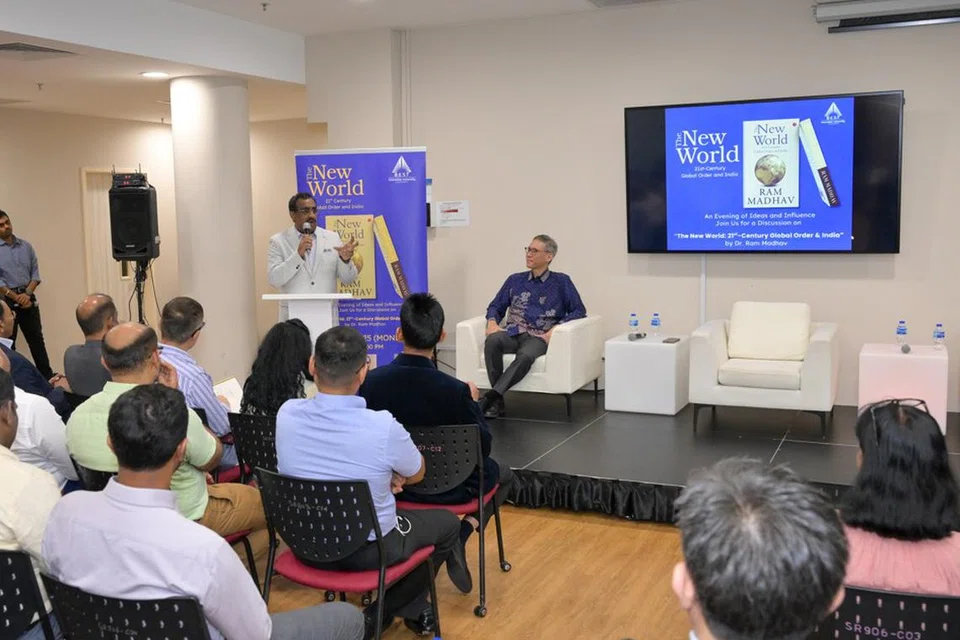
On July 14, Dr Ram launched his book at Nanyang Technological University’s One-North campus, alongside former Deputy High Commissioner at Singapore’s High Commission in New Delhi, Jonathan Tow and Chair Professor at Singapore University of Technology and Design, Dr Mohan Rajesh Elara.
During the mediated panel discussion and in his book, Dr Ram identified three seismic currents reshaping international affairs. Firstly, China’s assertive authoritarian capitalism, followed by the erosion of global multilateralism and lastly, the transformative impact of frontier technologies.
The blurb on the back of his book reads, “As we progress towards building a new world order, India should not allow the process to be dominated by Western institutions and thought processes once again.”
Instead, it should lean into its cultural and civilisational uniqueness, which is how it can build its own mojo, it said.
He cautions that artificial intelligence, climate stress, and shifting demographics will test existing institutions and the social compact.
The book also drills into both grand themes and concrete policy. Dr Ram urges India to champion regional multilateralism, starting with the Indian Ocean rim and extending into Southeast Asia, rather than seeking global primacy.
He also warns that India must close critical technology gaps, from semiconductors to artificial intelligence, if it aims to move from growth to genuine power projection.
Singapore, with its status as a global node, can resonate with this as a small and diverse state leveraging strategic autonomy to punch above its weight, Dr Ram added.