The search and rescue operation to locate an Indian national, who fell into a sinkhole at Jalan Masjid India in Kuala Lumpur, continued on Thursday with the deployment of ground-penetrating-radar (GPR).
Kuala Lumpur mayor Datuk Seri Dr Maimunah Mohd Sharif said the GPR method will be used until the woman is found.
On Aug 23, Ms Vijaya Lakshmi Gali, 48, from Kuppam in Andhra Pradesh, went missing after falling into an 8m-deep hole caused by a sudden ground collapse, reported Bernama.
The sinkhole appeared out of nowhere and swallowed her as she was heading to a nearby temple.
Authorities believe the woman was then swept into the sewer tunnels below, with gushing water running underground at the time due to heavy rain.
Ms Gali and her family had been in Malaysia for about two months and were due to fly home on Aug 24.
Her husband, who was with her in Kuala Lumpur, and their son, who flew in from Thailand on the day of the incident, are too distraught to speak to the media.
Kuala Lumpur authorities have provided a counsellor for the family members, whose visas have been extended for a month.
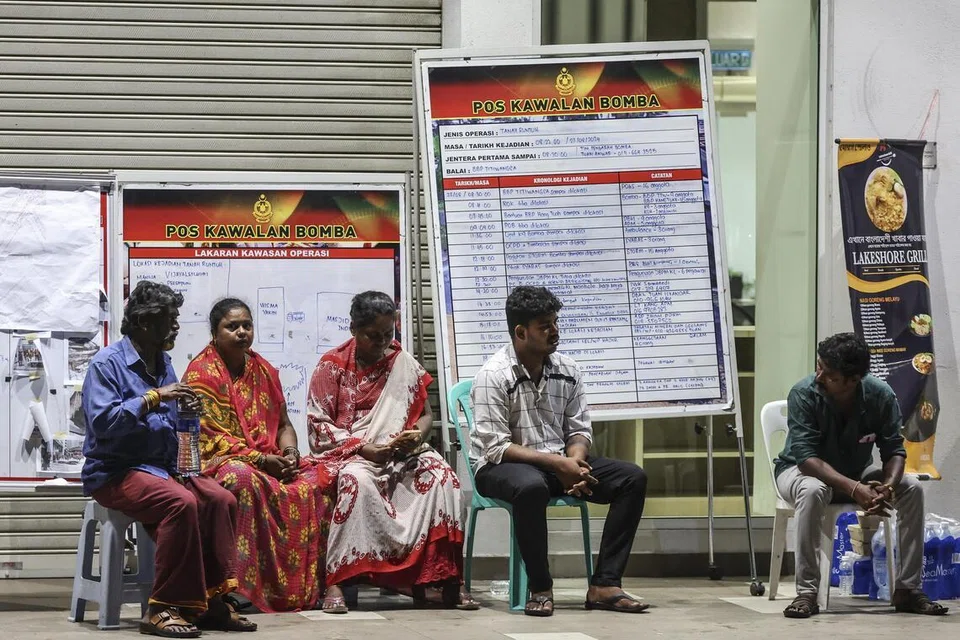
The family members, the New Straits Times reported, are waiting for updates at the police operational tent in Jalan Masjid India, where media is not allowed access.
So far, only a pair of slippers belonging to Ms Gali has been found, according to officials.
Indah Water, the national sewerage company, has been using high-powered water jets to try to dislodge debris in a manhole about 70m from the sinkhole.
Assistant Commissioner Sulizmie Affendy Sulaiman, who is overseeing the search, said authorities believe dislodging the debris could help reveal the victim’s exact location.
Although sinkholes are not a common occurrence, a few incidents of cars being swallowed by sinkholes have been reported in Kuala Lumpur over the years.
Malaysian Water and Wastewater Quality Safety Association president G. Parameswaran told The Straits Times that it is unlikely Ms Gali has survived, after being trapped in the sewer system for days.
“There are a few things that could have happened and (that’s) why the authorities have not found her yet,” he said. “The sewer system is full of toxic gas which would kill anyone without proper protection. She would have been poisoned the moment she fell in.
“Sewage water is also very harsh, and the current has a minimum flow speed of 1m per second. Theoretically, she could have travelled up to 86.4km within 24 hours.”
On Tuesday, Mr Ibrahim Mat Zin, better known as Raja Bomoh, offered his “expertise” and reportedly performed a ritual near where the woman fell in a bid to trace her.
“We just want to help and ensure that everyone is safe,” he told Bernama. “We dont want anything untoward to occur.
“We do not know if there are any dangerous animals such as snakes underneath,” he added, claiming that he was instructed to go to the scene by “an important figure”.
Mr Ibrahim, most notably remembered for his ritual involving coconuts at Kuala Lumpur International Airport in 2014 shortly after the disappearance of a Malaysian Airlines (MH370) flight, then proceeded to perform his ritual by sprinkling “special water” that he claimed was taken from the bottom of a waterfall in Perak.
His actions were widely criticised, with many saying the rituals contradict Islamic teachings and have embarrassed Malaysia and its people.
On Wednesday, the federal territories mufti’s office said it would summon Mr Ibrahim, after Religious Affairs Minister Na’im Mokhtar said his actions have caused public distress and misunderstandings about Islam.
The shocking sinkhole incident has turned the usually bustling shopping district of Jalan Masjid India into a mini ghost town as many shoppers have avoided the area amid concerns about other possible sinkholes occurring.
On Wednesday, a new sinkhole appeared in KL, just 50m away from where Ms Gali disappered. This collapse happened at about 2.30am after a storm.
Although no casualties were reported, the second sinkhole prompted authorities to close the entire stretch of Jalan Masjid India, which is about 400m, to pedestrians and traffic. Footpaths remain open.
The area, which means Indian Mosque Road in Malay, is dominated by a large red mosque, a reflection of its Indian-Muslim heritage in the early days of Kuala Lumpur.
Located just two LRT stations away from Petronas Twin Towers, Jalan Masjid India is renowned for its goldsmiths and jewellers, as well as low-priced goods ranging from colourful Malay attire to Indian saris.
“We’ve been hit very hard. There have been zero customers since the accident happened,” Maharaja Jewellers salesman Mohamed Nasir told The Straits Times.
He said the business has 15 employees and the company will be forced to dip into its savings if the situation does not improve.
“I don’t mind the authorities closing up the main street, but at least allow some space for pedestrians to walk through,” said the 62-year-old, whose shop is located a mere 10m away from the sinkhole.
Some shops near the sinkhole have remained shuttered due to the lack of business and traders’ concerns about safety.
Prime Minister Anwar Ibrahim has vowed that the government will not give up in its efforts to find the unfortunate tourist, with more than 100 rescuers, including scuba-diving units, scouring the sewers.