


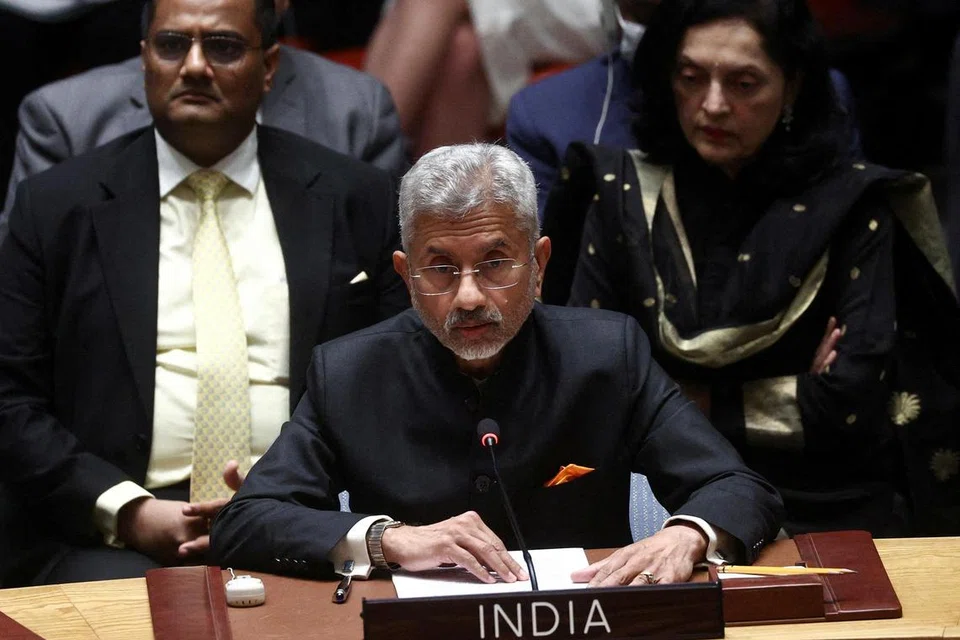
India’s diplomacy is being put to the test after Qatar meted out the death sentence to eight Indians, all former naval personnel.
The eight were detained in Doha in August 2022, reportedly on suspicion of espionage. On Oct 30 this year, a Qatari court sentenced them to death – a decision India’s government described as a shock.
The exact grounds on which the men were arrested and the charges on which they were convicted have not been disclosed, reported BBC.
It is speculated that they are accused of spying for Israel. They had been working in a personal capacity for Dahra, an Omani private defence company, to help oversee the introduction of Italian U212 stealth submarines into the Qatari Emiri Naval Force.
Among the eight men are decorated officers, such as Commader (retd) Purnendu Tiwari, who in 2019 was awarded the Pravasi Bharatiya Samman, the highest honour conferred on overseas Indians by the Indian government.
Now the pressure is on India’s diplomats to save the accused, whose family members have urged Prime Minister Narendra Modi to intervene.
“The foreign ministry assured us that it was their priority to bring back our loved ones but there has been nothing concrete. We’re waiting for a quick resolution now because their lives are in danger,” a relative of retired Captain Navtej Gill, who was awarded the President’s Gold Medal for his service in the armed forces, told Nikkei Asia.
Indian External Affairs Minister S. Jaishankar announced last week that he had met the families of the men, and that “the Indian government will leave no stone unturned to ensure their release”.
But Mr Modi’s opponents have been unforgiving, slamming the government for not negotiating the officers’ release earlier.
“It is mystifying why things came to this unfortunate pass. What had the foreign ministry been doing since August 2022?” opposition Congress party spokesperson Manish Tewari posted on X.
The case puts a strain on bilateral ties that encompass trade and Indian manpower. There are about 700,000 Indians there, Ambassador to Qatar Deepa Gopalan recently told The Hindu.
The death sentence comes amid an already challenging period for Indian diplomacy, just after a spat erupted with Canada in September over Prime Minister Justin Trudeau’s revelation of “credible allegations” that Indian agents were behind the killing of a Sikh separatist in British Columbia. New Delhi called the charge “absurd”.
With regard to the Qatar case, Ms Gopalan stressed that it needs to be taken “up at the highest level to ensure the lives of the accused are saved”.
Legal experts say the lack of transparency around the charges against the navy veterans will complicate the effort.
“The speculation that the men were held on charges of espionage further makes the case a highly sensitive one that will make a quick resolution very difficult,” Indian High Court advocate Prakriti Chadha told Nikkei Asia.
Some draw parallels with the case of another retired Indian naval officer Kulbhushan Jadhav, who has been held by Pakistan since March 2016.
Islamabad says Jadhav was spying in Balochistan province for India’s intelligence agency, the Research and Analysis Wing. He was sentenced to death by a Pakistan military court in 2017, a ruling challenged by the Indian government at the International Court of Justice (ICJ).
The matter is still pending with the ICJ. In 2019, the court rejected India’s appeal for Jadhav’s immediate release but ordered Islamabad to suspend the execution.
While Pakistan and India are nuclear-armed rivals, India and Qatar have cordial relations, which one Indian foreign ministry official suggested lends some hope.
“Despite the complexities involved in the Qatar case, we’re confident of tackling the issue successfully via diplomacy,” an anonymous official told Nikkei Asia.
Foreign policy experts emphasise that government-to-government talks are the best way forward.
Observer Research Foundation fellow Kabir Taneja, who specialises in West Asia, posted on X that India should “operationalise the prisoner exchange deal that it had signed with Qatar in 2015”.
Under the agreement, in theory, Qatari citizens convicted in India could be sent back to their country in exchange for the release of the Indian navy personnel.
But Mr Modi’s solidarity with Israel over the recent Hamas attack could be a stumbling block. Qatar blames Israeli actions against the Palestinians as a trigger for the attack.
Indo-Asian News Service

