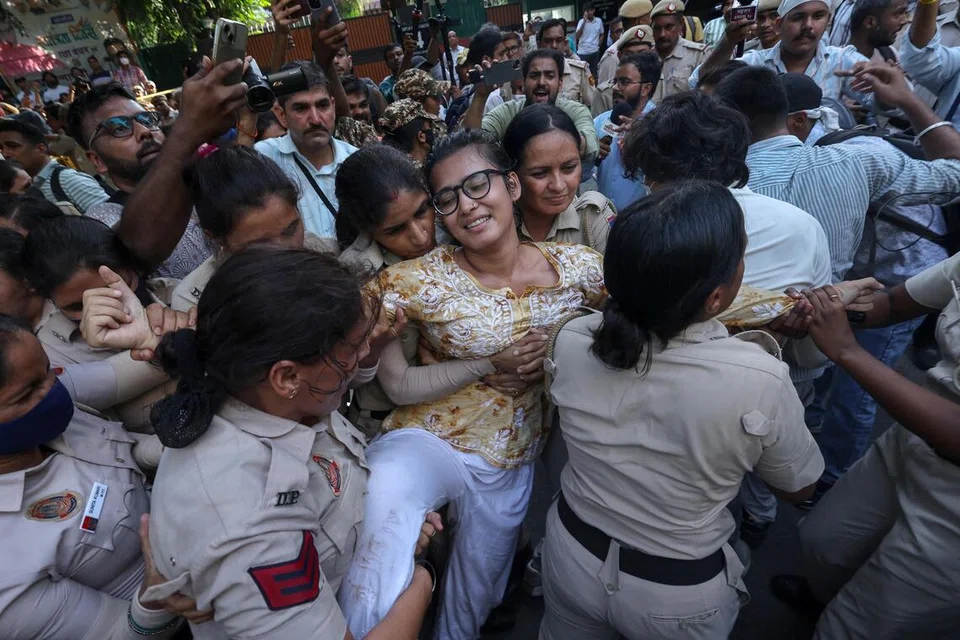
Neha Bora escaped from a police van in Delhi in full view of media cameras. The young activist stood at the van’s door, and as soon as the vehicle moved, held a friend’s hand, jumped out into the crowd of protesters and rapidly walked away.
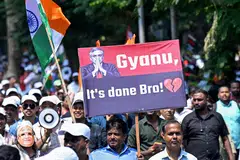
The Delhi police had detained Bora for leading thousands of young people in demanding the resignation of India’s chief election commissioner Gyanesh Kumar. Protesters and opposition parties have alleged that Kumar made unilateral decisions that led to the deletion of more than 130 million voters in the country’s most extensive Special Intensive Revision (SIR) voter-roll revision.
Ms Neha has escaped detention twice since Oct 2 – when the protest began at the Jantar Mantar monument – a designated protest site in Delhi.
When finally detained and released dozens of kilometres away, Ms Neha filmed a video from a car: “They think we are dogs, cockroaches and vermin. But we are the citizens of this country who have the right to ask questions of our government system. And if we are removed from a designated protest site, we will go back again to assert our rights.”
Ms Neha’s televised rebellion has become a symbol of India’s Gen Z protests. When the police drag Ms Neha along the road, the protester leans back, face placid but eyes blazing, and delivers pitch-perfect political rhetoric in literary Hindi and English.
The bespectacled 29-year-old, wearing oversized T-shirts or simple cotton tops, prefers the pronouns they/them and could disappear in a campus crowd. But the tough-talking student has hit the front pages of most Indian newspapers.
Hindi media are calling Ms Neha a “national crush” or a “sherni” – lioness.
As national president of the All India Students’ Association (AISA), Ms Neha has inspired more people to join the protest, young and old. AISA was the organising force behind the Gen Z protest against exam paper leaks in July, spearheaded by Abhijeet Dipke, founder of the Cockroach Janta Party (CJP).
National attention
Ms Neha drew national attention in July when the activist, two other AISA members and educationist Sonam Wangchuk went on a 23-day hunger strike. The strike forced education minister Dharmendra Pradhan to resign, a first for a minister in Prime Minister Narendra Modi’s government.
Opposition party leaders, including Rahul Gandhi, held press conferences with the student leader. Bollywood celebrities, such as Shabana Azmi, visited the protest site to help end Bora’s fast.
Literature professor Swati Moitra, some of whose students from Gurudas College in Kolkata also joined Gen Z protests in the eastern city, said: “In a society like ours, we are always on the lookout for heroes. So it was inevitable that a young woman who is so articulate and so brave becomes a larger-than-life figure, especially in the age of social media.”
Ms Neha, praising Gen Z protesters for their “ingenuity and fierce energy” in evading police violence, told The Straits Times: “The hostile behaviour of the police is nothing new to us.
“The more you beat us up and curb our rights, the more prepared we are to find new ways to fight your force.”
Yogendra Yadav, a senior political activist and commentator, said the young activist’s popularity was a thorn in the Modi government’s side. He jokingly posted on social media platform X on Oct 5, suggesting the police “relax” as Bora was not in town that day.
“The police are clearly scared of Neha because this person has become a symbol of resistance, the kind of spontaneous protest that has the Delhi police flummoxed,” said Mr Yogendra, who was among several detained in Delhi.
Other detained protesters are also escaping custody, like Ms Neha, by jumping out of police vans, squeezing out through windows, writhing away from police hands and blocking police vans. One woman even snatched the keys to a police bus full of detained protesters and ran away.
In response, the Delhi police, which faced a backlash for tear-gassing and beating up students on July 20, are now occupied with the Sisyphean feat of repeatedly scooping up hundreds of Gen Z protesters to remove them from the protest site.
Simultaneously, the CJP called for a “jail bharo andolan” (fill the jails campaign) in Mumbai on Oct 2, asking protesters to court arrest until the chief election commissioner resigns and the SIR is halted. There too, protesters were detained and let off, but the police filed complaints of unlawful assembly against CJP members and 400 unidentified participants.
Gen Z makes up around 30% of eligible voters today, and “the political cost of plain repression is bound to be high”, Mr Yogendra said.
The power of street theatre
Ms Neha’s traction is as obvious as it is surprising.
As part of AISA, a students’ wing affiliated with the Communist Party of India (Marxist-Leninist) Liberation, or CPI(ML), Ms Neha has been involved in campus movements since 2018.
Neville Thomas, an AISA member who is pursuing a PhD in sociology at Jamia Millia Islamia University, said: “Every AISA member develops the capacity for public action, for organising and mobilising people. What we are seeing now is the maturing of Neha’s years of political activism.”
Ms Neha also credited their experience in the Delhi-based street theatre group Sangwari with learning “how to speak in public, things like throwing your voice, modulation, expression”, and the “human exercise of empathy” while playing various characters, which became cornerstones for their activism.
Ms Neha is now pursuing a PhD on folk theatre practices in Uttarakhand – the activist’s native state – at the Jawaharlal Nehru University’s (JNU) School of Arts and Aesthetics in New Delhi.
Brahma Prakash, cultural theorist and Bora’s PhD adviser at JNU, told ST that the activist was a perceptive researcher, bringing “a lot of local examples and behaviours to strengthen her arguments, the same way she engages with politics”.
Supporters of Modi’s ruling Bharatiya Janata Party (BJP) are not fans of Bora’s leftist background and criticism of government policies, which they dismiss as “anti-national” for questioning government decisions.
But Ms Neha has largely avoided such stereotypes.
Sai Balaji, a former president of AISA and now CPI(ML) member, said: “We don’t have many self-made women making it to the public stage in India. Most are celebrities or dynasts. Neha has an ordinary family upbringing and is standing with people in difficult times – it resonates with many.”
Ms Neha’s mother is a homemaker, and the activist’s father is a recently retired army officer.
Mr Sai said part of Ms Neha’s public appeal was also because of AISA’s agenda-focused alliance with the CJP, which has no overt ideological framework but whose irreverence “brought a freshness” to a longstanding call for government accountability.
“Young people look for inspiration, someone to look up to. At this moment, Neha Bora and Abhijeet Dipke have emerged as voices of courage who risk everything (by) speaking truth to power,” Mr Sai said.
Ms Neha’s ability to engage with those who hold polar opposite views also comes from home, where politics was taboo.
“My father has not talked to me in years because I am associated with left-wing politics,” Ms Neha said.
“Over the recent months, my mother has turned away from her obstinate support for the government and is able to see cracks in the government’s narrative. She still sometimes questions why we (as leftists) only see the negative side of the government. I try to engage with her, and slowly I hope her mind is changing.”
‘We do not fear you’
Ms Neha said the collective action against the SIR was specifically to oppose “a targeted campaign to wipe out the votes and rights of those constituencies already at the margins of society”, such as Muslims, Dalits, tribals and women. But it was only the beginning of a harder, longer fight for systemic change, the activist added.
AISA, the CJP and other activist groups have now announced a protest in Delhi on Oct 10 for the election chief’s resignation, SIR’s reversal and the reinstatement of the voting rights of millions. The Delhi police have issued prohibitory orders on large gatherings, cordoned off the protest area and are making announcements asking young people not to join the protest.
In a video on Instagram on Oct 8 about the upcoming protest, Bora played with lines from Gorakh Pandey’s Hindi poem Unka Dar (Their Fear):
“They fear/that the defenceless and common people will stop fearing them.”
“Now, that day has come. We do not fear you.” THE STRAITS TIMES