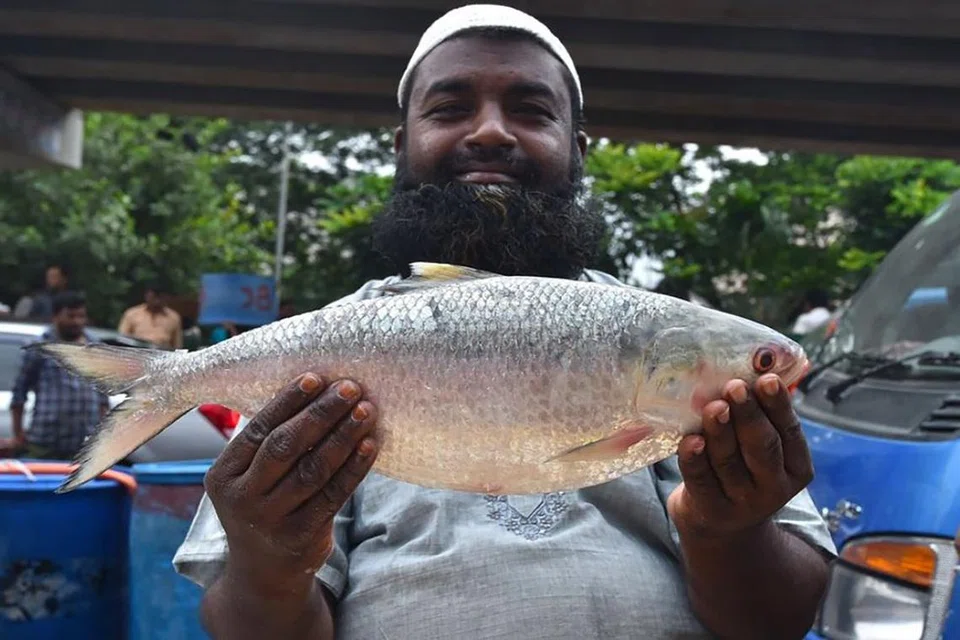
As drummers herald the beginning of the Durga Puja season (the main festival falls from Oct 9 to 13), kitchens in West Bengal could be starved of the hilsa fish, a staple of Bengali cuisine during the festivities.
According to reports, prices of the fish, which is very popular in West Bengal and some other parts of India, are expected to go up by as much as Rs2,200 ($34) a kilo in the coming days. This is because India’s biggest source of hilsa supply, Bangladesh, has decided not to export the popular fish to India.
Hilsa, also known as ilish, is the national fish of Bangladesh, but it is a luxury, affordable only for the rich and middle class.
The country produces around 70 per cent of the world’s supply. In 2012, Bangladesh banned the export of the fish, citing a shortage of supply.
However, then Bangladesh Prime Minister Sheikh Hasina made an exemption for India in 2019 and allowed the export of 500 metric tonnes of hilsa to India. This increased to 1,850 metric tonnes in 2020.
The consignment of hilsa from Bangladesh used to reach India ahead of the Durga Puja festival, when it is in high demand. This was often referred to as Ms Hasina’s “hilsa diplomacy”.
Ms Hasina has sent hilsa to West Bengal Chief Minister Mamata Banerjee on a number of occasions. Hoping to resolve a long-standing water dispute, she also gifted 30kg of the fish to then Indian president Pranab Mukherjee in 2017.
Ms Hasina was dramatically removed from power on Aug 5 after weeks of student-led protests that escalated into deadly nationwide unrest. Initially expected to stay in India briefly, her attempts to secure asylum in the UK, US and UAE have so far failed.
Her continued presence in India has also complicated Delhi’s efforts to build a strong relationship with the new interim government in Dhaka. For India, Bangladesh is a key strategic partner and ally, vital for border security, especially in its north-eastern states.
Now the supply of hilsa to India has come to an end with her ouster from power. The interim government in Bangladesh, led by Mr Muhammad Yunus, has decided not to export the fish.
Adviser to the Bangladesh Ministry of Fisheries and Livestock Farida Akhter said the government has imposed a ban to ensure sufficient supply for local consumers.
“We cannot allow ilish to be exported while our own people cannot buy them. This year, I have instructed the Ministry of Commerce to prevent any ilish exports to India during Durga Puja,” Ms Akhter told the Dhaka Tribune.
“The previous government would lift the ban during the Durga Puja festival. They used to call it a gift. This time I don’t think we need to give a gift because (if we do it) our people will not be able to eat the fish while it is allowed to be exported to India in large numbers,” Ms Akhter told the BBC.
“A lot of fish is still going from Bangladesh to India despite the ban. This time we will not allow the hilsa to cross the border.”
Asked whether the new interim government could have made a goodwill gesture to India by allowing supply of hilsa, Ms Akhter said: “We will have goodwill gestures in all other ways. They are our friends. But we should not do anything by depriving our people. The question of goodwill is separate from this.”
Hilsa holds an almost sacred status among Bengalis on both sides of the border, and its scarcity will frustrate many.
The fish is celebrated for its versatility, often cooked in a variety of ways such as steamed with mustard paste, which enhances its delicate flavour, or fried with a light coating of spices for a crispy texture.
Right before the Durga Puja in October, Bengalis love to feast on hilsa paired with khichuri (a rice and lentils dish).
Bengali-American food historian and author Chitrita Banerji is among the many writers who have raved about the fish.
“I think its enduring role as an icon of Bengali food is a combination of many elements, not the least being its physical beauty, which has led Bengali writers to describe it as the darling of the waters or a prince among fish,” she told an interviewer.
“And its tender flesh (bony though it may be), combined with an emollient texture and exquisite flavour, lends itself to an infinite variety of culinary preparations.”
Following the new military-backed government’s ban on hilsa exports, Indian will have to rely on alternative supplies from Odisha, Myanmar and Gujarat.
“Traders at Gazipur wholesale market have told us that hilsa from Bangladesh is now being routed via Myanmar,” a fish seller at New Delhi’s Chittaranjan Park Market 1 said.
“This has pushed up prices. We are selling a 1.3-kg hilsa from Bangladesh for Rs2,400 a kilo now. The price was between Rs1,800 and Rs2,000 a kilo a few months ago.”