


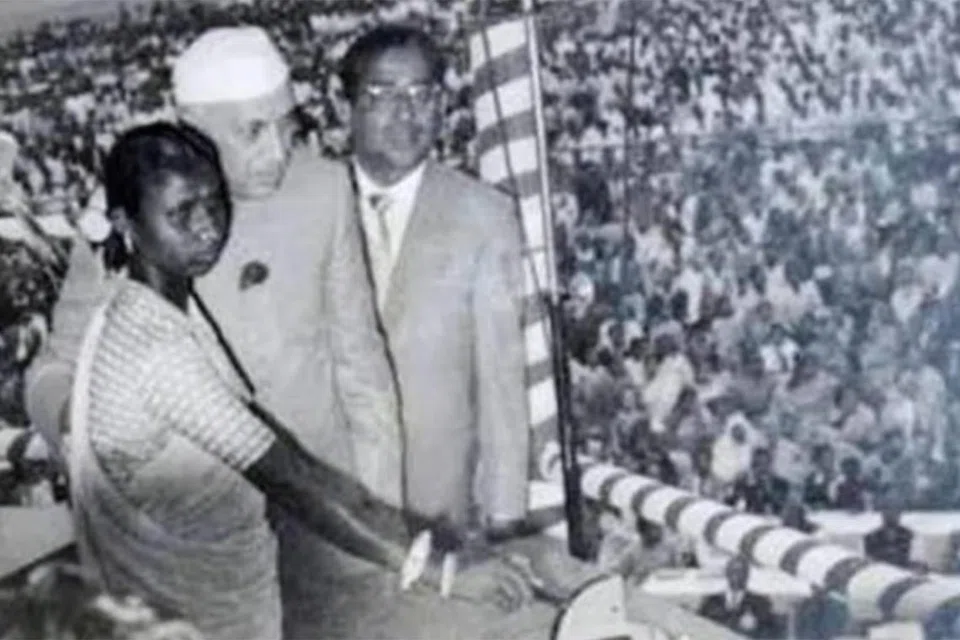
Ms Budhni Manjhiyain, 80, the woman who was ostracised by her Santhali tribal community and forced to flee her village after exchanging garlands with then Indian Prime Minister Jawaharlal Nehru in 1959, was content and had no complaints in the days leading up to her death on Nov 17, according to her grandson.
“What happened to my grandmother was very wrong, but I have let it go,” 43-year-old Baapi Dutta told The Indian Express. “During her last moments, she did not complain and was at peace when she passed away.”
Ms Budhni was just 16 when she exchanged garlands with Pandit Nehru on Dec 6, 1959, when he had visited Dhanbad district, then a part of Bihar, for the inauguration of the Panchet Dam.
Mr Nehru had insisted that a woman working on the project be a part of the inauguration, and the Damodar Valley Corporation (DVC) selected Ms Budhni, along with Mr Ravan Manjhi, a Santhali man, to welcome the prime minister.
However, what happened next altered the course of Ms Budhni’s life.
In reciprocation of Ms Budhni garlanding him, Mr Nehru garlanded her. He also insisted that she press the button at the power station to signal the start of operations. Mr Nehru also stood close to Ms Budhni, which offended the tribal community.
When she returned to her village, Karbala, now a submerged area in Jharkhand, after all the fanfare, the elders told her that by garlanding the PM at the function she had, in effect, married him.
Furthermore, since Mr Nehru was not a Santhal, she was no longer a part of the community and was told to leave the village.
Left with no option, Ms Budhni left her home and took shelter in Panchet with the help of a DVC colleague Sudhir Dutta.
In 1962, Ms Budhni left her job at the DVC and moved to Saltod in West Bengal’s Purulia district. There, she took up work as a daily wager.
Media reports said she later married Mr Dutta and the two had a daughter, Ratna Dutta.
In a recent interview with a local news channel, Ms Budhni said: “What happened? Nothing. Nehru came, we exchanged garlands, and he left… I was later called the ‘tribal wife’ of Nehru. I had to flee for my own sake.”
Mr Baapi Dutta, who works as an assistant clerk at DVC, said: “My grandmother fled for her life, as she could have been killed for ‘marrying’ Nehru. Those days, the old people of the village had some outdated practices, and she was a victim of that. She fled to the Saltod area and worked in a government-operated coal mine.
“The Central government had received a lot of criticism for the treatment meted out to my grandmother. During a visit to West Bengal, a local legislator told then-PM Rajiv Gandhi about her ordeal. This later led to her getting a job at the DVC around 1985-86 as a contract labourer.”
Ms Budhni retired from the DVC in 2005, and later, at her insistence, Mr Baapi Dutta got a job there.
Following her retirement, Ms Budhni lived a quiet life and died on Nov 17 following a prolonged illness.
Thousands, including local politicians and officials, attended her funeral.
According to The Times Of India, there are now calls for a monument built in her honour and for pension to be provided to her daughter Ratna, now 60.
Local leader Bhairab Mondal told The Indian Express: “She was a fighter her whole life. We will demand a memorial for her.”
The deputy chief engineer of DVC at Panchet, Mr Sumesh Kumar, told The Times Of India that no decision has been taken on the memorial yet. “These decisions can be taken only after consulting top officers,” he said.
Indo-Asian News Service

