


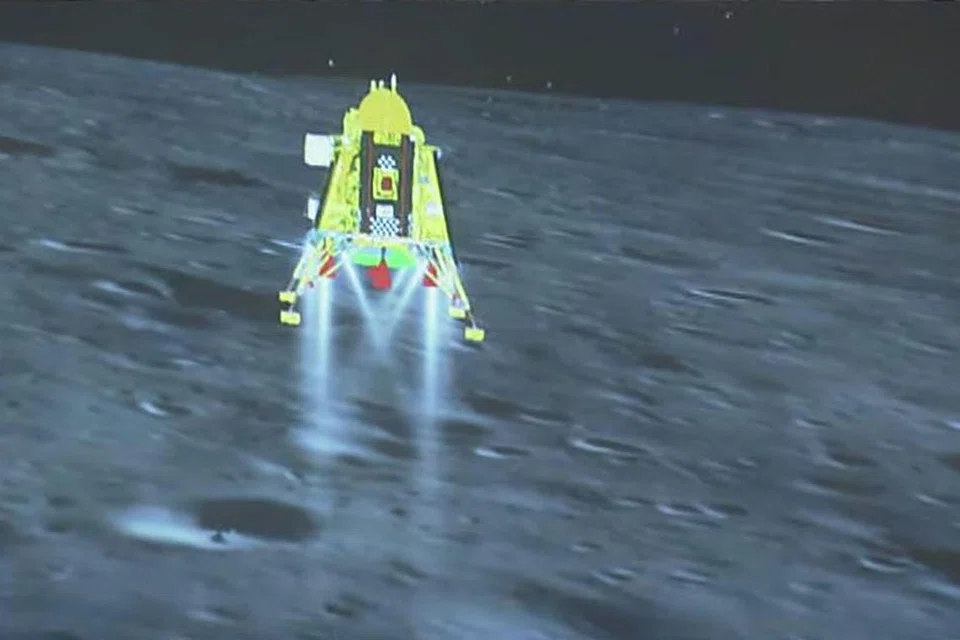
An Indian spacecraft became the first to land on the rugged, unexplored south pole of the moon on Wednesday in a mission seen as crucial to lunar exploration and India’s standing as a space power, just days after a similar Russian lander crashed.
“This moment is unforgettable. It is phenomenal. This is a victory cry of a new India,” said Prime Minister Narendra Modi, who waved the Indian flag as he watched the landing from South Africa, where he was attending a Brics summit with the leaders of Brazil, Russia, China and South Africa.
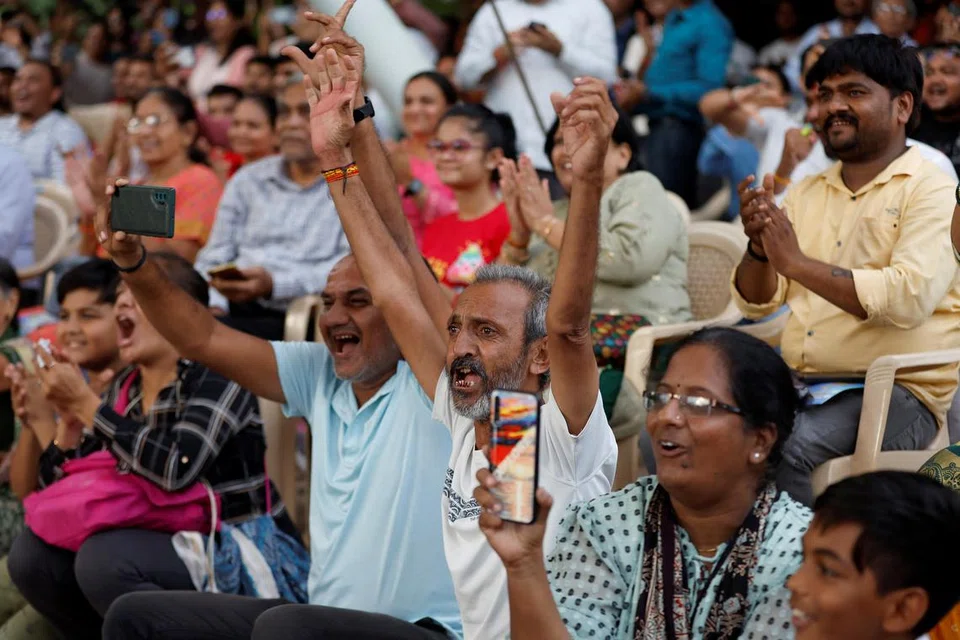
Scientists and officials clapped, cheered and hugged each other as the spacecraft landed and people across India broke out in celebration, setting off firecrackers and dancing in the streets.
“India is on the moon,” said Mr S. Somanath, chief of the Indian Space Research Organisation (ISRO) as the Chandrayaan-3 landed, making India the fourth nation to successfully land a spacecraft on the moon after the United States, China and the former Soviet Union.
Chandrayaan-3’s rover “ramped down” from the lander on Thursday and “India took a walk on the Moon!”, ISRO said. The 26kg rover, Pragyaan, will now roam around the rocks and craters, gathering crucial data and images to be sent back to Earth for analysis.
Pragyaan, which is carrying two scientific instruments to find out what minerals are present on the lunar surface, and study the chemical composition of the soil.Pragyaan will communicate only with the lander. That will then send the information to the orbiter from the earlier Chandrayaan-2, which is still circling the Moon, to pass it on to the Earth for analysis.
ISRO shared photos from the spacecraft showing the moon’s surface and the leg and shadow of the lander.
Rough terrain makes a south pole landing difficult, but the region’s ice could supply fuel, oxygen and drinking water for future missions.
Russian President Vladimir Putin congratulated India in a message to Mr Modi published on the Kremlin website. “This is a big step forward in space exploration and of course a testament to the impressive progress made by India in the field of science and technology,” he said.
In the United States, Nasa Administrator Bill Nelson congratulated the ISRO on the landingX and added: “And congratulations to India on being the 4th country to successfully soft-land a spacecraft on the Moon,” he said on X. “We’re glad to be your partner on this mission!”
This was India’s second attempt to land a spacecraft on the moon, less than a week after Russia’s Luna-25 mission failed. People across the country were glued to television screens and said prayers as the spacecraft approached the surface. Nearly 7 million watched a YouTube live stream.
Chandrayaan means “moon vehicle” in Hindi and Sanskrit. In 2019, ISRO’s Chandrayaan-2 mission successfully deployed the orbiter but its lander crashed.
The Chandrayaan-3 is expected to remain functional for two weeks, running a series of experiments including a spectrometer analysis of the mineral composition of the lunar surface.
The moon rover will take a few hours or a day to come out of the spacecraft, Mr Somanath said, adding that the landing has given India confidence to extend its reach to possible voyages to Mars and Venus and it is. India is also planning to launch a mission in September to study the sun, Mr Somanath said. A go further and a human space flight is also planned and, while no official date has been announced, preparations are likely to be ready by next year.
The landing is expected to boost India’s reputation for cost-competitive space engineering. The Chandrayaan-3 was launched with a budget of about Rs6.15 billion ($100 million), less than what it cost to produce the 2013 Hollywood space thriller Gravity.
“Landing on the south pole would actually allow India to explore if there is water ice on the moon. And this is very important for cumulative data and science on the geology of the moon,” said Ms Carla Filotico, a partner and managing director at consultancy SpaceTec Partners.
Anticipation before the landing was feverish, with banner headlines across Indian newspapers and news channels running countdowns. Prayers were held at places of worship across the country, and School children waved the Indian tricolour at live screenings of the landing. There were prayers at various places of worship.
Children gathered on the banks of the Ganga river, considered holy by Hindus, to pray for a safe landing, and mosques offered prayers.
At a gurduwara in the capital New Delhi, Petroleum Minister Hardeep Singh Puri also offered prayers.
“Not just economic, but India is achieving scientific and technological progress as well,” he said.
Reuters
