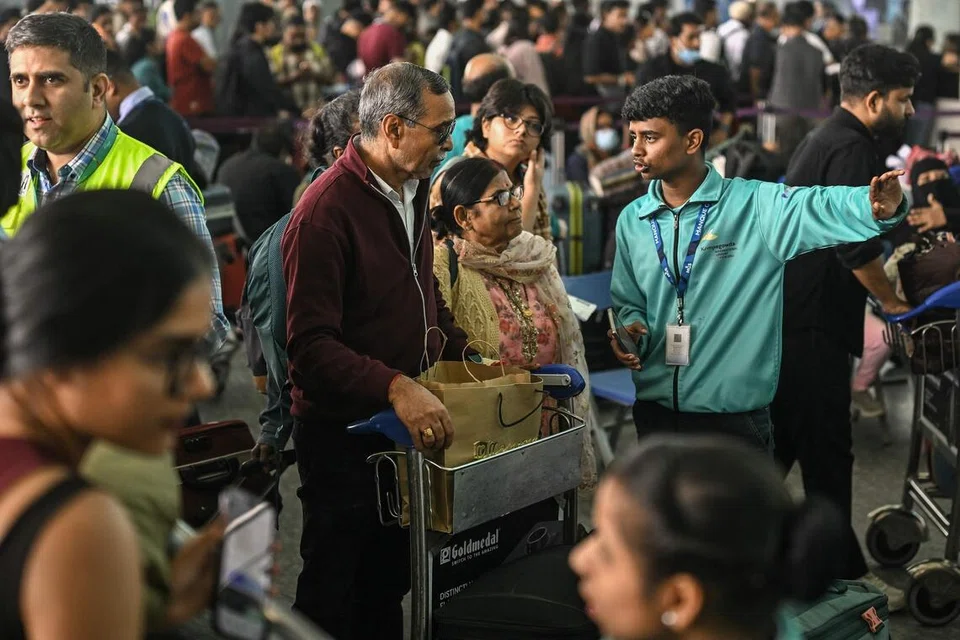

Thousands of passengers from India and abroad, including several from Singapore, are reeling from one of the worst aviation meltdowns in Indian history, as IndiGo Airlines struggles to recover from mass flight cancellations, crew shortages, and lost baggage.
The crisis, now in its second week, has caused nationwide chaos across airports in Delhi, Mumbai, and Bengaluru, with ripple effects on international routes. Many Singapore-based passengers flying to India have faced cancellations, long delays, or missing luggage.
Businessman Peer Mohammed, stranded at Chennai airport for over 10 hours, said his Coimbatore flight was cancelled without a warning.
“There was no airline staff to give an explanation. There was no assistance or proper communication,” he said. “I had to take an alternate route to Coimbatore.”
Beauty influencer Kashmira Virendra Rajput, who flew from Singapore to Mumbai on Dec 3 along with her husband and two children, told tabla!: “Our onward IndiGo flight from Mumbai to Vadodara was cancelled without notice. The airline refused to give us hotel accommodation, and we had nowhere to go as it was midnight. Eventually, a security officer helped us get a taxi. We reached Vadodara, a distance of 440km, after nine hours by paying Rs17,000 (S$245).”
Another traveller, business owner Atul Merchant, recounted how his Singapore-Mumbai flight was delayed for over five hours on Nov 27.
“There was not a single IndiGo staff at Changi from 9.30am to 5pm. We were left clueless,” he said.
India’s Directorate General of Civil Aviation (DGCA) has launched an investigation and stationed an oversight team at IndiGo’s Gurugram office.
Civil Aviation Minister Ram Mohan Naidu said operations are “returning to normal” but confirmed a 10 per cent cut in IndiGo’s winter schedule.
The Delhi High Court, taking suo motu notice of passenger distress, rebuked both the airline and government: “Why did you allow the situation to precipitate before taking action?”
IndiGo CEO Pieter Elbers apologised publicly, attributing the chaos to “crew shortages, tech glitches, and weather issues”.
Chairman Vikram Singh Mehta admitted: “We did not meet your expectations. We are truly sorry. We will examine every aspect of what went wrong.”
However, allegations have surfaced that the crisis was “engineered” to delay new safety norms limiting pilot work hours. The airline denies this, maintaining it followed regulations throughout.
Indian media quoted several pilots as saying that the airline was at fault. An IndiGo pilot told tabla! that the airline probably did not take the new safety norms too seriously, and was caught short when the implementation date neared.
The Competition Commission of India is now reportedly weighing a probe into whether IndiGo misused its market dominance (it controls 65 per cent of domestic air traffic). Analysts warn the carrier’s reputation may take years to rebuild. Despite assurances that operations will stabilise by Dec 15, many travellers remain anxious.
Singapore resident and founder of events and entertainment company Anu Samtani, who plans to fly to Mumbai on Dec 18, said: “We’ve booked tickets but are unsure if the flight will take off. Alternate airlines are too costly.”
Engineer Vijin Kunjumon, bound for Kerala for Christmas, added: “IndiGo has promised normalcy soon, but I’m still worried. I’ve never seen anything like this.”
Singaporean Eva Singh, who is in India for her mother’s death prayers, said the situation has improved.
She took an IndiGo flight from Bengaluru to Delhi on Dec 9 which was smooth. She is also flying from Kolkata to Gaya on Dec 12 and is not one bit anxious.
However, as IndiGo battles to regain public trust, passengers continue to demand what they were always promised – reliability, communication, and dignity in the skies.