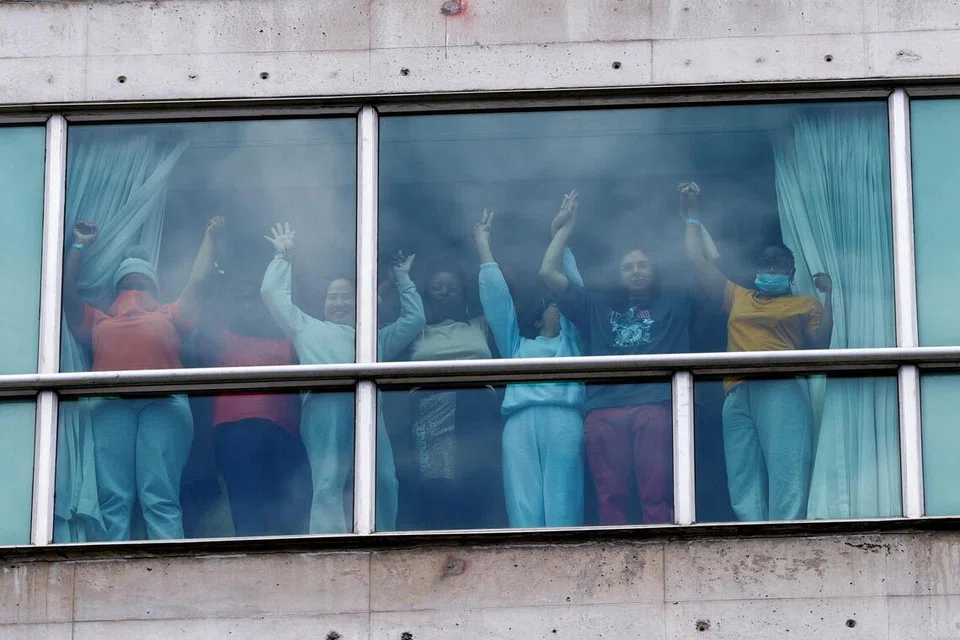
Nearly 300 people, including Indians, are being held in a hotel in Panama as they wait to be sent back to their home countries after being deported by the United States as part of the Donald Trump administration’s crackdown on illegal immigrants.
The migrants are reportedly from 10 Asian countries, including India, Nepal, Sri Lanka, Iran, Pakistan, Afghanistan and China, the Associated Press reported.
The news agency said those detained are under police guard and barred from leaving the hotel as the Panama government is waiting for international officials to organise their return to their home countries.
Some migrants were seen holding up notes from their windows with messages like “Please help us” and “We are not safe in our country,” AP reported, adding that the situation has sparked concern in Panama as images of detained migrants circulate.
The deportees are in limbo in Panama after the Central American nation agreed to serve as a transit point for migrants whom the Trump administration finds it difficult to deport directly to their countries.
Costa Rica is also expected to receive a similar group of deportees.
Around 40 per cent of the deportees have said they would not voluntarily return to their countries of origin, raising questions about how long they would be detained in the hotel.
Of the 299 deportees, 171 have agreed to return to their countries with help from the International Organisation for Migration and the UN Refugee Agency. Talks are ongoing for the remaining 128 migrants to find alternative destinations. One Irish citizen has already returned home.
Those who refuse to return may be temporarily held in a facility in Panama’s Darien province, a well-known migration route. The Panamanian Ombudsman’s Office is expected to release more details on their situation soon.
Security Minister Frank Abrego said on Tuesday that 171 migrants have agreed to return to their countries of origin, although he did not provide a specific timeline.
Mr Abrego added that the others will leave gradually when the United Nations provides them transportation.
Panama’s national immigration service reported on Wednesday that one migrant, a Chinese woman, had escaped from the hotel with the help of people loitering nearby. It asked the alleged collaborators to return the woman, warning that they could face human trafficking or migrant smuggling charges.
Panamanian authorities later said they recaptured the woman.
Mr Abrego wrote in an X post that she was found abandoned near a migrant processing facility along the northern Panama-Costa Rica border, a high-transit point for migrants headed towards the US.
Authorities have indicated that the remaining migrants will be transferred to a temporary migration facility near the Darien Gap, a dense jungle region along the Colombian border until a resolution is found.
The Darien Gap is a historically perilous route used by migrants travelling north towards the US, and its use as a holding area for deportees has only deepened the controversy surrounding Panama’s role in US immigration enforcement.
At least three US aircraft with illegal Indian immigrants have landed in India after Mr Trump took over as the US president.
According to PTI, the flights landed in Amritsar, bringing back a total of 335 Indian nationals.
The first flight arrived last week, carrying 104 deportees, including 33 each from Haryana and Gujarat and 30 from Punjab.
The second flight landed on Feb 15 with 119 deportees, of whom 67 were from Punjab, 33 from Haryana and eight from Gujarat.
The latest flight, which arrived on Feb 16, brought back 112 Indian nationals, with 14 children among them.
Haryana had the highest number of returnees in this batch at 44, followed by Gujarat with 33 and Punjab with 31.