India on May 24 expressed concern over the United States’ tightening visa policies, marking a rare moment of public criticism even as both countries reaffirmed strong strategic ties during US Secretary of State Marco Rubio’s first official visit to India.
Speaking in New Delhi, Mr Rubio said India and the United States remained aligned on all major global issues, downplaying recent tensions surrounding trade, China, and the Iran war. India’s External Affairs Minister Subrahmanyam Jaishankar acknowledged that the two nations shared a “convergence of national interests in many areas” but openly raised concerns about the impact of US immigration policies.
Mr Jaishankar said he “apprised Secretary Rubio of challenges that legitimate travellers face in respect of visa issuance”.
“While we cooperate to deal with illegal and irregular mobility, our expectation is that legal mobility should not be adversely impacted as a consequence,” he said, stressing the importance of visas to US-India cooperation in the technology sector.
US President Donald Trump, who has prioritised stricter immigration controls, has increased restrictions and costs associated with H-1B visas, commonly used by Indian technology professionals, leading to a sharp decline in applications.
The Trump administration further announced on May 22 that green card applicants, including those legally residing in the US, would be required to leave the country for processing, a move expected to separate many families for prolonged periods.
Mr Trump has faced criticism for amplifying anti-immigrant rhetoric. In April, he reposted comments from a far-right commentator who referred to India as a “hellhole” and falsely claimed Indian immigrants lacked English proficiency.
When questioned about racist remarks directed at Indians in the United States, Mr Rubio responded: “Every country in the world has stupid people”.
“Our nation has been enriched by people who come to our country,” said Mr Rubio, whose parents emigrated from Cuba.
He acknowledged there may be “bumps” during the immigration overhaul but maintained the changes stemmed from a broader “migratory crisis” and were “not India-specific”.
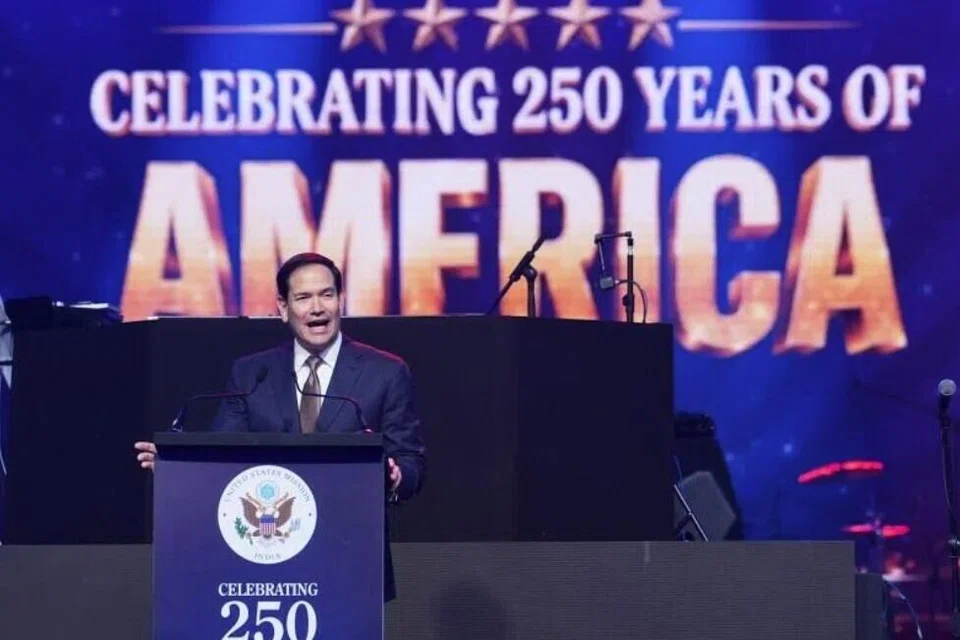
Later in the day, Mr Rubio attended a gala event in New Delhi commemorating the 250th anniversary of US independence. Guests, many dressed in red, white and blue, posed alongside cutouts of Mr Trump, Mr Rubio, and Indian Prime Minister Narendra Modi.
Joining the event briefly by speakerphone held by US Ambassador Sergio Gor, Mr Trump praised his relationship with Mr Modi, saying, “anything India wants, India gets.”
Despite such remarks, Mr Trump has departed from longstanding US policy by publicly challenging India on trade and diplomatic matters. Earlier in 2025, he imposed steep tariffs on Indian goods after Mr Modi declined to credit him for helping end a brief conflict with Pakistan.
The tariffs were later eased following the arrival of Ambassador Sergio Gor in India in January.
At the same event, Mr Gor said he expected an interim trade agreement between the two countries to be finalised “in the next few weeks”.
Mr Rubio, who is on a four-day visit across four Indian cities, described India as “one of our most important strategic partners in the world”.
“It begins with the fact of our shared values. We are the two largest democracies,” Mr Rubio said during a news conference.
“Our nations are strategically aligned on all of the key issues that will define the new century – all the great challenges that are before us now in the modern era,” he added.
Addressing questions about Pakistan’s emerging role in mediating discussions related to Iran, Mr Jaishankar said the US was entitled to choose its own international partners, while acknowledging that differences between Washington and New Delhi were inevitable.
“The Trump administration has been very forthright in putting forward its foreign policy outlook as America First,” Mr Jaishankar said.
“We have a view of India First,” he said.