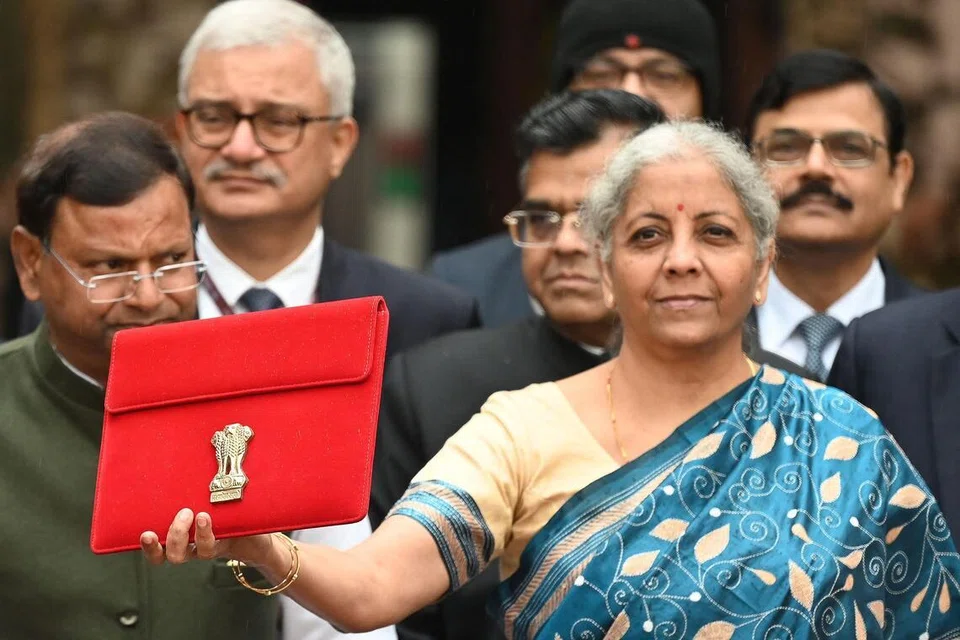

India’s Finance Minister on Thursday unveiled her last budget before the general elections this year, announcing a double-digit boost to infrastructure spending and flagging the government’s “golden moments” ahead.
Ms Nirmala Sitharaman also proposed a scheme that would allow people to buy or build their own homes, free electricity as part of a new rooftop solar programme, and increased medical coverage for some government workers.
Prime Minister Narendra Modi’s Bharatiya Janata Party (BJP) has a large majority in the 543-member lower house, and is widely viewed as the favourite going into polls set to begin in April.
“The next five years will be years of unprecedented development, and golden moments to realise the dream of a developed India by 2047,” Ms Sitharaman said. “We expect that our government will be blessed again by the people with a resounding mandate.”
Economic growth has driven a tax windfall, allowing the government to increase spending while still reducing debt.
Ms Sitharaman said the budget deficit for the financial year ending March 31 would come in lower than expected at 5.8 per cent of gross domestic product, adding that she plans to bring that down to 5.1 per cent over the next 12 months.
The budget is an interim plan to meet immediate financial needs before the new government takes power.
The government has drastically increased spending over the past three years, ramping up capital expenditure by almost a third on ambitious road, port and railway projects.
While New Delhi’s deficit and growth targets took a hit after Covid, the country has recovered to become the world’s fastest-growing major economy, with the International Monetary Fund projecting it would grow 6.7 per cent this year.
“The interim budget 2024 made no big-bang announcements, but it continued to focus on infrastructure upgrades and building connectivity across the country,” said Mr Anuj Puri, chairman of Anarock Group in Mumbai.
“This will benefit real estate growth in not just the top cities but also in Tier 2 and 3 cities across the country.”
DBS Bank Singapore’s senior economist Radhika Rao observed: “The budget delivered on the consolidation and capex theme, by not only expecting the FY24 deficit to fare better than budgeted, but also pegging the FY25 goalpost at a narrower-than-expected (level of) 5.1 per cent of GDP.”
AFP