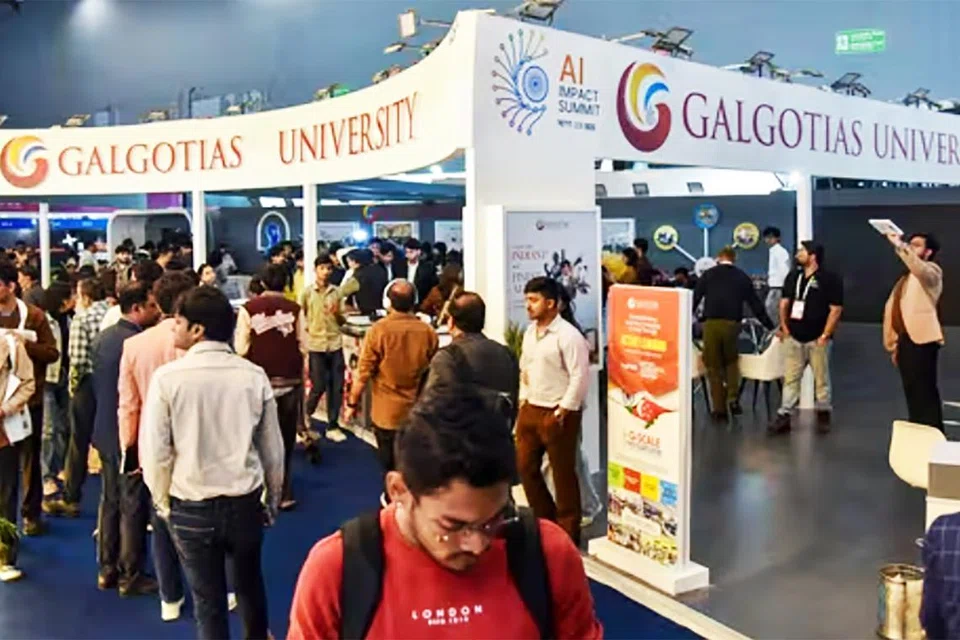
The Central government has stressed that “misinformation cannot be encouraged” following controversy over a robotic dog displayed by Galgotias University at the India AI Impact Summit 2026 in New Delhi.
The row erupted after a faculty member from the Greater Noida-based university told DD News that a robotic dog exhibited at its pavilion had been developed by the institution’s “centre of excellence”.
The device, referred to as “Orion”, was later identified as the Unitree Go2, a commercially available product manufactured by China’s Unitree Robotics, reported the Hindustan Times.
The claim triggered widespread criticism on social media, with users accusing the university of misrepresenting imported technology as its own innovation. The organisers of the summit subsequently asked Galgotias University to vacate its pavilion, which it did.
Responding to the controversy on Feb 18, Mr S. Krishnan, Secretary at the Ministry of Electronics and Information Technology (MeitY), said the government expects genuine work to be showcased at such events, reported NDTV.
“We want genuine and actual work to be reflected in the way that people exhibit in expos. The idea is not to use this as an opportunity in any other fashion. We don’t want a controversy around exhibits presented here,” he said. “A set code must be followed. Misinformation cannot be encouraged.”
Mr Krishnan clarified that the exhibits at the summit were not products meant for sale and therefore did not undergo formal certification. “When somebody is demonstrating a product, you presume that they know what they are talking about. If we have to certify even what has to be exhibited, then you’ll say we are stifling innovation. Our intention is not to stifle innovation,” he added.
Mr Abhishek Singh, Additional Secretary at MeitY and CEO of the India AI Mission, was more direct. “The main problem is they claimed to be something they are not. They misled. The whole world is here,” he said, underlining concerns about credibility at a global event.
The controversy intensified after a video featuring the robotic dog was shared on social media, prompting fact-check notes pointing out that the device was an imported Chinese product retailing for around US$2,800 (S$3,547).
Facing mounting backlash, the university issued an apology, attributing the episode to miscommunication. In a statement, it said a representative manning the pavilion was “ill-informed” and not authorised to speak to the media.
“We wish to apologise profusely for the confusion created at the recent AI Summit. There was no intent to misrepresent the innovation,” the university said, reaffirming its commitment to “academic integrity, transparency and responsible representation”.
The professor at the centre of the controversy also accepted responsibility for unclear communication, telling reporters that her comments may have been misinterpreted and that the robodog retained its original branding.
Despite the clarifications, the episode overshadowed parts of the summit, with officials emphasising the importance of maintaining credibility as India pushes to position itself as a global AI innovation hub.