India’s Central government on Wednesday asked the Tamil Nadu government to submit a “detailed report” after a Reuters story revealed that Apple supplier Foxconn rejected married women from iPhone assembly jobs across the country.
In a statement calling for a probe, the Central Ministry of Labour and Employment cited the Equal Remuneration Act of 1976, saying the law “clearly stipulates that no discrimination (is) to be made while recruiting men and women workers”.
The ministry said it has requested a detailed report from the Labour Department of Tamil Nadu, the site of a major iPhone factory in Sriperumbudur, near Chennai, where Reuters uncovered Foxconn’s practice of shunning married women.
It also directed the office of the Regional Chief Labour Commissioner to provide a “factual report”.
Apple and Foxconn have not commented on the Reuters report or the government statement.
On Tuesday, Reuters said its investigation has found that Foxconn has systematically excluded married women from jobs at its main India iPhone assembly plant in Sriperumbudur on the grounds they have more family responsibilities than their unmarried counterparts.
Mr S. Paul, a former human-resources executive at Foxconn India, told the news agency that the company’s executives verbally convey the recruitment rules to its Indian hiring agencies, which Foxconn tasks with scouting candidates, bringing them in for interviews and employing them.
Foxconn typically doesn’t hire married women because of “cultural issues and societal pressures”, said Mr Paul, who left the company in August 2023 for a better-paying role at a consulting firm.
The company’s view was that there were “many issues post-marriage,” Mr Paul added. Among them: Women “have babies after marriage”. “Risk factors increase when you hire married women,” he said.
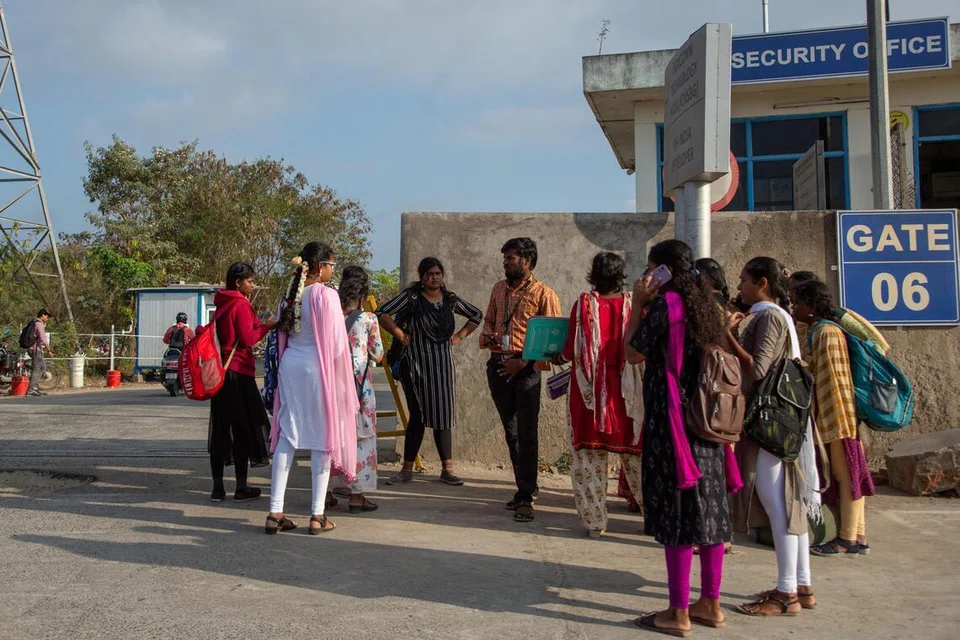
Reuters’ investigation team reported that two sisters in their 20s, Ms Parvathi and Ms Janaki, had gone to the Sriperumbudur plant for interviews in March 2023 after seeing job ads on WhatsApp. But they were turned away at the main gate by a security officer who asked: “Are you married?”
“We didn’t get the jobs as we both are married,” Ms Parvathi told Reuters. “Even the autorickshaw driver who took us from the bus stand to the Foxconn facility told us they wouldn’t take married women. We thought we would still give it a shot.”
Reuters also spoke to five other women who said they were rejected by Foxconn’s hiring vendors on the grounds that they were married.
Ms Priya Darshini, who is in her late 20s, received the news in a WhatsApp group chat, which a recruiter from SS Enterprises had created to scout for candidates.
She posed questions to the group in August 2023, according to a transcript reviewed by Reuters: “I have a baby. Are there child care facilities? Could I bring my baby? Age is 2. Salary?”
The recruiter, Mr T. Balu, sent a curt reply: “Married not allowed.”
Asked about his response, Mr Balu told Reuters that Foxconn does not hire married women who wear ornaments because it wants to ensure a metal-free zone.
Mr Paul said the Foxconn management advises its hiring vendors not to mention marital and age criteria in their job ads. But in some instances vendors did not heed that advice.
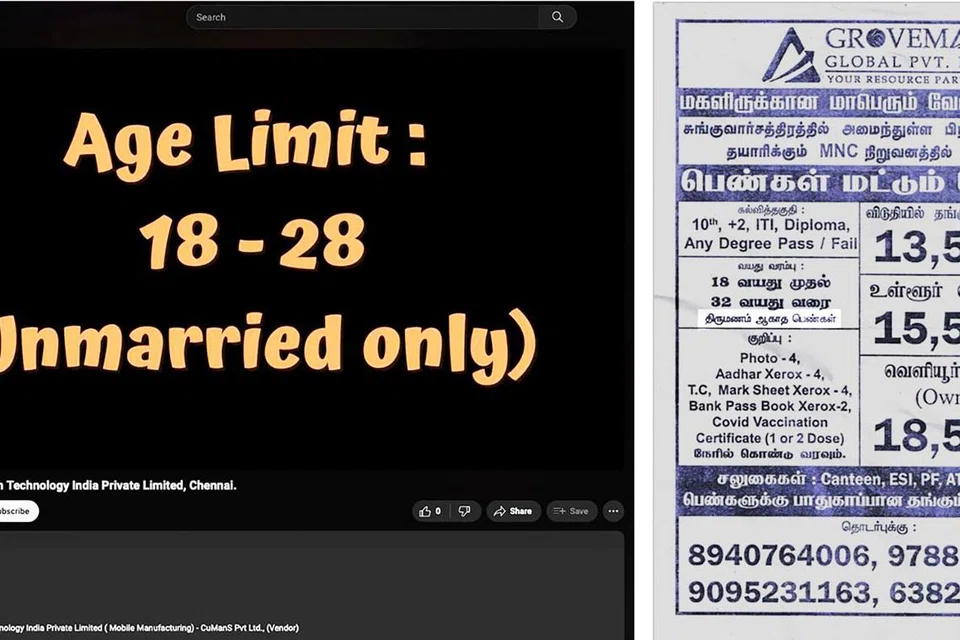
“Job vacancy for Only Female … iPhone Manufacturing … Age: 19 to 30 Unmarried,” said an ad posted by a recruiter at Proodle, a hiring agency for Foxconn, in a publicly accessible WhatsApp group in February 2024.
A YouTube ad for Foxconn jobs posted by recruiter Cumans Manpower in July last year sought “unmarried only” female candidates aged 18 to 28.
None of the hiring agencies identified by Reuters responded to questions about the job ads and employment practices at the Foxconn plant.
In response to questions from Reuters, Apple and Foxconn acknowledged lapses in hiring practices in 2022 and said they had worked to address the issues. All the discriminatory practices documented by Reuters at the Sriperumbudur plant, however, took place in 2023 and 2024. The companies didn’t address those instances.
Apple told Reuters it upholds the “highest supply chain standards in the industry,” and noted that Foxconn employs some married women in India
In a statement, Foxconn said it “vigorously refutes allegations of employment discrimination based on marital status, gender, religion or any other form.”
However, the exposure of the factory’s hiring practices turns a new spotlight on one of the highest-profile foreign investments in India.
Apple, Foxconn and other big companies play a key role in Prime Minister Narendra Modi’s imperative of removing societal impediments that prevent many Indian women from getting jobs.
While Foxconn employs thousands of women in India, discrimination on the basis of marital status risks undercutting Mr Modi’s aims.
For some Indian women, a job making iPhones is a ticket out of extreme poverty. The Foxconn positions offer food and accommodation and a monthly cheque of about Rs16,690 ($270), roughly in line with India’s per capita GDP.
Such jobs are the kind of opportunities offered by multinational companies that the government has encouraged to help lift living standards.
Reuters