
Tamil Nadu’s 2026 Assembly election may have produced its biggest political twist even before the counting day, with an Axis My India exit poll projecting a stunning debut for actor Vijay’s Tamilaga Vettri Kazhagam (TVK).
The poll has given TVK 98 to 120 seats in the 234-member Assembly, putting it almost neck-and-neck with the Dravida Munnetra Kazhagam-led alliance, which is projected to win 92 to 110 seats.
The All India Anna Dravida Munnetra Kazhagam-Bharatiya Janata Party alliance is placed far behind at 22 to 32 seats.
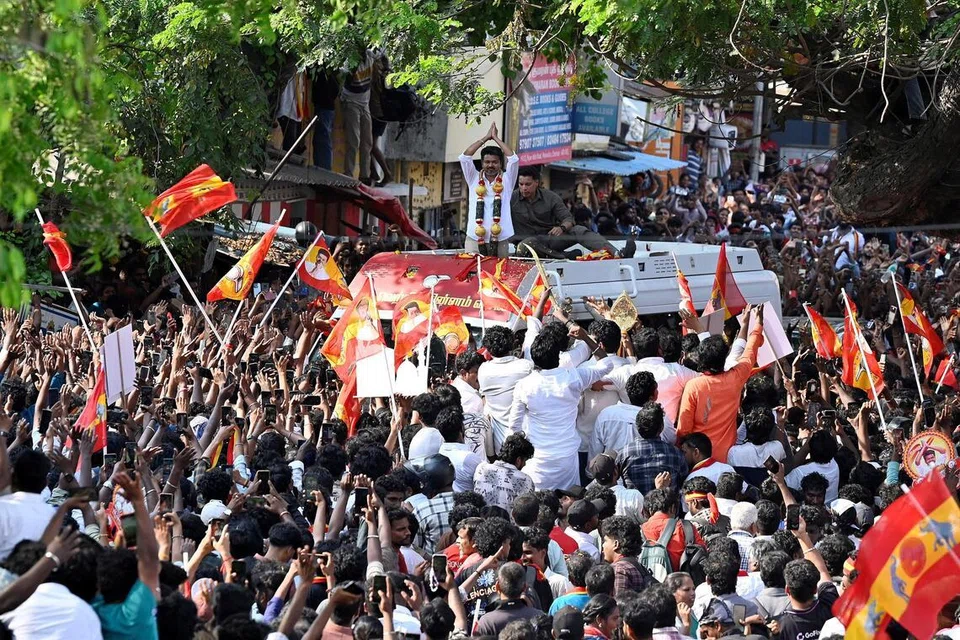
If the numbers hold when votes are counted on May 4, Vijay will not merely be a vote-cutter or spoiler. He could emerge as Tamil Nadu’s most important new political force in decades – possibly even a kingmaker, or at the upper end of the projection, a contender for power.
Axis My India has pegged TVK’s vote share at about 35 per cent, matching the DMK-led bloc. More significantly, Vijay has emerged as the most preferred chief ministerial face in the survey, with 37 per cent support, narrowly ahead of Chief Minister M.K. Stalin at 35 per cent. AIADMK leader Edappadi K. Palaniswami is placed at 22 per cent.
Pollster Pradeep Gupta even compared Vijay’s rise to that of M.G. Ramachandran in Tamil Nadu and N.T. Rama Rao in Andhra Pradesh – film icons who converted mass popularity into political power.
The strongest signal from the Axis data is the youth surge. TVK reportedly secured 68 per cent support among first-time voters aged 18 to 19, 59 per cent among voters aged 20 to 29, and 45 per cent in the 30 to 39 age group. This suggests that Vijay’s appeal has travelled beyond fan clubs and entered a broader generational space.
The central mood, according to the poll, is “change”. About 35 per cent of voters cited change as their main reason for voting, and among TVK supporters, that figure rose sharply to 77 per cent.
That makes Vijay’s campaign less a celebrity experiment and more a possible expression of fatigue with Tamil Nadu’s long-running DMK-AIADMK binary.
However, Axis My India is an outlier. Most other exit polls predict a DMK-led victory and place TVK much lower.
P-Marq has given TVK 16 to 26 seats, Matrize 10 to 12, and Praja Poll just 1 to 9. Peoples Pulse and Peoples Insight also favour the DMK alliance strongly. Kamakhya Analytics, however, gives TVK 67 to 81 seats, suggesting that Vijay may still play a major role even if he falls short of the Axis projection.
This wide variation shows how difficult it is to measure the Vijay factor. His popularity is undeniable, but converting star power into booth-level votes is a different challenge.
Tamil Nadu’s established parties have deep networks, loyal cadres and decades of electoral experience. TVK, by contrast, is a young party contesting all 234 seats independently.
That is why the comparison with MGR is tempting but premature. MGR had broken away from the DMK and inherited a political base. Vijay is attempting something more difficult – building a new formation almost from scratch.
Still, even a modest double-digit tally would make TVK a serious player. A result near the Axis projection would be historic.
Counting day will decide whether Vijay becomes Tamil Nadu’s next great political phenomenon or remains a powerful disruptor in his first election. But one thing is already clear: he has changed the conversation.