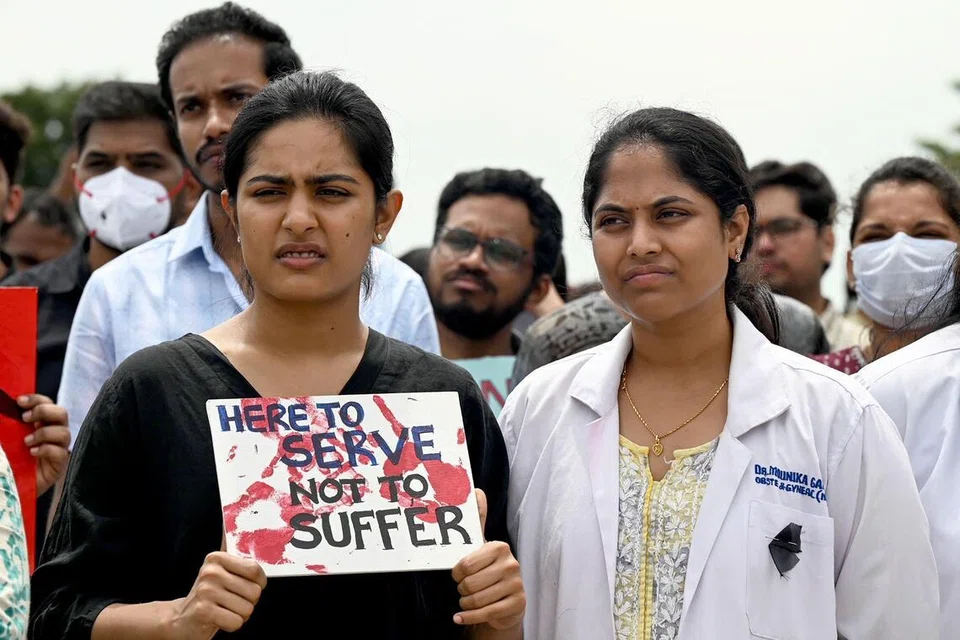
The rape and murder of a 31-year-old trainee doctor at the RG Kar hospital in Kolkata on Aug 9 has led to widespread protests by doctors and medical students across India. They are demanding that the management of hospitals and college campuses provide them with better facilities and security.
The crime has particularly horrified doctors because of where it occurred – in the hospital’s seminar room, where the victim was sleeping.
“It could have been any of us,” Dr Radhika, who works at RG Kar, told AFP. “I was on night duty just two days before this incident. What she did is what any of us do – resting whenever, wherever we can.”
The murdered doctor – who has not been formally named but is being called “Abhaya” (fearless) by protesters – had gone to the seminar room for a break during a long shift. The details of what exactly happened after that is being investigated by the Central Bureau of Investigation. One man has been detained.
Dr Radhika said conditions such as long working hours – with barely any time to eat or rest – were not unusual for doctors in Indian hospitals.
A key problem, she noted, is that very few hospitals had on-call rooms equipped with beds and other facilities to allow doctors on duty to rest. Thus, it was common for doctors to sleep in rooms meant for other activities.
Safety and security measures are other issues that worry female doctors, especially when using the restroom.
“When I was in college, we would not go to the restroom alone during night duty,” Dr Sangeetha Sivaraman, a doctor based in Bengaluru told online news site Scroll. “We would take someone along because it was often in an isolated area and we were scared.”
According to philanthropic organisation Dasra, women make up nearly 30 per cent of doctors in India and 80 per cent of nursing staff. Attacks on female medical staff are all too common.
On Aug 20, the Supreme Court ordered a national task force to examine how to bolster security for healthcare workers, saying the brutality of the Kolkata killing had “shocked the conscience of the nation”.
The court also highlighted a lack of CCTV cameras and a failure to screen visitors to hospitals for weapons.
Medical superintendent Indira Kabade, who works at KC General Hospital in Bengaluru, said she worries about her staff getting home safely after work. “We never know if anyone is following them from the hospital,” she said.
Though hospitals are usually equipped with CCTVs, they do not always install a sufficient number of them. In the Kolkata case, when police asked for relevant CCTV footage, the administration is reported to have said that there were no CCTVs installed in the seminar room because “many women change clothes there”.
Foul sanitation – including often only one toilet for male and female medical staff – illustrates a failure by the authorities to provide basic infrastructure.
The situation is particularly worrying when the women are menstruating, Dr Radhika said.
In the Himalayan territory of Kashmir, doctor Rubeena Bhat said some medical staff would rather use washrooms in houses neighbouring the hospital. “It’s that bad,” she said.
Doctors also observed that many hospitals did not have enough security personnel.
Poor security can present a major problem to doctors when large crowds visit hospitals. “Anybody can enter,” said a female doctor in Chennai. “There is no control.”
Doctors sometimes face physical violence and even sexual harassment from relatives and friends of patients – in some instances even through calls or messages. “People find the numbers from a register or somewhere else and then send inappropriate messages,” said Dr Radhika.
Sexual harassment also occurs within the hospital system itself. “Medical campuses and hospitals are highly hierarchical spaces and also inherently sexist,” said Dr Radhika. “Female doctors and nurses are exposed to sexual behaviour and harassment from male doctors and administrators. Nurses have it especially hard because of the power dynamics between doctors and nurses.”
One female doctor in Thiruvananthapuram, a city in Kerala, said she and her colleagues face abuse every day, from verbal insults to physical molestation. “There is no end to it,” she said.
“Doctors are called gods or angels by some people,” the doctor said. “So we think we are immune to crimes. And when such a crime happens at a place which we consider the safest place, we are all afraid.”