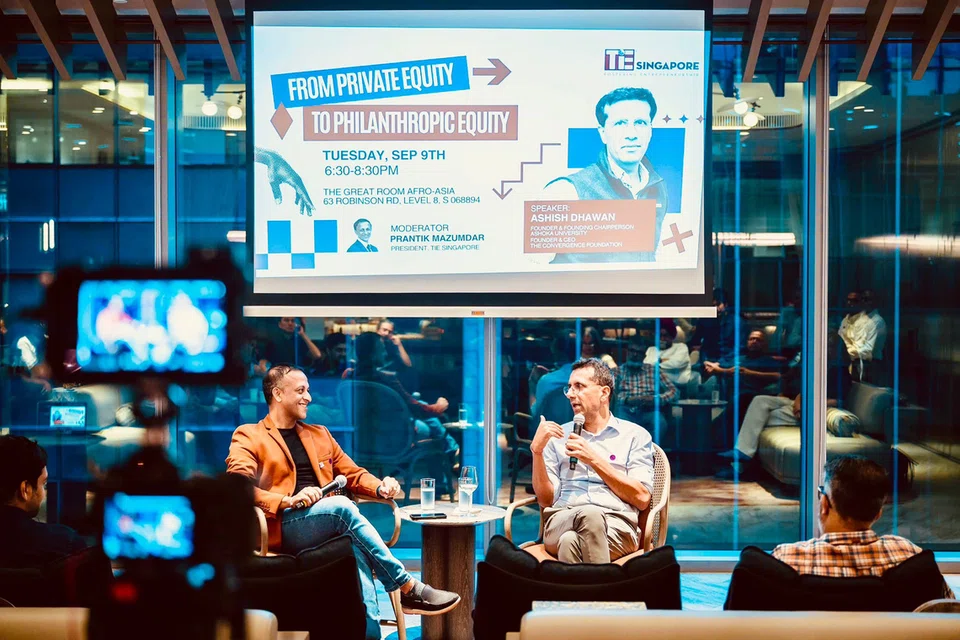
Fifteen years ago, Ashish Dhawan was at the peak of a glittering corporate career. The Harvard-educated co-founder of ChrysCapital, one of India’s most successful private equity funds, was widely regarded as one of the sharpest minds in finance.
Then, in his mid-forties, Dhawan made a decision that stunned peers and colleagues – he stepped away from investing to devote himself fully to philanthropy, with education at the centre of his mission.
“I always wanted to be in the social sector,” Mr Ashish, 56, said during a visit to Singapore last week, when he met National University of Singapore (NUS) and Nanyang Technological University (NTU) leaders and engaged TiE (a global non-profit founded by successful entrepreneurs) members in a dialogue session. “I had a good corporate career, I was financially secure, and I wanted to do this in my mid-40s, so I could make it a second career, not a retirement posting. Education was my passion, so I felt I should do it full time, not part time.”
That conviction led to the birth of Ashoka University in 2010, India’s first liberal arts and sciences university.
Inspired by the American model of broad-based learning, Ashoka’s curriculum combines a core foundation with interdisciplinary choice, allowing students to major, double-major, or mix courses across disciplines.
“In India, if you get into physics at (the prestigious) St Stephen’s (college in New Delhi), you only study physics. We wanted to change that,” Mr Ashish told tabla!. “In the 21st century, just knowing one thing deeply is not sufficient. Critical thinking, the ability to be a continuous learner – these are far more important.”
Today, Ashoka is widely seen as a success story, attracting applications from over 400 cities and towns in India and 40 countries abroad.
It is a top choice for students in fields such as economics, psychology, history, computer science, and biology, with many turning down offers from global institutions like the London School of Economics, Duke University, and McGill to study in Sonipat, Haryana.
Its growth has been fuelled by a unique philanthropic model. Rather than relying on one family or corporate group, Ashoka has been built with contributions from over 250 philanthropists.
“We wanted a collective effort in nation-building, not domination by a single donor,” Mr Ashish, who co-founded the university with entrepreneur Pramath Raj Sinha, explained. The funds support infrastructure, scholarships, and research labs.
By 2035, the university plans to triple in size, expanding from 2 million to 6 million square feet.
Ashoka was only the beginning. In 2012, Mr Ashish founded the Central Square Foundation (CSF) to address India’s school education challenges, focusing on early childhood literacy, teacher effectiveness, and learning outcomes.
Later, through the Convergence Foundation, he helped incubate non-profits tackling broader issues such as women’s economic empowerment and economic growth.
“India has done remarkably well in terms of access,” Mr Ashish said. “Ninety-eight per cent of children in primary classes are in school. But learning outcomes lagged for decades. Children who cannot read by Class 5 never catch up. That’s why CSF is focused on systemic reform.”
His approach reflects what he calls strategic philanthropy: Working collaboratively with governments, creating new models, and building institutions that outlast their founders. “At the end of the day, whatever I build, I should eventually become redundant,” he noted.
Mr Ashish acknowledges that India’s higher education landscape is changing, with universities like Shiv Nadar, O.P. Jindal Global, Krea, and FLAME emerging in recent years. But he welcomes the competition. “India needs 100 flowers to bloom,” he said. “One Ashoka is not enough.”
Ensuring quality remains a challenge in a system sometimes marred by exam scandals and uneven standards. Mr Ashish insists Ashoka’s holistic admissions – including academics, extracurriculars, and interviews testing intellectual curiosity – help maintain integrity.
“Our system largely works,” he said. “And we add checks like our own admissions test to ensure fairness.”
Mr Ashish’s visit to Singapore underscored his interest in international partnerships. He met NUS and NTU leaders to discuss student and faculty exchanges, noting that Singapore’s higher education transformation over the last 25 years offers valuable lessons.
“There’s a lot to learn from Singapore,” he said. “Not just from today’s schools, which are world-class, but from the history of how the system was built in the 1960s and 70s.”
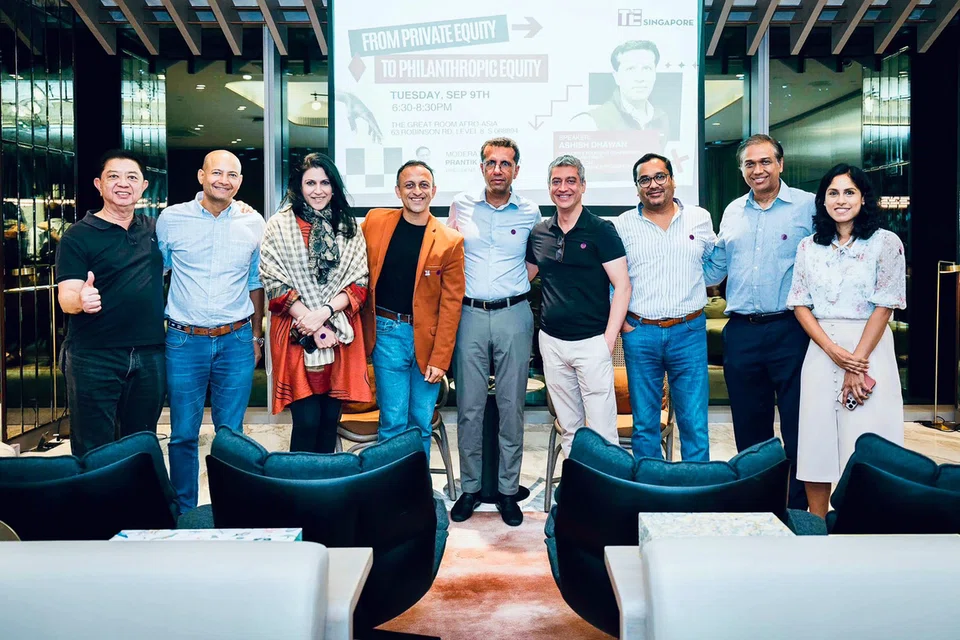
At TiE Singapore, his journey resonated deeply with the diaspora community. Mr Prantik Mazumdar, president of TiE Singapore, described the session as energising: “It was a privilege to host Ashish Dhawan. He is a rare person to have transitioned from private equity to philanthropy and public policy at scale. Many of us complain about India’s challenges, but Ashish has chosen to get involved and make a difference. His work with CSF and Ashoka University left us inspired to contribute to India’s vision of Viksit Bharat (Developed India) through entrepreneurship, philanthropy, and mentoring the youth.”