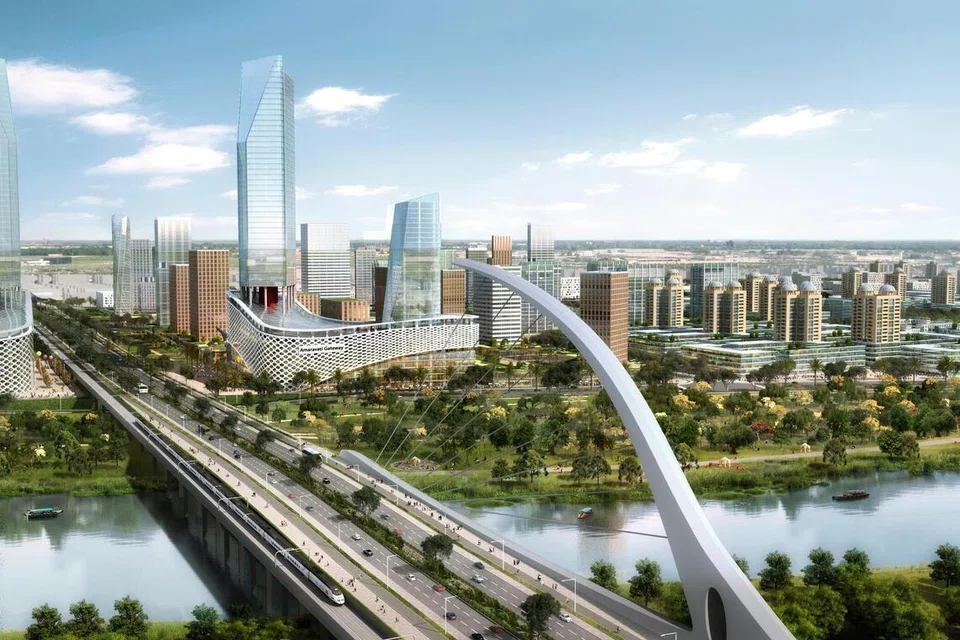
Senior Andhra Pradesh officials seem almost eager to address questions about the collapse of Singapore’s involvement in building Andhra Pradesh’s new capital, Amaravati.
The 2019 cancellation was somewhat embarrassing. A Singapore consortium had been brought in to master-develop part of the proposed city, only for the deal to be scrapped after a change of government, with then Chief Minister N Chandrababu Naidu voted out.
Now, with Mr Chandrababu back at the helm, the message is simple: Yes, what happened was unfortunate. But work is moving at full tilt, and they want international investors, including those from Singapore, to take another look.
That sense of urgency was the biggest takeaway from seven days in the south-eastern state in October, on a trip for Singaporean journalists organised by India’s Ministry of External Affairs.
Besides extensive meetings with senior bureaucrats and Mr Chandrababu’s son, the influential tech minister Nara Lokesh, the itinerary included a visit to Simbex, the Singapore-India naval exercise. In 2026, it was held in Visakhapatnam, home to the Indian Navy’s Eastern Naval Command.
The economic pitch was unmistakable: This is a state in a hurry.
There is lost ground to make up. Andhra Pradesh lost Hyderabad, its economic and technology hub, when the state was split in two in 2014. Peeyush Kumar, a senior finance and planning official, told us that the loss of Hyderabad had made the economy far more dependent on agriculture.
Beyond building a capital from scratch, Andhra Pradesh has ambitious plans spanning renewable energy, quantum computing, drones, flying cars, biotechnology and pharmaceuticals. Not all of it is a pipe dream.
The Andhra Pradesh MedTech Zone in Visakhapatnam, a manufacturing park for medical devices, is already up and running. In the same city, also known as Vizag, the gleaming new airport, opened earlier in 2026, could fool you into thinking you were at one of Changi Airport’s newer terminals.
Amaravati itself remains largely a construction site, though bungalows for ministers and flats for legislators are nearing completion. Officials took us to the site of a quantum computing facility being developed with IBM and Tata Consultancy Services, part of plans to make the city a hub for advanced research and industry, including financial applications.
Determined to deliver
Mr Chandrababu’s government is determined to see Amaravati built and, more broadly, to transform the state’s economy. Mr Nara said he hoped the state could summon the kind of siege mentality that drove Singapore to success after its separation from Malaysia.
Duvvuri Subbarao, a former Reserve Bank of India governor who once served as Andhra Pradesh’s finance secretary, said Mr Chandrababu had long been “ahead of the pack” in embracing technology. During his first stint as chief minister, from 1995 to 2004, he had bet on Hyderabad’s IT industry before many others recognised its potential. It was during his second spell in charge of the state, from 2014 to 2019, that he roped in the Singapore consortium to develop Amaravati.
Now, in his third term, he is making another big bet, this time on artificial intelligence.
“So, the expectation is that Andhra Pradesh will be ahead of other states, and will have the front-mover advantage whenever AI starts yielding dividends,” Mr Duvvuri said in a phone interview.
Sharat Kaul, a veteran of India’s semiconductor scene, said progressive policies by states such as Andhra Pradesh, with generous incentives, were driving global investor optimism, even bullishness, about India as a viable place to relocate critical supply chains. Beyond semiconductors, the state is also courting data centres. Cost is a big draw: Andhra Pradesh officials say they can offer land at a tenth of the price in neighbouring Tamil Nadu.
Beyond big investment pledges
As with all developing economies hustling hard for foreign investment, one of the biggest is the big step from pledged investment to completed projects on the ground.
Vinod Rai, a former comptroller and auditor-general of India who was also a distinguished research fellow with the NUS Institute of South Asian Studies, told me the key question is how much of the current momentum will turn into realised investment.
The US$15 billion (S$19 billion) Google AI hub in Visakhapatnam is arguably the centrepiece of the state’s ambitions to become a home for AI infrastructure. But delivering it, and projects like it, will depend on factors such as timely infrastructure, reliable power, sustainable water supplies and quick regulatory clearances.
Said Mr Vinod: “Andhra Pradesh has established a credible investment pipeline, but its long-term success will depend less on headline commitments and more on projects reaching commercial operation and generating durable employment, manufacturing capabilities and economic growth.”
The Andhra Pradesh Economic Development Board (APEDB), which Mr Chandrababu, a well-known admirer of Singapore, modelled on this Republic’s own EDB, has ready answers to these and a host of other concerns raised by sceptics.
On the criticism that data centres create jobs mainly during the construction phase, with relatively few permanent positions once they are running, APEDB chief executive Sagili Shan Mohan – one of the state’s young, cosmopolitan elite bureaucrats – explained that the plan was to build an entire industry around the data centres, attracting makers of cooling systems, server racks, fibre-optic cables and other equipment.
That, rather than the facilities themselves, was where the state expected much of the employment and tax revenue to come from. “So, we don’t want to be just a data centre operator,” he said in a briefing at the APEDB’s headquarters. The plan is for those ecosystems to be built out in the next three to four years, he said.
Biggest bottlenecks
Mr Sagili is a frequent visitor to Singapore, an important stop in the state’s efforts to court global investors. Officials credited meetings here with helping to advance major investments involving Google and air-conditioning manufacturer Carrier. The latter’s planned factory near Tirupati, Mr Sagili said, was an early example of the ancillary industries the state hoped to attract.
Environmental groups have warned that water-hungry data centres could strain supplies in a state with drought-prone regions. Mr Sagili’s contention was that Andhra Pradesh is not short of water and the bottleneck is building the infrastructure to capture more of it for industry. Some operators are also moving to air cooling, which needs far less water.
For power, the state is counting on vast solar farms. To keep electricity flowing after sunset, it plans to use spare daytime power to pump water uphill into reservoirs, then release it through turbines at night, much like a giant battery. New power lines will carry the supply to factories and data centres.
Then there is the liveability problem, which cannot be solved quite so easily. Officials offered brisk timelines for Amaravati – this will be ready in a year, that in two – some of which sounded aspirational, or what the tech world calls “stretch goals”.
Until then, how does the state persuade skilled professionals to move their families from the established south Indian tech metropolises of Bengaluru, Hyderabad or Chennai, with their established schools, hospitals and other amenities?
Hard truths
Some problems, of course, cannot be solved simply by clever officials with ready answers and the skills to execute. They run deeper, to the philosophy and ethos of how a state ought to be governed.
Both Duvvuri and Mr Vinod, themselves former senior bureaucrats, stressed the importance of clear rules, low corruption, policy stability and institutions that foreign investors can trust.
Mr Duvvuri said that investors will happily accept free land, tax breaks and other incentives. But ultimately, their refrain, as he put it, was “what is even more important for us than all of this is law and order and rule of law”.
If Andhra Pradesh’s leaders already know this, they would also appreciate one final thought. In the state, the talk is of building a Singapore on the Krishna, the river on whose banks Amaravati is rising. THE STRAITS TIMES