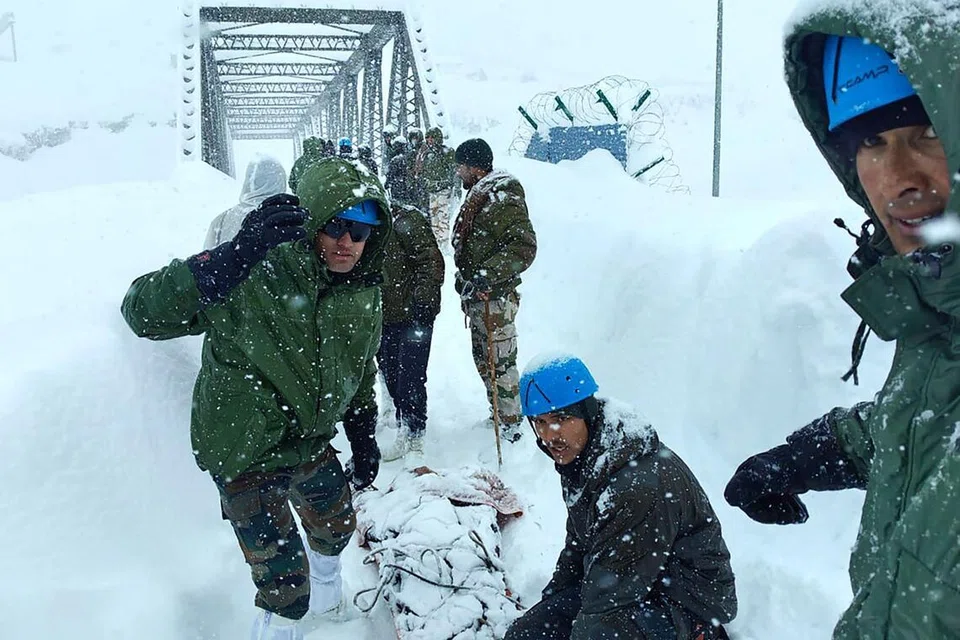

Forty-six construction workers were pulled out alive from metal containers on Sunday, after they were buried by an avalanche that hit the Himalayas in Uttarakhand.
They survived – some as long as nearly two days – as the containers in which they were living in had enough oxygen to sustain them until rescuers could dig them out, Indian media reported quoting officials.
Eight, however, died in the mishap. The workers were building a highway near Mana village, in Chamoli, near the northern border with China.
Two avalanches hit the camp within five minutes, hurtling eight containers and a shed down the mountain on Friday.
Despite the force of the blow, the containers retained enough oxygen to keep the workers alive for nearly 60 hours in below-freezing temperatures before they were saved on Sunday.
“The metal shelters saved most of them,” a senior rescue official told The Times of India. “They had just enough oxygen to hold on until we got them out.”
It took roughly 250 army and border police personnel, stationed nearby, to dig the workers out of the snow.
The army used a drone-based detection system and a rescue dog to assist in its search operations.
Photos from the scene show rescue teams using ice picks, shovels and a digger to uncover the trapped men.
Others show them carrying stretchers through a blizzard.
Many of the rescued workers are receiving treatment at hospitals in the state’s Joshimath town and Rishikesh city.
Mr Satyaprakash Yadav, a migrant worker from Uttar Pradesh who was among those rescued, said the “avalanche hit our container like a landslide”, according to a video released by the army.
“The container I was in broke apart when the snow hit, and it ended up near a river,” he said.
“We managed to get out on our own and reached a nearby army guest house, where we stayed overnight,” he added.
Mr Rajnish Kumar, a worker from Uttarkhand’s Pithoragarh town, said most of them were sleeping when the avalanche struck.
“When the snow hit the container, it sank about 60 metres down the mountain. The Army arrived quickly and rescued us,” he said.
His colleague Vipan Kumar thought “this was the end” when he found himself unable to move as he struggled for air under the thick layer of snow.
“I heard a loud roar, like thunder… before I could react, everything went dark,” he told the Times of India.
Avalanches and landslides are common in the upper reaches of the Himalayas, especially during the winter season.
Mana lies at an altitude of more than 3,200 metres. The minimum temperature in the area was down to -12 deg C last weekend.
Mr Dhan Singh Bisht said his son and nephew were alive only because of the prompt action by the relief teams.
“I am grateful to them,” he said.
Among the dead was Mr Anil Kumar, a 23-year-old who joined the construction team as a chef in October.
He had been due to return home on March 1, after postponing the trip on Feb 22.
“We video called him on February 27 and he complained about the weather,” his father Ishwari Prasad told The Indian Express.
That was a day before the avalanche. Initially, the family was told Mr Kumar was alive in hospital. In reality, he was dead and had been mixed up with someone else.
“He was supposed to be home,” his father said. “If only he had come.”