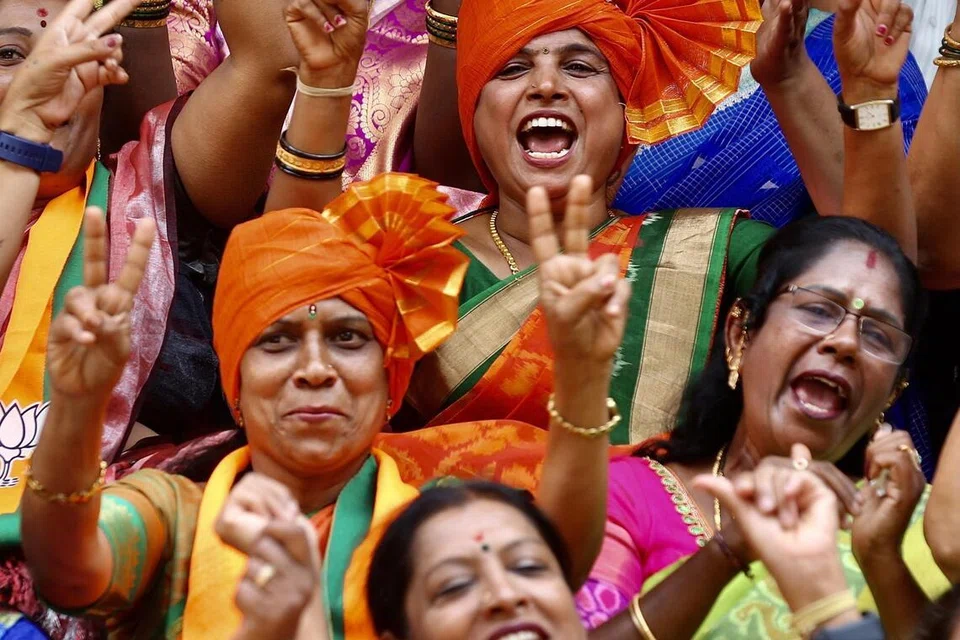
The ruling Bharatiya Janata Party’s (BJP) success in the Indian general elections was hardly ever in doubt.
Few would be surprised by the party’s victory this week, even though the BJP, led by popular Prime Minister Narendra Modi, lost seats to a stronger than expected opposition, which pushed back against his mixed economic record and polarizing politics.
After all, the massive demonetisation exercise of 2016, which was not exactly acclaimed as a success, failed to derail the BJP’s electoral prospects. Likewise, no great harm seems to have been done to the BJP by the government’s less-than-satisfactory handling of the coronavirus pandemic, which resulted in the second-largest migration in Indian history after the Partition of India in 1947 (the migration this time being that of poor workers in cities returning to their villages). Indians are a forgiving people.
The BJP, part of the National Democratic Alliance (NDA) coalition, managed to ride out whatever public sentiments went against it by holding on to two tenets.
The first tenet rests on what is broadly called Hindu nationalism (and its cognate concept, Hindutva). In one assessment, Hindu nationalism is “a political ideology which asserts that Indian national identity and culture are inseparable from the religion of Hinduism”. Hindutva, or Hindu-ness, is a political movement that co-opts the idea of Hindu nationalism to the goal of achieving a Hindu nationalist state in India.
The second tenet is development. According to the BJP’s website, when a political party talks of development, it often talks of roads, ports, GDP growth, stock markets, agriculture, exports and international trade, among other issues. To the BJP, however, development is all this and much more. At its core, the BJP’s concept of progress means Indians experiencing change that enables them to fulfil their potential.
Both tents have their roots in reality. One of the great faults of the Indian National Congress, the party of Indian Independence, was perhaps to underestimate the Hindu-ness of Hindu Indians in favour of an eclectically liberal idea of secularism derived from India’s encounter with the modernising colonial British.
That secular ideal was of course a desirable one morally; indeed, it was necessary, politically, to hold India together after the emergence of Muslim Pakistan following Partition. But Congress’ secularism arguably conceded too much to religiously restive minorities in India through policies of appeasement while withholding from Hindus an equal share of appeasement. The BJP redressed that. Hence its sway on the Hindu mind.
As for development, the BJP’s formula has succeeded in countering the Congress’ emphasis on state-led growth. That choice, too, was necessary in a poor country whose capital had been drained out by 200 years of British rule. The Nehruvian Model – named after Indian’s first prime minister Jawaharlal Nehru – emphasised the role of the state as the prime enabler of national economic growth.
Unfortunately, the British Raj turned into a Licence Raj where bureaucrats stifled private initiative, particularly entrepreneurship. The results were so obscenely clear by the beginning of the 1990s that the Congress government itself had to turn to privatisation and liberalisation as the answer to India’s economic woes. The BJP continued on the reformist trajectory.
The BJP developed a winning electoral formula on the basis of these two tenets: Hindu nationalism and private-sector development.
The election results show that the formula is not working as before. The opposition INDIA alliance, centred on a rejuvenated Congress and its regional allies, has made deep inroads into the corridors of electoral power that belonged overwhelmingly to the BJP and its NDA.
India is headed for a new balance. That balance will consist of two tenets as well.
First, whatever the faults of the secular liberal constitutionalism promoted by the Congress, Hindu nationalism alienates religious minorities, whose “no” votes in an election add to the number of discontents in the Hindu community itself.
Religious majoritarianism has clear limits in an ethnically diverse country that is also a democracy. Unlike in a theocracy or some other kind of autocracy, democracy has a penchant of bringing disparate but discordant voices together.
Second, the liberalisation of the Indian economy cannot be oblivious to bread-and-butter issues faced by ordinary Indians, particularly those who inhabit the vast agricultural heartland of what is still an overwhelmingly rural country. There is no macro-economics without micro-economics.
These two tenets – inclusive nationalism and inclusive economics – will determine the course of India in the coming years.
This should not come as a surprise. India has survived centuries of challenge from both within its borders and outside them because of its people’s capacity for imaginative thinking and ameliorative change.
It is up to the new government to encourage that capacity. At the end of the day, what matters is the voice of the people. Those who hear and amplify it win. Others are consigned to the silence of overtaken history.
By Asad Latif
The writer is a former Straits Times journalist.