Streets lined with beautiful flower pots, colourful paintings and posters of Indian Prime Minister Narendra Modi welcomed foreign leaders and delegates to New Delhi over the last weekend.
As thousands of people from across the globe arrived in the Indian capital for the G20 Leaders’ Summit on Sept 9 and 10, the Indira Gandhi International Airport operated with exceptional efficiency, giving every traveller a seamless experience.
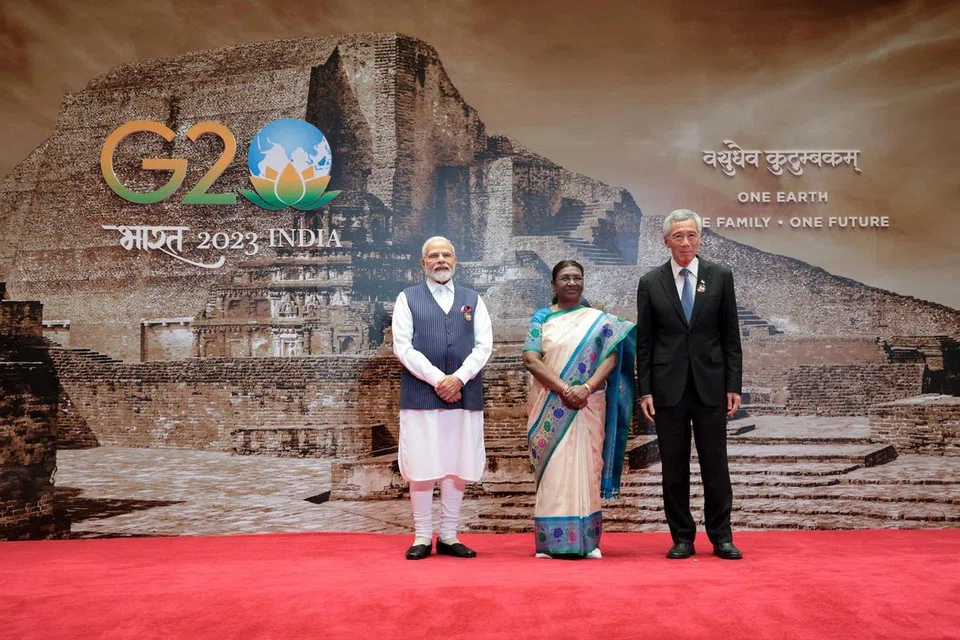
The leaders met at the new Bharat Mandapam, which featured a monumental 8.2m Nataraja statue that was made in Tamil Nadu.
Delegates were served sumptuous free-flowing vegetarian food.
At the event venue and all collaterals wereelsewhere, the designs incorporated the lotus – India’s national flower as well as the ruling Bharatiya Janata Party’s logosymbol.
The show-piece event not only focused on India as an important global power and Mr Modi as a significant world leader, but also served as a platform for the Indian PM to engage the domestic audience ahead of parliamentary polls next year.
The use of Bharat instead of India in the name tag in front of Mr Modi during the sessions created a buzz among the journalists seated at the media centre beside the Bharat Mandapam. They took out their phones and cameras to record the scene.
Days earlier, there was commotion in India when President Droupadi Murmu’s dinner invitation hadused the wordname Bharat instead of India.
Leaders and their spouses who attended the G20 Summit were treated to a dinner made with millets served on silver- and gold-plated dinnertableware, showcasing India’s rich tradition, culture and diversity.
India’s presidency of the G20 comes at a time of uncertainty, with the tensions between the United States and China as well as the war between Russia and Ukraine taking centre stage.
Amid these contentious points, India pulled off a successful summit, with a joint communique agreed upon by all members on the first day itself.
Through the year of India’s presidency, the Russia-Ukraine conflict has been a sticky point, with many doubting if India could get all together and make a joint declaration. Without condemning Russia for its actionswhat it did and not callingdescribing it as aggression, a communique permissible byacceptable to all parties was reached in seven paragraphs.
Singapore Prime Minister Lee Hsien Loong described the declaration, which spanned 10 chapters, as comprehensive and covering a lot of ground. “India had a very difficult job as president of the G20. The international environment is just uncertain,” he said.
“I think we did well to have a communique and a meeting where substantial issues were discussed and views aired, and a certain sense of the mood is created on many of these issues.”
The G20 also saw the landmark addition of its 21st permanent member – the African Union.
The organisation representing 55 African countries will join the Group of Twenty, which meets to discuss economic and political issues as well as climate change and sustainable energy.
India’s theme for its G20 presidency was Vasudhaiva Kutumbakam (Sanskrit for One Earth, One Family, One Future). Much emphasis was accorded toput on food security, climate change and sustainable energy at the summit.
Speaking at the first session, titled One Earth, PM Lee put forth three ways in which Singapore is tackling climate change.
“We believe new technologies, financing models and markets offer us hope. All these require international collaboration, which the G20 can and should provide leadership for,” he said.
Mr Lee called for like-minded partners to work together to diversify Singapore’s power mix and realise the potential of low-carbon hydrogen, mentioning that Singapore has developed a National Hydrogen Strategy to green its power sector.
He also reiterated the need to catalyse more private funds at scale to crowd-in and complement public capital as trillions of dollars of annual investments are required for the world to achieve net-zero emissions by 2050.
Emphasising the need for governments to work together to create a conducive environment for the decarbonisation investments, PM Lee stated Singapore’s support for multilateral approaches towards mitigation goals.
His speech at the third session, titled “One Future” was also a call for multilateralism and the need to refresh the mandate and laws of multilateral organisations, such as the World Trade Organization, to keep to the times.
“WTO rules need to keep pace with digital transformation and remain relevant for the modern economy,” said PM Lee, urging that the G20 provide a “strong impetus to advance negotiations on WTO reform, in particular to restore a fully-functioning dispute settlement system as soon as possible”.
The leaders also visited Raj Ghat to pay their respects at the Mahatma Gandhi memorial and participated in a tree-planting ceremony.