A Bengaluru man’s dying allegation on social media that he had been falsely accused of domestic violence by his wife has gone viral, and cases like his are now being championed by a small group of men’s rights activists (MRAs) in India.
On Dec 8, Mr Atul Subhash, 34, a deputy manager in an Indian conglomerate in Bengaluru, uploaded an 80-minute video accusing his estranged wife Nikita Singhania and her family of filing false reports of cruelty and dowry harassment against him to extort money.
Early the next morning, the Bengaluru police found Mr Subhash dead in his apartment, with a piece of paper on his chest with the words “justice is due”.
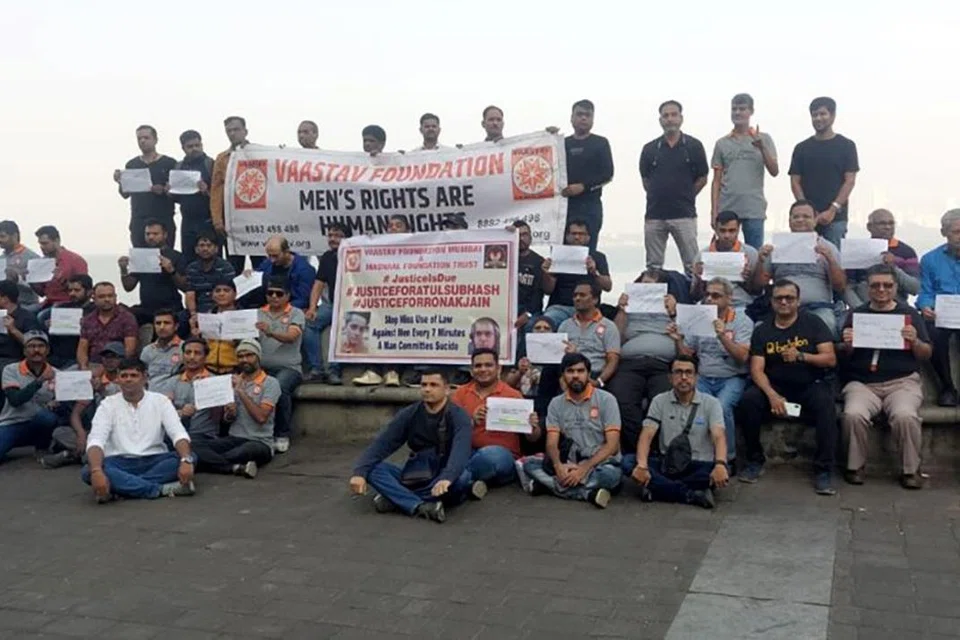
On Dec 15, Indian MRAs held protests and public memorials in at least five cities across India, demanding that husbands like Mr Subhash be protected from the alleged misuse of laws that are supposed to shield women against dowry and domestic violence.
In Bengaluru’s Freedom Park, a man dressed as a bride with horns and vampire teeth held a placard that said in the Kannada language: “Stop men’s suicide! Stop false cases!” The walls in the park had posters with a line from Mr Subhash’s video: “Dump my ashes in the gutter outside the court if my harassers are not punished.”
Karnataka Home Minister G. Parameshwara said the investigation into Mr Subhash’s suicide will look into why his wife “kept filing cases against him”.
He added: “We always talked about women’s rights. (Mr Subhash’s) case has exposed men’s rights. It’s a debate (happening) throughout the country.”
MRAs claim that men in India are oppressed by marriage laws and women who file false reports against them. They identify the judicial system and organised feminist groups as the primary culprits.
“The judicial and police ecosystem is not humane to men. It does not recognise men’s vulnerabilities,” said Mr Anil Kumar, co-founder of Save Indian Family. “It forces husbands and men to suffer for years under false domestic violence cases and extortionist alimony demands.”
Mr Kumar confirmed that Mr Subhash had frequented the weekly meetings of Save Indian Family in Bengaluru since his wife moved out with their four-year-old son.
From the early days of scattered solitary actions in the 1990s, MRAs have emerged in India as a well-organised social movement, with careful outreach through social media, legislative lobbying and street action.
MRA groups in Bengaluru and Mumbai said at least 150 men turn up at their meetings every week, but their social media handles have hundreds of followers.
Professor Srimati Basu, chair of the gender studies department in the University of Kentucky in the US, said: “The men’s rights movement has not had big systematic actions in the last 10 years compared with the decade before.
“But its concerted communication and grassroots meetings in the past decade have made a dent in public and legal discourse.”
She added: “Atul Subhash’s death, though unfortunate and unexpected, seems suddenly to have become a catalysing event, a remobilising moment for the men’s rights movement.”
Rohini Mohan for The Straits Times