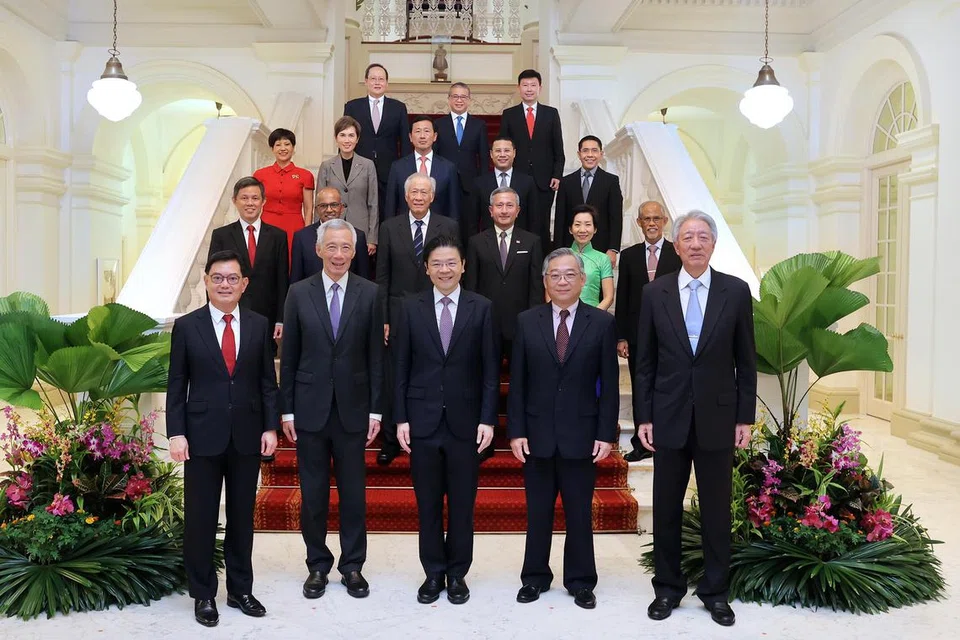
On May 15, Prime Minister Lee Hsien Loong handed over the reins of national leadership to his erstwhile deputy Lawrence Wong.
The handover ceremony was as sombre as it was simple, seamless in both substance and symbolism.
Against the background of a beautifully-lit Istana on a peaceful Singapore evening, guests assembled on the lawn and heard President Tharman Shanmugaratnam speak before Mr Wong and his ministers were sworn into office.
The President noted that the appointment of Mr Wong as Mr Lee’s successor marked a smooth and orderly transition of political power in Singapore.
It was only the third in Singapore’s six-decade history, he noted, adding: “No lengthy defence is needed for this because it has worked well for Singapore.
“It has preserved political stability and allowed the government to plan for the long term, while enabling a new team to adjust policies to fit the changing times.”
Mr Tharman said of Mr Wong: “He will be his own person, with his own approach to building consensus and finding the best way forward for the country. And he will no doubt do so to his own rhythm and beat.”
The grace and poise of the occasion demonstrated the political balance that Singapore has found since the transition in 1990 from the nation’s founder Lee Kuan Yew to his successor Goh Chok Tong, who in 2004 left the country in the hands of a prime minister who is doing the same now to a person whom his fourth-generation (4G) peers view as the best person to lead Singapore.
Much is at stake in this handover.
Testimony to (now) Senior Minister Lee Hsien Loong’s economic leadership, Singapore’s domestic product per capita more than doubled from $46,664 in 2004 to $113,779 in 2023.
A go-for-growth strategy was responsible for this remarkable transformation. However, growth comes at a price. Income gaps widened, creating public disquiet.
That led the Government to invest its energies in redistribution programmes such as ComCare, which was launched in 2005 to bring support schemes together; and Workfare in 2007 to top up the wages of lower-income workers.
The Progressive Wage Model was formulated to lift the wages of those at the bottom of the economic ladder, while MediShield Life and CareShield Life provided financial assurance for those who need long-term care.
Reflecting the democratic socialist principles that brought the People’s Action Party (PAP) to power in 1959, Singapore moved to the Left under Mr Lee.
Mr Wong will no doubt continue the process. He would have to balance the needs of the population – particularly its most economically vulnerable segments – with the national exigency of benefiting from globalisation, which seeks to create a single global market eventually.
The problem with globalisation is that it produces first-world, second-world and third-world economies within nations even as it integrates them without, by softening economic borders between them.
No political system can last for long if it is trifurcated economically.
The upcoming unemployment benefit scheme, the need for which the government previously dismissed, is an example of how the benefits of globalisation can be retained while addressing its downside, including unemployment caused by economic dislocation.
If the handover had a motif, it was the necessity of change within continuity. In his speech at the Istana, Mr Wong said that he would never settle for the status quo.
“I will always seek better ways to make tomorrow better than today,” he added.
Even as he spoke, the evening wore on. The Istana looked more beautiful than ever.