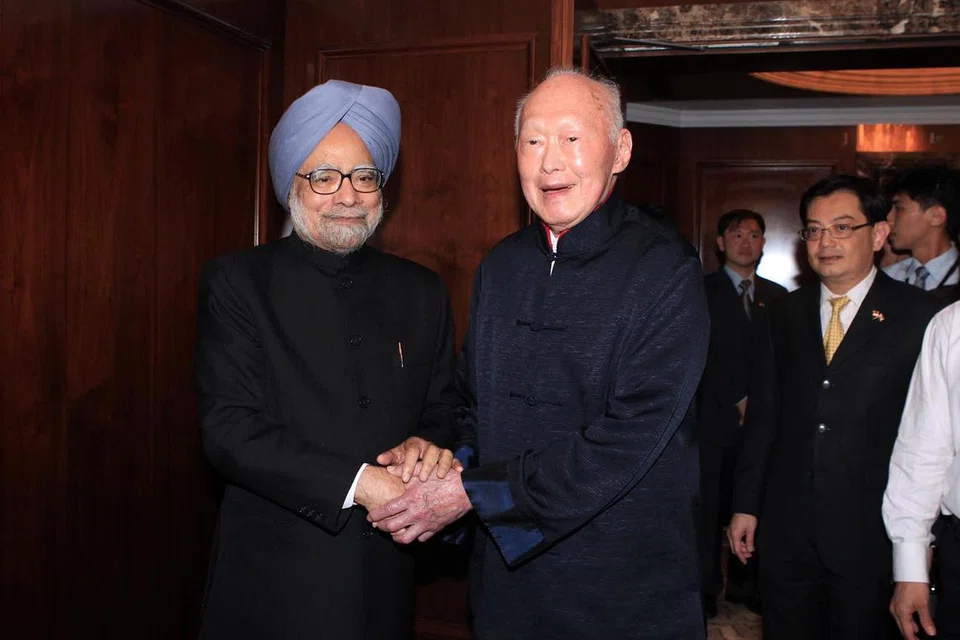

Former Indian prime minister Manmohan Singh, who died of health issues on Dec 27 aged 92, was arguably the first Indian leader to lay the foundation for close ties with Singapore.
In 1994, Mr Goh Chok Tong, who was then Singapore’s prime minister, first spoke about setting off a “mild India fever” in Singapore.
It was triggered by Dr Singh, as finance minister, unshackling India’s economy from the “licence Raj” (a pejorative for the system of strict government control and regulation of the Indian economy from the 1950s to the early 1990s) two years earlier.
Dr Singh, who was prime minister from 2004 to 2014, described ties with Singapore as “warm and friendly”, shortly after giving then-Prime Minister Lee Hsien Loong a ceremonial welcome in New Delhi in 2005.
“Singapore has consistently been bullish on India’s reform process ever since it started (in 1991) and we appreciate this endorsement,” he said. “With the Comprehensive Economic Cooperation Agreement (CECA), Singapore can act as a window into India, an India which is just beginning to realise its immense growth potential.”
CECA, which was signed in New Delhi on June 29, 2005, paved the way for a closer engagement between India and Singapore.
Though in recent years a section in Singapore has seen it as having mainly facilitated Indians to take up jobs in Singapore, the agreement led to trade booming between the two countries.
While major Singapore companies such as DBS Bank, Sembcorp, CapitaLand, Singapore Airlines, Singtel and Temasek have thrived in the Indian market, the agreement has helped India attract foreign direct investments from Singapore and open the doors for further business links with Asean countries.
“The signing of CECA was very significant,” said Mr Girija Pande, who was then the chairman of the Confederation of Indian Industry’s Singapore chapter and attended the ceremony at Hyderabad House in New Delhi. “Dr Manmohan Singh was clearly the architect. He wanted open trade relationships with every country and saw the CECA with Singapore as a test for future Indian Free Trade Agreements.”
CECA was the first comprehensive economic agreement Singapore signed with a South Asian country.
“Dr Manmohan Singh considered Singapore a close friend and centre of what the then-Indian prime minister Narasimha Rao coined India’s Look East Policy,” said Mr K.V. Rao, a former resident director, Asean region, of Tata Sons. “He had great respect for Singapore and its development model, and during his visits to the island in 2007 and 2011 emphasised the need for closer cooperation and strengthening of the bilateral relationship.”
In November 2011, Dr Singh made his first bilateral visit to Singapore as prime minister and said the city-state had contributed much to India’s progress. “Ours is a partnership that stands on the foundation of shared values of pluralism, secularism and democracy, and convergence of our perspectives on regional and international issues,” he said.
During that visit, Dr Singh unveiled a “Friend of our Shore” marker and bust of India’s first prime minister Jawaharlal Nehru at the Asian Civilisations Museum – on a green stretch along the Singapore River.
Before that, Dr Singh had visited Singapore in 2007 for the ASEAN summit, where he also pushed for greater investment and technology flows from Singapore.
Mr Lee, who is now Senior Minister, said in a Facebook condolence post on Dec 28 that he had known Dr Singh since they were both finance ministers and had met him many times over the years, most recently in 2018, when Asean leaders visited New Delhi for Republic Day. “I will always remember his warmth and kindness, as well as the friendship he had for Singapore.”
Prime Minister Lawrence Wong, in his letter to Indian Prime Minister Narendra Modi on Dec 28, said the relationship between Singapore and India grew significantly under Dr Singh’s stewardship.
“It (CECA) was a milestone in our relations and laid the foundation for the strong economic partnership we enjoy today,” PM Wong said. “Under his leadership, India joined the East Asia Summit in 2005 and actively supported Asean’s efforts in building a stronger regional architecture.”
Agrocorp International chairman and managing director Vijay Iyengar said it was Dr Singh’s vision and determination that helped India forge close ties with Singapore.
“Dr Manmohan Singh, a noted economist, knew economic trends well and saw Singapore as a gateway to Asean,” said Mr Iyengar, who was part of a business delegation from Singapore which met Dr Singh in New Delhi in 2003 when he was the leader of the opposition. “He was humble and cordial and looked forward to trade flourishing between India and Singapore.”
Mr Malminderjit Singh, chairman of the Sikh Advisory Board and a former journalist, also found Dr Singh “very approachable” when he met the then Indian prime minister as part of his media assignments in 2012 and 2013.
“Mr Singh was soft-spoken, patient and kind, said Mr Malminderjit. “His intellect was clear in all of his responses and engagements. He had a clear mind and vision on policies, especially economic growth and development.”