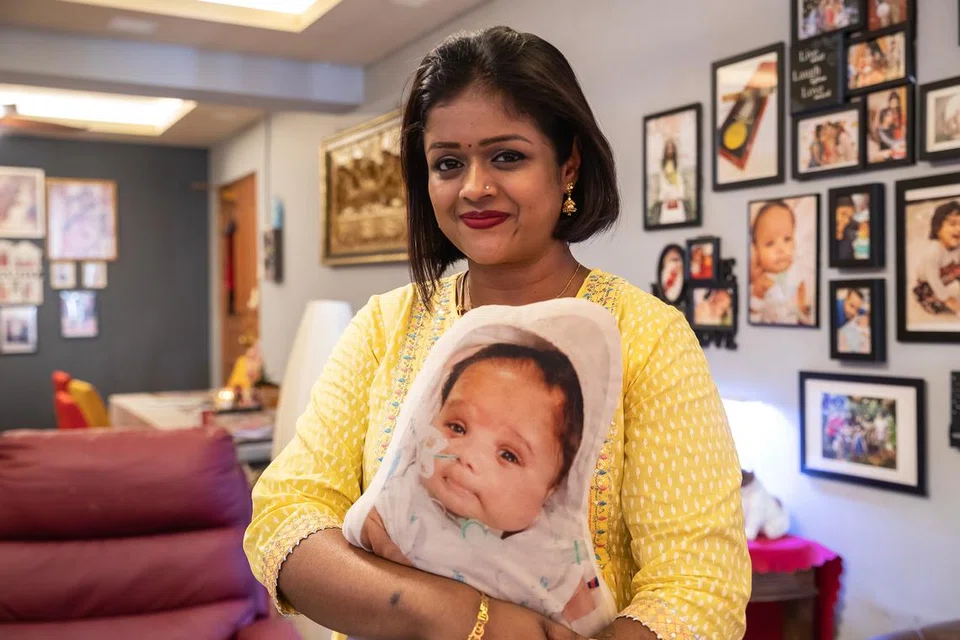

Ms Elizabeth Meera Palgunan clutches a bolster imprinted with a life-sized likeness of her infant son Adam as she sits down for our interview at her Woodlands Circle flat.
In the middle of the living room is a shrine where garlands drape over a metre-high poster of Adam, next to an assortment of clothes, trinkets and baby accessories.
It’s been four years since the death of her son, but the 41-year-old Meera keeps his memory alive every year on Mother’s Day and various other occasions.
In her mind, she says, Adam will always be six months old.
“Adam was my husband’s first child and the first grandchild for his parents,” said Ms Meera, who has a 17-year-old daughter from a previous marriage.
“Nothing was amiss during my pregnancy. My family were eagerly preparing for his birth, and friends and loved ones were buying clothes,” she recalls.
But when Adam was born on Oct 16, 2019, doctors soon realised he was not breathing normally. A trachea had to be inserted into his throat to assist his breathing.
He was later diagnosed with congenital laryngomalacia, a condition where the soft, immature cartilage of the larynx collapses inward during inhalation, causing airway obstruction.
Adam was afflicted by other prenatal conditions too, including low blood pressure in the liver. He also had to be fed milk via tubes.
Requiring constant hospital care, Adam was treated at one of the Ronald McDonald House Charities Singapore family rooms, a facility set up within National University Hospital for critically ill children and their parents.
Ms Meera recalls there were about 20 sets of parents staying at the facility.
“Some children recovered while others didn’t. We were witnessing both sets of reactions from parents, wondering which outcome would happen for us.”
Soon after, circuit breaker measures reduced the number of parents allowed to stay in the facility.
“While my husband could visit me, he could not stay over,” Ms Meera says. “If anything had happened in his absence, I would have been all alone.”
She remembers her husband, Bala Murugan Masapsami, 46, refusing to carry his infant son at the time, proclaiming that if he were to carry Adam, “it would be to carry him home”.
Eventually he relented, carrying the baby on the last day he was alive. “Adam was holding onto his life for that moment,” Ms Meera says with tears glistening in her eyes.
Adam died on May 2, 2020.
Adjunct Associate Professor Jacqueline Ong, a senior consultant in the division of paediatric critical care at NUH, said congenital laryngomalacia can be severe in some cases, leading to significant breathing difficulties, feeding problems and poor weight gain.
“Adam’s case was exceptionally severe where the abnormal softening of the airway (malacia) extended to his lower airways as well, creating profound difficulty in breathing,” she said.
Ms Meera describes clearing away Adam’s clothes and the gifts bought for him as a particularly painful period.
“I do regret disregarding my mother’s advice not to buy so many clothes before his birth,” she says.
“But I was also advised by my elders not to take pictures of the newborn. Had I not done so, I would barely have anything to remember him by.”
She was despondent for a long period after her son’s death, and it took a while for her to steer her focus back to her daughter.
“At the time, I was unable to be there for my daughter during her PSLE, and many other milestones. All my attention went to Adam.”
Even today, as evinced by the living room altar and the bolster with Adam’s photo, Ms Meera can’t fully let go of her son’s memory.
On occasions such Mother’s Day and Adam’s birthday and death anniversary, she hosts family and friends to commemorate her late son.
“Some people try and comfort me by saying he’s in a better place, but can there be a better place for a child other than here with his mother?”
Still, Ms Meera says she tries not to be stuck in the past, and has recently turned to Facebook groups where she can provide a listening ear for and give advice to grieving mothers.
“We wanted to teach Adam and raise him into a fine young man. In the end, what he taught us about the value of life was greater,” she says.