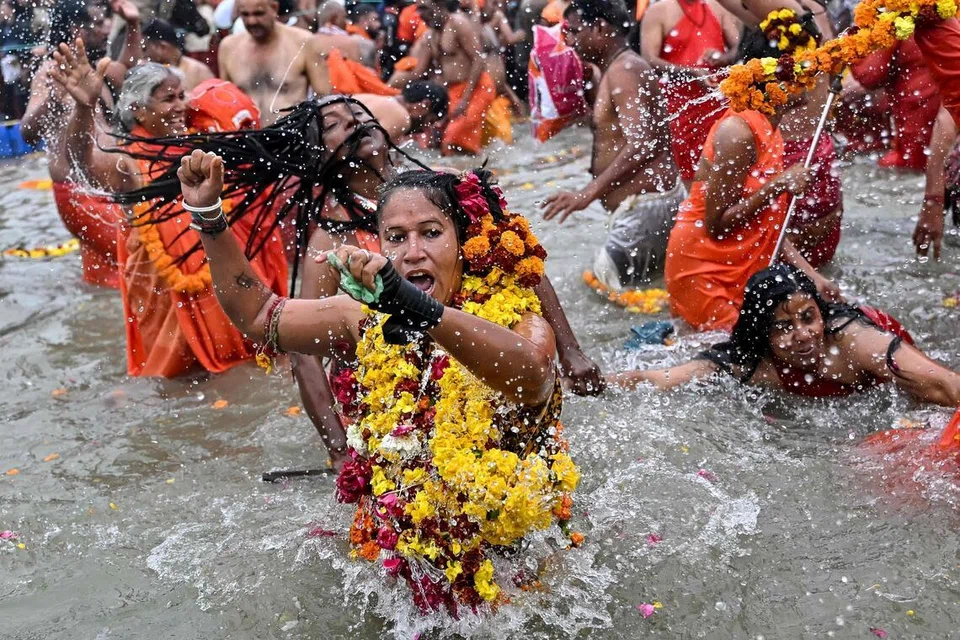

Naked Hindu ascetics smeared in holy ash charged into the waters of sacred rivers in India on Tuesday, part of a large crowd of 35 million devotees who took the holy dip on the second day of the Maha Kumbh Mela, or Great Pitcher Festival, seeking absolution from their sins.
The “royal bath” of the ascetics is a key part of the event, held every 12 years in Prayagraj, Uttar Pradesh, because Hindus believe it confers salvation from the cycle of birth and death, in addition to the absolution of sins.
Thousands of devotees watched the ascetics take a dip in freezing waters, dreadlocks flying and clad only in holy beads, though some carried tridents, spears or maces, after a procession to the water accompanied by chants and the beat of drums.
“The crowd today was fantastic,” said ascetic Rakesh Kumar after his holy dip at the confluence of the rivers Ganga, Yamuna and the mythical Saraswati. “We need people to follow our faith and participate in festivals like this.”
On Tuesday, 35 million people “earned the holy benefit” of taking a dip, Uttar Pradesh Chief Minister Yogi Adityanath said, thanking authorities for their efforts to maintain law and order.
Nearly 15 million people, more than double the six million population of the city, had taken a ritual dip on Monday, when the six-week festival, expected to attract more than 400 million people, began.
The Kumbh originates in a Hindu belief that four drops of the nectar of immortality fell to earth, one in Prayagraj, during a battle between the god Vishnu, known as the Preserver, and demons over a golden pitcher holding the elixir.
The battle spanned 12 days in divine time, equivalent to 12 human years, and the drops of the nectar fell at four places – Prayagraj, Haridwar, Nashik and Ujjain – which became the venues for the Kumbh Mela.
Here, devotees from different Hindu sects, or Akharas, join in grand processions to take the “Shahi Snaan” or royal bath, when they take a dip in the sacred river.
Every 12 years, the festival is described as “maha” or great, as the timing is considered to render it more auspicious, drawing bigger crowds.
This year’s Maha Kumbh is extra special because the sun, moon, Jupiter and Saturn are in alignment after 144 years.
The grand spectacle attracts millions who come not just for the ritual, but also hoping for a glimpse of thousands of ascetics, often clad in traditional saffron attire, who immerse themselves in near-freezing temperatures.
In the past, celebrities such as actor Richard Gere, movie director David Lynch and Tibetan Buddhist leader Dalai Lama have attended the Maha Kumbhs.
This year, personalities from all over the globe are expected to attend, with some already spotted in Prayagraj.
Apple founder Steve Jobs’ wife Laurene Powell Jobs was spotted at the ashram of her guru, Swami Kailashnand Giri, the Acharya Mahamandleshwar of Niranjini Akhara.
The American businesswoman is being accompanied by a 40-member team.
Bollywood stars such as Amitabh Bachchan, Ranbir Kapoor and Alia Bhatt are also expected to attend the spiritual festival, along with renowned singers Anup Jalota, Shankar Mahadevan, Kailash Kher, Kavita Krishnamurthy, Hariharan, Mohit Chauhan and Shaan.
Devotees from Japan, Russia, South Korea, Europe and other nations have already made the trip to India to experience the 45-day festival.
In 2017, UNESCO placed the Kumbh Mela on its listing of the Intangible Cultural Heritage of Humanity.
A showcase mix of religion, spirituality and tourism like no other in India, the event offers a test in crowd management for authorities in the world’s most populous country who must balance arrangements for millions while retaining its sanctity.
Organising the mammoth event gives authorities a bigger challenge every time. In contrast, about 1.8 million pilgrims attended the Haj pilgrimage in Saudi Arabia last year.
More than 150,000 tents have been set up across 4,000 hectares, or the size of 7,500 football fields, to accommodate visitors, and nearly as many toilets.
About 50,000 security officers are also on guard to ensure the event, touted to be the world’s largest gathering of humanity, goes off smoothly.
In the past, the gathering has been visible from space, with India’s space agency releasing photographs of it in 2019.
The budget for this year’s festival is an estimated US$800 million and analysts estimate it will boost economic growth by US$35 billion.
Reuters