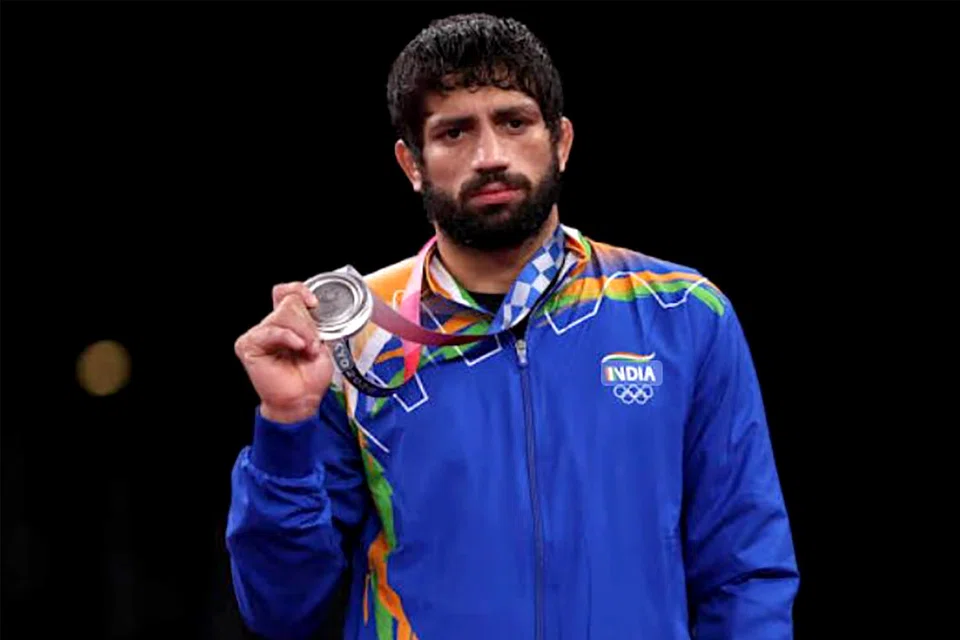
Ravi Kumar Dahiya won the world’s respect with a silver medal at the Tokyo 2020 Olympics. Four years on, the wrestler from Haryana’s Nahri village is reshaping his craft, his body, and his ambitions for a return to the Olympic podium at Los Angeles 2028.
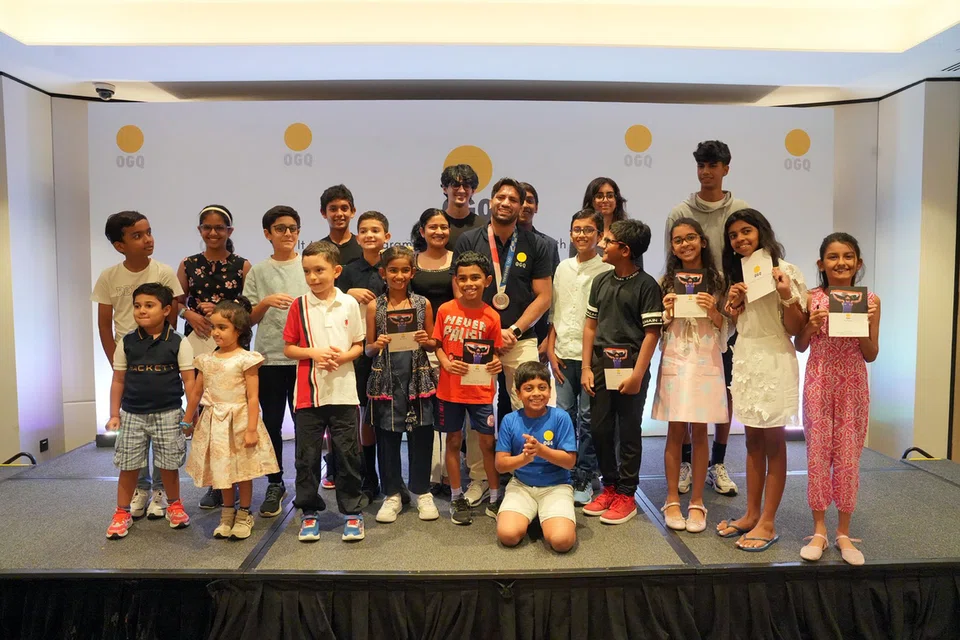
In Singapore for an event with Olympic Gold Quest (OGQ), the non-profit that supports elite Indian athletes, Ravi spoke about growth after glory, the discipline behind his resurgence, and how India can turn a wrestling tradition into a medal machine.
“You have to be a lifelong learner,” he said in an exclusive conversation. “The moment you stop feeling the need to learn, stagnation sets in. I keep training, keep competing, sparring with the best and learning from them.”
Ravi’s biggest call has already been made: a move up from the 57kg class in which he became Olympic silver medallist.
Injuries and the toll of repeated weight cuts convinced him to compete heavier – first at 61kg (a non-Olympic category) and now towards 65kg, the nearest Olympic class for LA 2028.
“With age, 57kg becomes very troublesome,” he explained. “Going higher allows better conditioning and more effective training.”
Technically, that demands recalibration. The 65kg field features rangier athletes with different tempos and ties. “Techniques and strategies evolve quickly,” Ravi said. “My coaches and I keep updating training to match international standards – new styles, new tactics.”
Ravi has long kept distractions at arm’s length. “The Olympics are time-bound,” he said. “This is the period I must dedicate to training and performing. Social gatherings, social media – keep them minimal.”
He still trains out of Delhi’s Chhatrasal Stadium, the crucible that produced Indian greats like Sushil Kumar and Yogeshwar Dutt. “Chhatrasal is not just training – it’s a way of living,” he said. “Every athlete there sacrifices a lot; that discipline builds champions.”
He acknowledges controversies around the Indian wrestling federation but refuses to be drawn. “I stay focused on my preparation and improvement,” he said.
Alongside the grind, Ravi serves as an assistant director of sports with the Delhi government, but he’s clear where his energy goes: “Wrestling first – especially LA 2028.”
Ravi’s rise still reads like a parable of persistence. Born to a farming family, he was initiated into kushti (wrestling) by his father, who ferried milk and fruit daily to Delhi to keep his son nourished through brutal training cycles.
Early injuries and iron deficiency did not stop him: junior silver (2015), U23 world championship silver (2018), senior world championship bronze (2019), a perfect Pro Wrestling League season, three straight Asian Championships golds (2020-22), Commonwealth Games gold (2022), and then Tokyo silver – a run powered by technique, pace and a refusal to concede.
That Tokyo semi-final, where he reversed a 2-9 deficit to pin Kazakhstan’s Nurislam Sanayev in the dying seconds, became instant folklore. The final against Russian two-time world champion Zaur Uguev ended in defeat, and Ravi’s first words were as revealing as the medal: “I didn’t come for silver.” That hunger still frames his goals.
Injuries halted his Paris 2024 bid and opened the door for fellow Chhatrasal product Aman Sehrawat, who won Olympic bronze at 57kg.
There is no bitterness. “People might be rivals on the mat, but outside we are all humans,” Ravi said. “Aman is like a brother. I told him: Remember your strengths, don’t get drawn into opponents’ tactics.”
The result only sharpened Ravi’s own target. With 65kg the likely path for LA 2028, the next four seasons are about building strength, ring minutes, and tactical versatility – one step at a time.
OGQ CEO Viren Rasquinha, the former India men’s hockey team captain, has watched Ravi for 15 years. “If you talk grit, resilience, discipline, commitment – Ravi is off the charts,” Viren said. “That’s why he’s won everything there is to win, including an Olympic silver. He’s an amazing role model.”
Viren stresses patience. “Wrestling punishes impatience – so we’re taking it one day at a time, managing loads and injuries.”
The pipeline matters too: OGQ supports 160 young athletes aged 9-19, planning not just for 2028 but 2032 and 2036.
Viren singled out rapid risers across sports – evidence that a system, not just a star, is in motion.
Singapore, he added, is already a meaningful partner: “We currently raise around Rs7 crore (S$1 million) per annum from Singapore and hope to multiply that. Every day of an athlete’s journey needs support.”
Ravi understands his symbolic weight in Indian sport – and the responsibility that comes with it. “Wrestling is strong in Haryana, but across India we need better infrastructure, more support, and awareness about diet and training,” he said. “If we fix these, we can consistently win medals.”
As for the trappings – fame, films – he laughs them off: “I just want to focus on wrestling. If a biopic happens later, fine. The goal is simple: bring glory to India through gold medals.”
There is humility in how he frames his journey – an awareness that the past is a platform, not a pedestal.
The boy from Nahri who once chased milk and mat time is now the man recalibrating for a new weight, a new Games, a new chase.
The method hasn’t changed: keep learning, keep competing, keep showing up.
“Wrestling is not just a sport – it’s a way of living,” Ravi said. “It forces you to keep going, regardless of the odds.”
For Indian wrestling – and for a nation eyeing glory at LA 2028 – that mindset might be the most valuable medal of all.