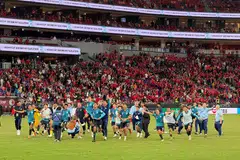
Singapore football has waited decades for a night like Nov 18 in Hong Kong.
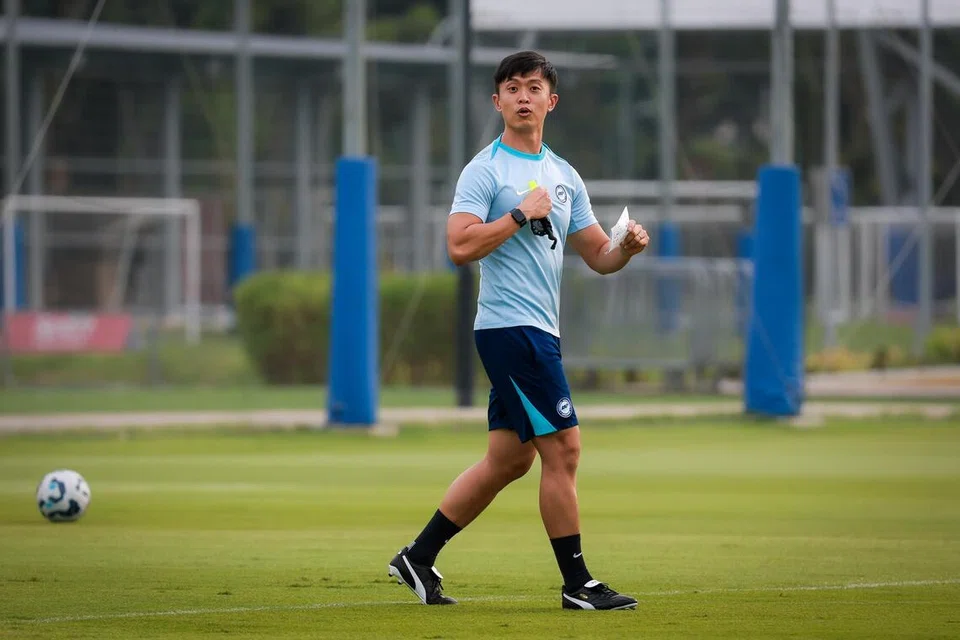
When the final whistle went at Kai Tak Stadium and the Lions sealed a 2-1 comeback win to qualify for the 2027 AFC Asian Cup on merit for the first time, one name quietly moved to the centre of the national conversation: Gavin Lee.
Interim or not, the 35-year-old coach is now the man who led Singapore to its biggest modern football achievement.
The question is no longer whether he can handle the job – it’s whether the Football Association of Singapore (FAS) dares to back the coach who has already delivered history.
The coach everyone is suddenly talking about
When FAS president Forrest Li said he wanted the identity of the next national coach to be a “dinner table topic in every home”, he probably imagined a big foreign name, with a glittering CV and glossy presentation deck.
He has that moment now – but the name on everyone’s lips is not Cannavaro, Kewell or Montgomery.
It’s Gavin, the former national youth player who realised early he wouldn’t make it as a pro, and instead poured his life into coaching.
Gavin has already done what no foreign coach has managed:
• Kept Singapore unbeaten away in a brutal qualifying run through Bangladesh, India, and Hong Kong.
• Stitched together a team that came from behind twice – in Goa and Kowloon – against higher-ranked opponents in hostile atmospheres.
• Turned a nation that had grown numb to disappointment into one that stayed up late for watch parties and flooded social media with pride.
You don’t stumble into that. You build it.
Continuity that became belief
It’s important to remember that this Asian Cup journey did not start with Gavin. It began under Japanese coach Tsutomu Ogura, who brought professionalism, tactical structure, and belief back into the camp – and who personally chose Gavin as his assistant.
For about 15 months, Gavin worked alongside Ogura, running briefings, shaping game plans and learning what international football demands.
When Ogura stepped down for personal reasons in June, Singapore did not collapse – because the football ideas were already embedded and Gavin knew them inside out.
Under him, the Lions:
• Kept the same intensity and compactness that Ogura introduced.
• Retained a clear tactical identity – purposeful, possession-based, but pragmatic when needed.
• Showed a remarkable emotional resilience: responding to gut-wrenching setbacks (like the last-minute equaliser against India at home) with character rather than collapse.
That kind of continuity is rare. And it is exactly why so many people now argue that replacing Gavin before the Asian Cup Finals would be, at best, unnecessary risk – and at worst, self-sabotage.
Why changing horses now is dangerous
Football writer Gary Koh put it bluntly: History shows that ripping up a successful blueprint just before a major tournament can be disastrous.
He referenced the 2008 AFC U-16 Championship, where Singapore’s qualifying coach was replaced and the team’s style and confidence were overhauled. The result: Three heavy defeats and a group-stage exit, with players struggling to adapt to new demands.
Gary’s point is simple:
• The coach who qualified the team should be trusted to lead the team at the Finals.
• Continuity in tactics, staff, and selection matters more than the glamour of a new name.
Even if Singapore are underdogs in Saudi Arabia, a tight, united squad with a coach they trust stands a far better chance of delivering three credible, proud performances.
Long-time fan Raspal Sidhu echoed that sentiment, saying Gavin has “galvanised the team in more ways than one” and should be allowed to lead the Lions in 2027 for the sake of consistency and momentum.
A modern, player-centric Singapore coach
What sets Gavin apart is not just that he’s Singaporean; it’s what kind of Singaporean coach he is.
His background is unusually rich for someone so young:
• Former Singapore U-15 teammate of Hariss Harun and Izwan Mahbud, he understood early that his ceiling as a player was lower – and turned fully to coaching.
• While studying sports science at Nanyang Technological University, he started “serious coaching” with Junior Soccer School and League, taking up to 14 sessions a week and earning his licences.
• He cut his teeth under coaches like English UEFA Pro Licence manager Alex Weaver, observing elite training environments in England.
• At 28, he became the youngest head coach in the Singapore Premier League with BG Tampines Rovers, winning the Singapore Cup and building a reputation for intelligent, possession-based football.
Ask those who’ve worked with him and certain traits keep coming up:
• Calm under pressure, even when stadiums are hostile, and stakes are high.
• Emotionally intelligent, knowing when to put an arm around a player and when to deliver the “hairdryer treatment” – as he hinted he did at half-time against India.
• Clear communicator, with tactical ideas that are detailed but digestible.
• Player-centric, obsessed with improving individuals, not just organising systems.
National captain Hariss has described matches against Gavin’s Tampines as “chess games”, praising his clarity and his commitment to his style while still adapting to opponents.
This is exactly the profile modern national teams look for: not just a big name, but a big brain with the emotional range to handle egos, expectations, and setbacks.
Better than a foreign name on a brochure?
Let’s be honest: a foreign coach with an impressive CV can create a buzz. Names like Cannavaro or Kewell are attractive. They sound like “progress”.
But Singapore has been here before – multiple foreign coaches, varying philosophies, constant resets, and a national team that never quite found a long-term identity.
With Lee, the Lions have:
• A coach who already understands local realities – the player pool, the league’s limitations, the psychology of Singaporean footballers and fans.
• A shared language and culture – he doesn’t just speak English; he speaks Singaporean.
• A tangible connection to the players’ journey; he was there in the dressing room when they suffered, and he was there on the pitch when they wept with joy in Hong Kong.
• And crucially: he has already shown that he can take a team of “not good enough” and “over the hill” players, blend them with youth, and make them punch above their weight.
That is coaching.
“Gavin has given the Lions a clear identity in record time. You can see the structure, belief, and the way players respond to him,” said Navin Nambiar, managing director of social football X-League and adjunct lecturer at Nanyang Polytechnic. “He understands Singapore football, develops young talent, and has now led us to our first Asian Cup on merit – proof he can take this team forward.
“Given his club success and how naturally he’s settled into the national setup, making him permanent coach would finally give us the continuity we’ve been missing.”
The bigger picture: What message do we want to send?
If Li truly wants football to be a regular dinner-table topic, then the decision on the next coach must send a clear, inspiring message.
Appointing Gavin permanently would say:
• We reward results, not just résumés.
• We trust our own talent when they prove themselves.
• We believe in continuity, identity and long-term development, not just quick fixes.
Replacing him now with a foreign “name” would risk undoing the culture he has built – and signal to every young Singaporean coach that even historic success isn’t enough to earn real trust.
“I strongly believe Gavin should be appointed permanent national coach. In his short interim spell, he has brought professionalism, tactical clarity, and a calm authority that have restored structure, belief, and identity to the Lions,” said superfan and author of the book ROAR: Football Legends of Singapore A. Thiyaga Raju.
“He connects with players, develops young talent and inspires discipline and purpose on the pitch. His leadership offers stability, vision, and real hope for sustained progress – and he deserves the chance to lead Singapore forward with pride and unity.”
Gavin himself has stayed humble, insisting the team and country come first. “The national team is bigger than any individual,” he said. “This milestone we’ve achieved is for everyone; it’s for Singapore.”
That humility, combined with proven tactical nous and the respect of his players, is precisely why he should be the one to lead the Lions out in Saudi Arabia.