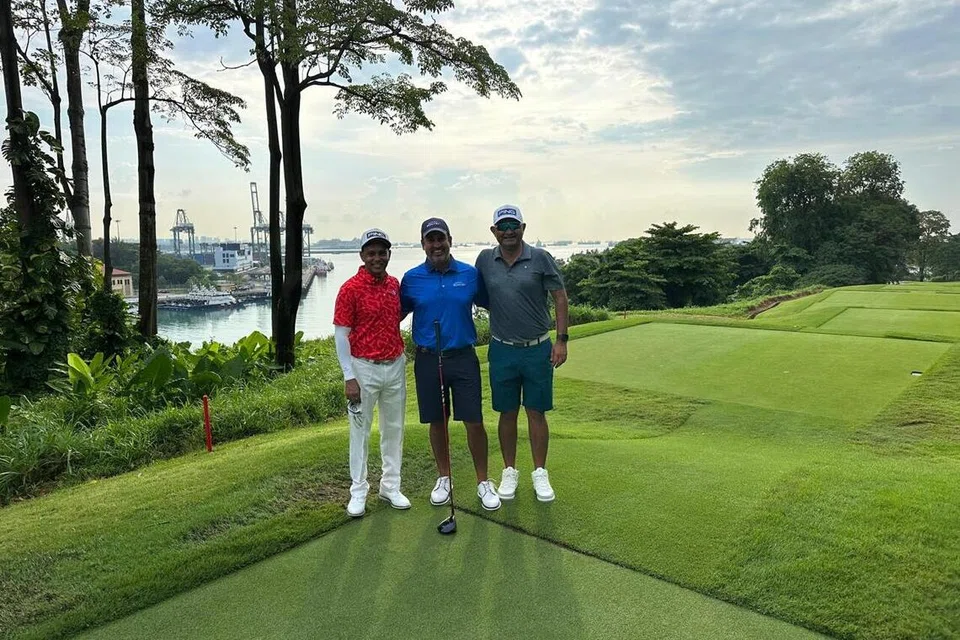
For Indian professional golfer Shiv Kapur, the Singapore Open has been a 21-year-long affair.
In 2005, the now 44-year-old stepped onto the greens of the Serapong course at the Sentosa Golf Club for the first time, the same year he would win “Rookie of the Year” at the 2005 Asian Tour.
Shiv entered this year’s Singapore Open presented by the Business Times, which started on April 23, as one of the 11 Indian golfers in the fray, and with several feathers in his cap, including six professional wins.
“What keeps me coming back for as long as two decades is the courses themselves. Singapore has some of the best courses in the world,” he said, citing features such as the quality of the greens that make for smoother putting and the difficulty of the course.
Shiv is one of several professional golfers who work with the Indian Golf Premier League (IGPL), an organisation that plans professional golf tournaments to develop golf accessibility in the nation.
“Golf has always been an aspirational sport for Indians; people are always striving for that ‘rich man’ tag,” he said.
There has been growth in the number of people interested in playing the sport over the past few years, according to Shiv, with courses increasing tenfold since he started and tournaments happening almost every week.
There’s great potential too. Only about 0.1 per cent of Indians play golf, but Shiv says if it increases to just 1 per cent, roughly 14 million people, Indian golfers could have a major presence in the world.
One of the major hurdles for those interested in playing, aside from some poorly maintained courses, is the expense.
Golfing in India is still restricted to clubs, with only a handful of public golf courses available.
Club memberships can be expensive, with Shiv’s own home club, Delhi Golf Club, giving out memberships for as high as Rs 18,000 per annum (S$244), not including the initial entrance fees, golf sets and proper attire. Additionally, most public courses are only found in bigger cities, like Mumbai or Delhi.
Another veteran pro who also works with the IGPL is S.S.P. Chawrasia, who has been playing golf since he was 10. The 49-year-old played his first tournament in Singapore at the 2006 Asian Tour.
Accessibility to golf is particularly important to him, considering his own start in the sport.
“My father was a greenskeeper at the Royal Calcutta Golf Club, and our family lived on the course,” Chawrasia said. “He would always tell me that we can’t afford my playing golf. But I still learnt it by borrowing clubs and working as a caddy.”
Today, Chawrasia has 18 professional wins under his belt.
“I think if we can have more public golf courses, we can create better players who can continue to represent the country,” he said.
Some of the initiatives IGPL has lined up are talent hunt programmes in rural areas and community classes for young children.
Another problem for golf is adapting to the youth’s preferences. “The average age of golfers is 60. Younger people today have very small attention spans and may find a full day of golf too slow, especially competing with sports like pickleball,” said Shiv.
He hopes to combat this with what he calls “golf in small spaces”. For example, constructing a public 9-hole par-3 course, a course that would take half as long to complete.
Though there is still a long way to go, golf in India has improved.
“Nowadays, companies are taking the sport more seriously; professional golfers can actually make a living through contracts and payouts, which wasn’t so common even 10 years ago,” he said, “So it’s improving but not nearly at the pace I would like.”