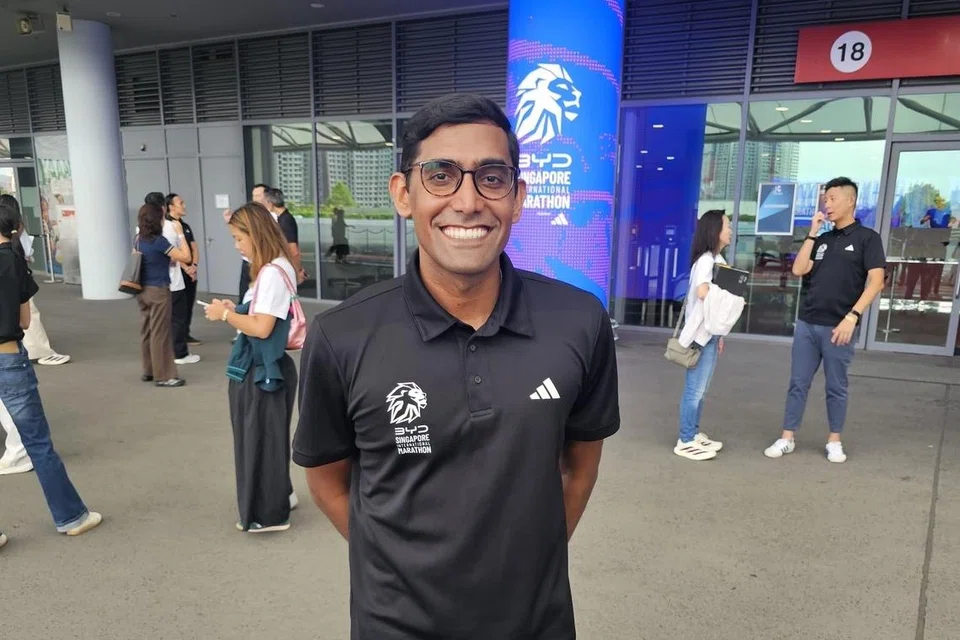

When Singapore’s national marathon returns this December under a new organiser and title sponsor, much of its direction and ambition will rest on the shoulders of one man who knows the sport from the inside out.
For Shalindran Sathiyanesan, better known as Shali, the role of event director of the BYD Singapore International Marathon presented by adidas is not just another administrative assignment. It is, in many ways, a continuation of a lifelong journey in athletics – one that began when he was just four years old.
A former SEA Games 400m sprinter and, until recently, general manager of Singapore Athletics, Shali now finds himself at the helm of the country’s largest annual running event at a pivotal moment of change.
“This isn’t just another race,” he told tabla!. “For many runners, it’s something they plan their entire year around. Our responsibility is to honour that commitment.”
A race shaped by runners
The 2026 edition marks a significant shift. With SG International Marathon taking over as organiser for the first time since 2016, and BYD coming on board as title sponsor, the event is entering a new chapter – one that aims to balance scale with experience.
Among the key changes is a three-day race format from Dec 4 to 6, with children’s races kicking off the weekend, followed by the 5km and 10km events, the half-marathon, and finally the full marathon.
In a deliberate move, the organisers have also capped participation at 52,000 runners, down from 55,000 in 2025.
For Shali, this is not about limiting growth, but refining it.
“The decision to cap numbers reinforces our focus on creating a better experience,” he explained. “We want a race that runners can trust – one that gets the fundamentals right.”
The athlete’s eye
It is here that Shali’s background becomes his biggest asset.
Having competed at the SEA Games and participated in long-distance races himself – including the Singapore marathon in 2006 – he brings what he calls a “practical lens” to event planning.
“You notice the small things as an athlete – how hydration points are spaced, how supported you feel when fatigue sets in,” he said. “Those details matter.”
That philosophy is already shaping the race’s design. Organisers are placing stronger emphasis on hydration strategies, pacing support and medical coverage, particularly given Singapore’s demanding heat and humidity.
“These are the moments that define a runner’s experience,” he said. “If we get these right, everything else builds from there.”
Building a community-first marathon
Beyond race-day logistics, Shali is keen to expand the marathon’s identity into something more enduring – a year-round platform that connects runners, communities and partners.
One of his priorities is to deepen engagement with Singapore’s growing network of running clubs.
“We want to listen to the community – understand their pain points, what they’ve experienced locally and overseas, and bring those insights into our planning,” he said.
This includes pre-race initiatives such as community runs and training programmes, aimed at building a stronger connection between participants and the event long before the starting gun fires.
At the same time, the organisers are looking to integrate local SMEs, cultural elements and international collaborations, creating what Shali described as a “total brand experience” that reflects Singapore’s identity while meeting global standards.
Experience at the helm
Shali’s tenure at Singapore Athletics has equipped him with more than just operational expertise. As general manager, he worked across athlete development, high-performance systems and stakeholder management – experience that now informs his approach to the marathon.
“I’ve seen the ecosystem from multiple angles – as an athlete, an events organiser, and an administrator,” he said. “That helps in understanding what different stakeholders need and how to bring it together.”
It is this blend of experience that he believes will be crucial in steering the marathon’s evolution.
Supported by partners such as Sport Singapore, the Singapore Tourism Board and Singapore Athletics, the event is also expected to strengthen its position as a regional and global showcase.
A bigger vision
First staged in 1982, Singapore’s national marathon has grown into Southeast Asia’s only World Athletics Gold Label road race, attracting participants from around the world.
For Shali, the goal is to build on that legacy – not through dramatic reinvention, but through steady, thoughtful progress.
“We want to earn trust over time,” he said. “To create an event that people can rely on, that they are proud to be part of.”
His approach is rooted in the same principles that defined his athletic career: discipline, resilience and humility.
“Running has an honesty to it,” he reflected. “You can’t fake the outcome – it’s always earned.”
That mindset now shapes how he views his new role.
As the marathon gears up for its next edition, Shali’s challenge will be to translate that honesty into an experience that resonates with every runner – from first-timers to elite athletes.
If successful, the race will not just be bigger or more visible. It will be, as he intends, something far more enduring: a marathon that Singapore can truly call its own.