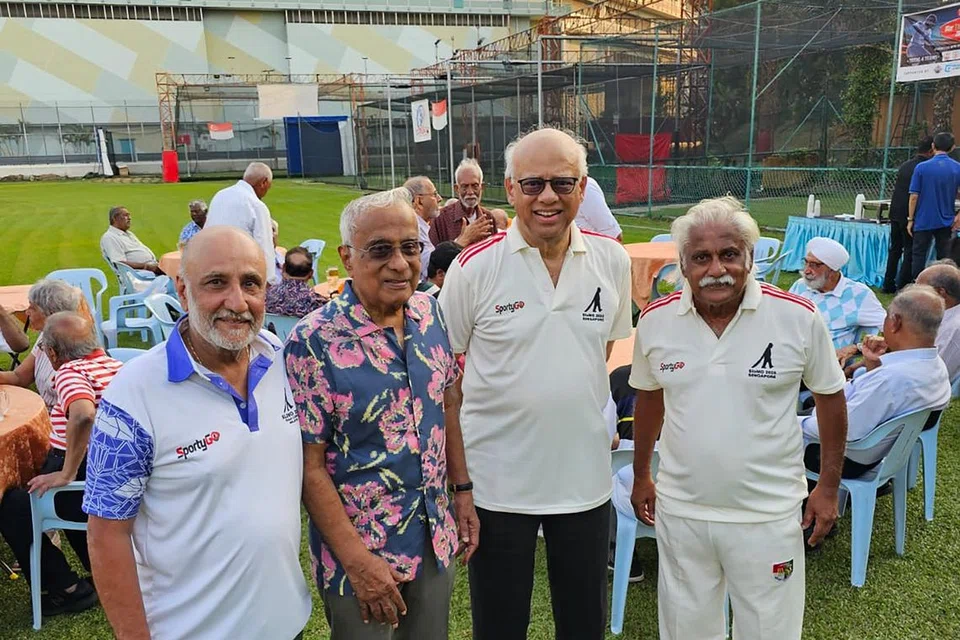

On Aug 29, the Ceylon Sports Club in Singapore echoed with the familiar thud of leather on willow, bursts of laughter, and the unmistakable sound of old friends ribbing each other across the field.
It wasn’t just another cricket match. It was the annual Slomo gathering, where men, who once ran hard as schoolboys in the 1960s, now in their sixties, seventies, and beyond, return to the crease in slow motion – but with their camaraderie and humour in full sprint.
I never studied with this band of brothers in the 1960s, but since Slomo’s inception in 2011, I’ve been part of the tradition – missing only three editions. And what keeps me coming back, year after year, is not the cricket alone, but the joy of reliving youthful friendships and making new ones along the way.
Slomo was born, fittingly, out of a cricket World Cup. Balbir Singh, 77, a former Singapore Airlines employee and lifelong cricket enthusiast, recalls the spark vividly.
“It was April 2011, India had just won the World Cup in Mumbai. A bunch of us were chatting online about where to watch the final. When it was all over, I told them: Why don’t we get on the field ourselves for old time’s sake? Some laughed it off, saying, ‘At our age? You must be joking!’ But a few others said, ‘Let’s go for it.’ And that’s how Slomo started.”
That first game, held in August 2011 at the Singapore Indian Association (SGIA) ground, set the tone. Balbir’s brother, Pritam Singh, who once captained Singapore, joined in. So did former University of Singapore captain and former SGIA president Giri Mudeliar, senior counsel and cricket stalwart Chelva Rajah, and Robin Lewis, a former Singapore Combined Schools captain.
Among the spectators were former sports masters Arumugam Pancharatnam, Harbans Singh, Ajit Singh Gill, and Ernest Wicks, who were well into their 80s.
What began as nostalgia quickly became a fixture.
Today, Slomo is more than a match. It is a reunion, a festival, a reminder that friendships forged in youth only grow stronger with time. This year, about 80 people gathered – players, spouses, families – for lunch, a 20-over game, and dinner that stretched into the night.
Chelva, 77, once a judicial commissioner and always a cricket romantic, summed it up best: “This is one of the games I look forward to the most. Even though I no longer play, I come to meet my long-time friends. Within five minutes of being together, it’s as though we were 40 years younger. There is no friend like an old friend, and Slomo ensures we see each other at least once a year.”
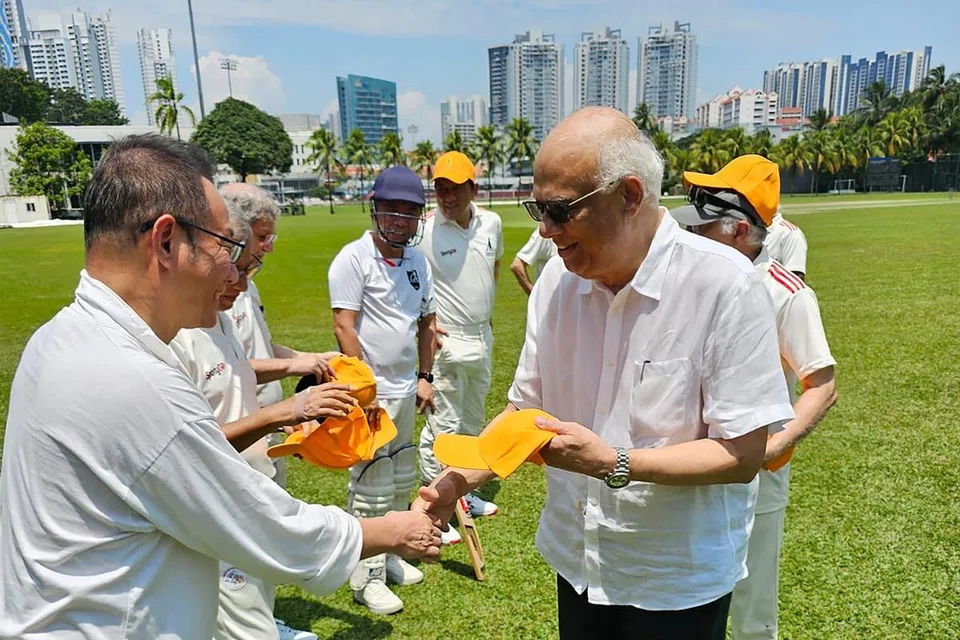
The name itself is a cheeky nod to advancing years: “Slomo” for slow motion. But, while the reflexes may not be what they once were, the spirit remains as fierce as ever.
Over the years, Slomo has drawn cricketers from across the globe. Oral Surgeon and former Singapore captain Mohan Rajalingam, 69, flies in from Perth to play. So do old rivals from Malaysia, like David Roberts and Jasbir Singh, rekindling memories of Combined Schools fixtures in the 1960s. Others travel from Sydney, Adelaide, Melbourne, Kuala Lumpur, Johor Bahru, and even India, proof that the love of the game and the friendships it nurtured know no borders.
Imran Khwaja, 70, former Singapore captain who went on to become International Cricket Council’s deputy chairman, calls Slomo a celebration of cricket’s finest traditions: “Slomo is about camaraderie and esprit de corps. Even though we may play in slow motion now, we stand tall in the qualities that matter – brotherhood, humour, and sportsmanship. It’s not just a match; it’s family.”
While the old guard forms the heart of Slomo, younger players have begun to join in, ensuring continuity. Among them is Moiz Sithawalla, 54, a lawyer and once a national cricketer himself.
“For me, it’s fantastic to be part of this. Many of these men were my seniors by decades, but cricket ties us together,” he said. “Some of their fondest memories, the ones that make them laugh the hardest, are about cricket tours, post-game showers, and silly moments on the field. That joy, unlike anything else, still shines through when we meet.”
This blending of generations – veterans in their late 70s playing alongside men in their 60s and 50s – ensures Slomo remains both a heritage event and a living tradition.
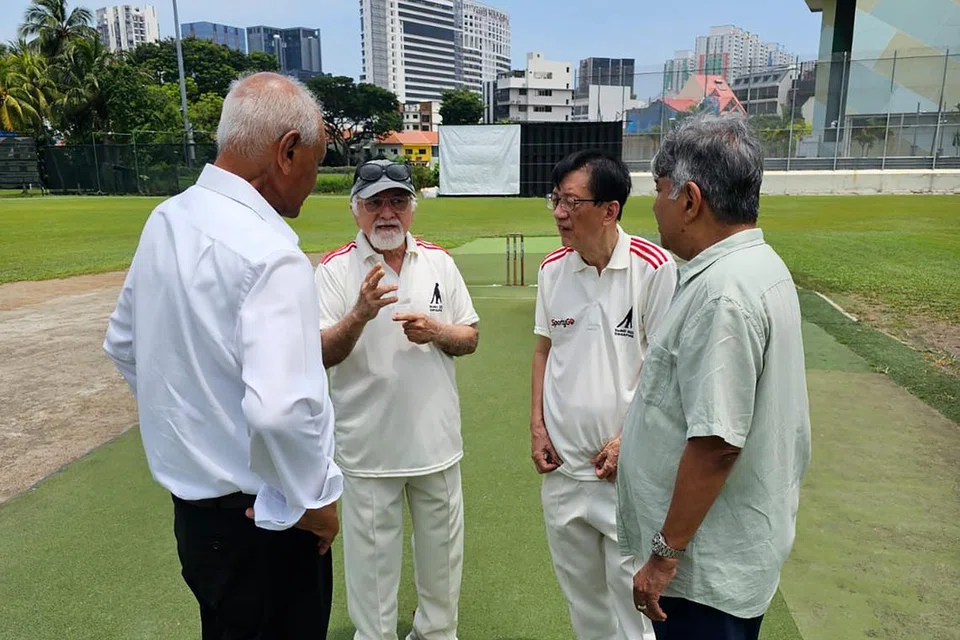
Behind the laughter lies hard work. For the past two years, former national team player Wong Hoe Sang has shouldered the task of bringing everyone together.
“Organising isn’t easy,” he admits. “I send out WhatsApp messages to almost everyone who has played with us since the 70s and 80s. People confirm, then drop out last minute. It can be frustrating, but I do it because cricket is in my blood, and the people I play with mean so much to me.”
Balbir, who passed on the baton of organising after more than a decade, adds: “It’s harder to organise adults than schoolboys. But the joy when everyone comes together makes all the effort worthwhile.”
For most participants – including Parama Thevan, 95, and Haider Sithawalla, 92, who attended this year’s Slomo – the cricket is incidental. The highlight lies in the stories told, the jokes repeated, and the chance to sit under the pavilion with old friends, rehashing games played half a century ago.
M. Neethinathan, 73, who represented Singapore in both hockey and cricket, puts it simply: “It’s a great feeling to play Slomo every year. The memories come flooding back – childhood games, national duty, the friendships we built. Cricket brought us together then, and it continues to unite us now.”
Slomo skipped only two years, during Covid, and last year was played in Kuala Lumpur to honour Malaysian friends. Otherwise, it has been a steadfast annual fixture in Singapore. And if this year’s turnout is any indication, the tradition is in no danger of fading.
As I stood on the boundary line this year, bat in hand, I thought about what Slomo has come to mean to me. I may not have studied or played with these men in the 1960s, but for the past 14 years, I have been welcomed into their circle. Cricket may have slowed us down, but friendships, if anything, have quickened.
Slomo is living proof that, while age may stiffen the limbs, it cannot dull the laughter of old friends – or the joy of picking up a bat once more, if only for the excuse to meet again.