
ALI KASIM
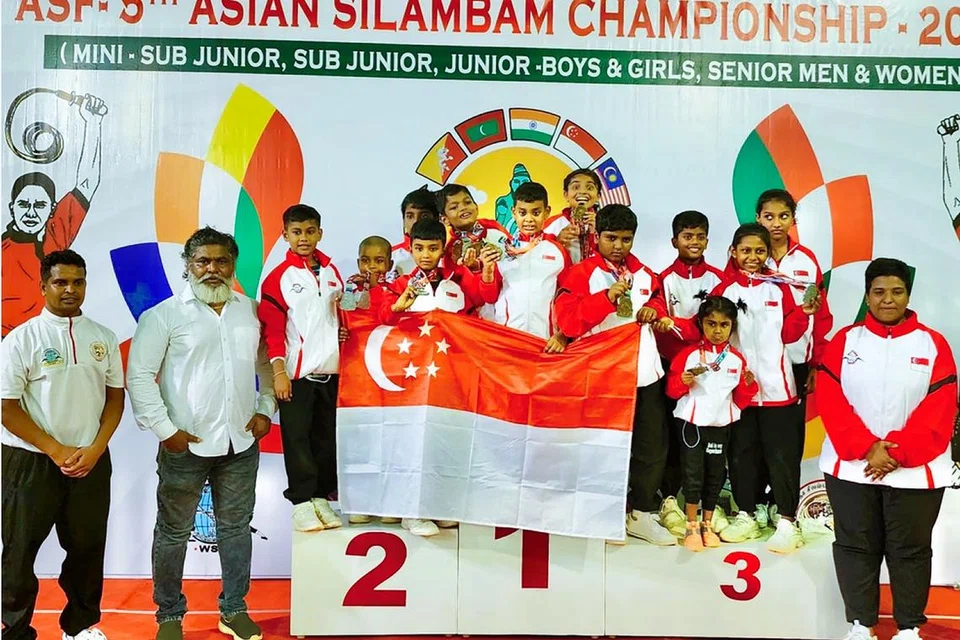
Competing for the first time in any competition – let alone an international one – 16 students from the International Silambam Academy (Singapore) returned home with an impressive haul of 30 medals last month.
They achieved that feat at the 5th Asian Silambam Championships, which was held in Nagercoil, Tamil Nadu.
Silambam is an art of self-defence that originated in south India some 3,000 years ago.
It not only equips people with self-defence skills, but is also a form of fitness training.
The four-day competition, held once every three years, featured contingents from India, Sri Lanka, Malaysia and Singapore.
The Singapore team finished runners-up behind India in the medal standings, after each member managed to win at least one medal in his or her age-group and category – such as stick fight, bare hands form and spear rotation.
In total, they bagged eight gold, 18 silver and four bronze medals.
The competitors were selected from a pool of 120 students of the academy who train weekly at various People’s Association (PA) venues, and under Master Sandhirakasan Ganesan, who has more than 20 years’ experience as a student and instructor in various martial art forms.
The 36-year-old instructor formed the academy along with his wife Arun Rani Piriyah, 31, two years ago. Training sessions are held at PAssion Wave @ Jurong Lake Gardens, as well as PA centres in Sembawang, Bukit Batok and Punggol.
“My husband was actually a taekwondo instructor for eight years,” said Piriyah.
“But he also trained in Silambam under international grandmaster P. Selvaraj Aasan, who runs the International Silambam Academy in India. So we decided to open the Singapore branch and focus on silambam.
“The People’s Association then granted us permission to hold our training sessions at their venues, and that has helped us a lot.”
Using long sticks, silambam practitioners learn armed as well as unarmed combat – though the martial art form also demands that students exercise restraint and maintain self-control at all times.
Silambam, with its stylised ritualistic steps ensconced in traditional Indian folk art, is practised in places in India, Malaysia, Sri Lanka and even England and the United States.
“To learn the bare hand pattern, weapon event and stick fight, it would take three to four years to reach black-belt status,” explained Piriyah.
“Silambam is taught in different ways in different places, and you never really stop learning. My husband has been practising the art form for 22 years – and he’s still learning.”
Notably, the martial art form has seen a rise in popularity among women over the past few years.
According to Piriyah, among the students aged above 14 in the academy, three-quarters are women.
“At our classes in Jurong on Fridays, parents would initially send their kids, but after a while the mothers started to join in. So now that has become a bit of a ladies’ class,” Piriyah said.
“We have one student, Rajee, who enrolled her three kids at first. Later, she too joined us. All four of them competed in India.”
A. Rajee, who is in her thirties, bagged silver medals in the stick fight and bare hands categories.
She said the team’s success in India would hopefully shine the limelight on silambam in Singapore.
“In my generation, the concept of silambam wasn’t articulated openly. It’s a good thing for us to have participated in the competition, because now silambam has at least been highlighted through our achievements,” she said.