Shanti Pereira was exhausted. She had barely slept. Four races were already in her legs and rain was pelting down at Nagoya’s Paloma Mizuho Stadium.
But one thought overrode everything else: This was her day.
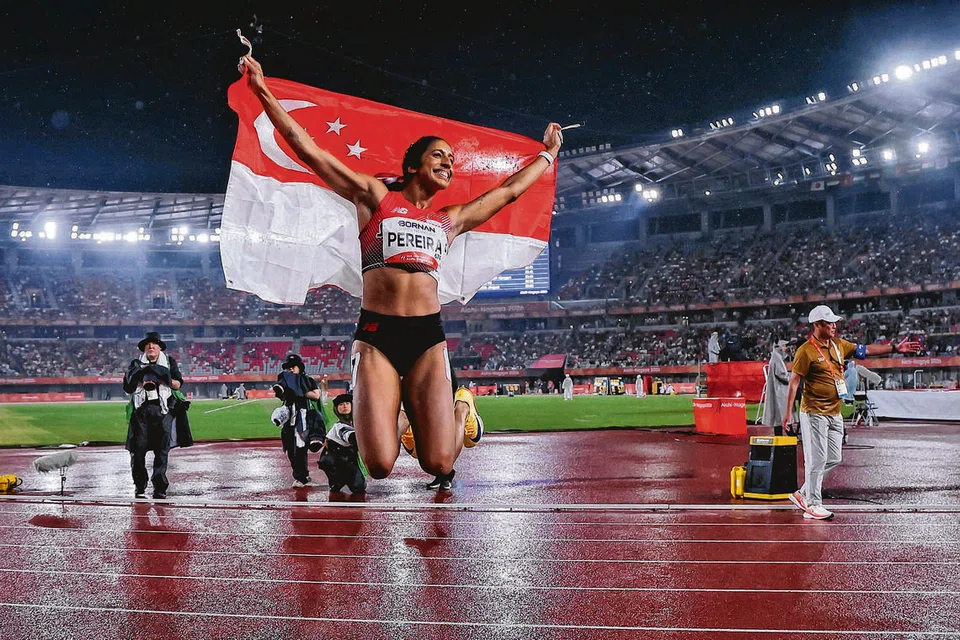
On Sept 27, the 30-year-old Singaporean powered down the home straight to win the Asian Games 200m in a season-best 22.78sec, becoming the first woman in the history of the Games to successfully defend the title.
Then came the emotion.
Shanti thumped the Singapore flag on her chest, screamed in celebration and broke down in tears. She had not merely won another gold. She had achieved something no female sprinter had managed since athletics entered the Asian Games programme in 1951.
“I knew coming into today that it was my day and nothing in the world was going to stop me from getting it,” she said.
“I’ve worked so hard for this, I really believed. I’m so exhausted from all my races, and I honestly haven’t been sleeping very well, probably from anxiety and just nerves.”
But she added: “I knew the mind was a powerful thing, and if I believed and just let my body flow, I could bring it back home to Singapore.”
It was a revealing insight into why Shanti has become such a formidable competitor.
Her speed is obvious, but increasingly her greatest strength appears to be her ability to perform when the stakes are highest.
She had already raced the 100m heats, semi-finals and final – collecting a silver in a season-best 11.21sec – before running the 200m heats. Yet, in the final, she produced her fastest 200m of the season.
China’s 17-year-old Chen Yujie, who had beaten Shanti to the 100m title two days earlier, was faster out of the blocks. But the Singaporean remained composed around the bend before surging past Chen on the straight. Chen finished second in 22.93sec.
So convinced was Shanti that something special was coming that she asked coach Luis Cunha, who normally watches her races from the warm-up track, to enter the stadium for the final.
“I want you to witness something special,” she told him.
Their partnership, which began in 2020, has transformed her career.
Shanti has become far more than an athlete who trains hard for a few hours each day. Her diet, sleep and recovery are meticulously managed, while her training and running technique have been refined to extract tiny improvements that can separate champions from the rest.
Equally important has been her mental transformation.
“She used to be so scared of everything, scared of her competitors and I really let the pressure get to me last time,” Shanti said of her younger self.
“She wouldn’t even believe the kind of person she grew into.”
Luis sees his role differently from simply producing faster times.
“As a coach, I see myself as a lighthouse, someone who guides the athletes,” he said, adding that Shanti is now capable of touching “the hearts of so many people in Singapore”.
“She doesn’t run just for herself.”
The victory carried additional significance because Shanti knows opportunities like this are finite.
After winning, she remained on the track for as long as possible, soaking in the stadium and the moment. At 30, she is increasingly conscious that an elite sporting career cannot continue indefinitely.
“I’m not done yet, but there’s always the thing that sport does not last forever, so I appreciate and treasure every time I get to participate in something like this,” she said.
There have been reminders of that fragility. After her breakthrough 2023 season, a stress injury to her right fibula disrupted the following year before she fought her way back.
Perhaps that explains why she is now learning not merely to endure the demanding process but to enjoy it.
“I wanted to work on embracing the process as much as I could,” she said, whether that meant competing on the circuit or grinding through another training block at home.
What comes next, therefore, is not simply about another medal.
Shanti wants to keep testing her limits and extending a legacy that already includes national records of 11.20sec in the 100m and 22.57sec in the 200m.
“For however much time I have left in this sport, I just want to keep pushing as hard as I can,” she said, “and hopefully that would inspire more and more people to do the same.”
Nagoya showed that she still has plenty left to give.