Indian women’s badminton is beginning to show greater depth and resilience, and South Korean coach Park Tae-sang is emerging as an important influence behind that transformation.
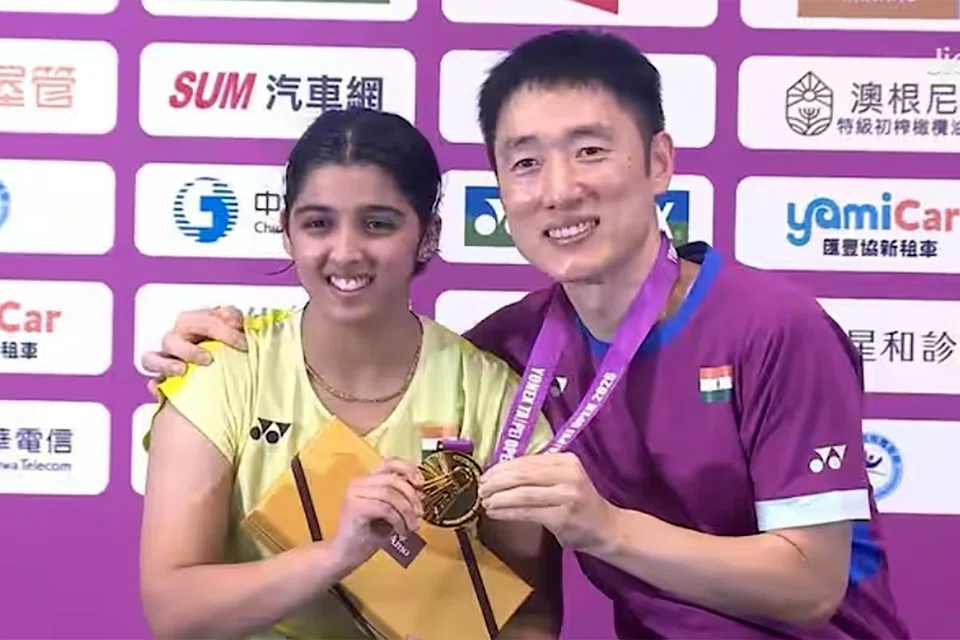
The former coach of P.V. Sindhu, whom he guided to bronze at the Tokyo Olympics, has taken many of the methods used to sharpen the Indian star’s game and applied them to a younger generation training at the National Centre of Excellence in Guwahati.
The results have been encouraging. Ashmita Chaliha broke through to win the Korea Masters, while teenager Tanvi Sharma captured the Taipei Open, giving India consecutive Super 300 successes and suggesting that the women’s singles challenge need no longer revolve around Sindhu alone.
Park’s biggest contribution appears to be combining the natural attacking instincts of Indian players with the defensive discipline associated with South Korean badminton.
His sessions emphasise precise footwork, court coverage, stamina and the ability to stay composed when rallies and matches become uncomfortable.
Chaliha’s progress illustrates that impact. After returning from a serious knee ligament injury, the 26-year-old improved her defensive structure and ability to remain calm after losing games or falling behind. That resilience played a significant part in her Korea Masters triumph.
Park had earlier performed a similar transformation with Sindhu.
Already one of badminton’s most devastating attacking players, Sindhu sometimes struggled against quick body attacks and low, dipping shots. Park worked on getting her to intercept the shuttle earlier and higher, while improving her lateral movement and transition from the back court to the net.
He also introduced greater back-court variation, including half-smashes, sliced drops and defensive tosses, reducing Sindhu’s dependence on outright power. Male sparring partners were used to simulate high-speed attacks, forcing her to defend and recover quickly.
Elements of those demanding methods are now being used with India’s emerging players. Multi-shuttle drills test reactions and movement, while intensive endurance work is designed to prevent players from relaxing physically or mentally during long rallies.
That approach could prove particularly important at the ongoing World Championships in New Delhi, where pressure will intensify with every round.
Sindhu has reached the last 16 after beating Canada’s Wen Yu Zhang 21-16, 21-17, but faces a formidable challenge against China’s Wang Zhiyi.
In women’s doubles, Treesa Jolly and Gayatri Gopichand have also advanced to the pre-quarterfinals after a convincing 21-15, 21-12 victory over Americans Lauren Lam and Allison Lee. They next face Japan’s Rin Iwanaga and Kie Nakanishi.
Can the Indian women go on to win a world title?
The draw makes that a demanding proposition, particularly for Sindhu, who must overcome elite opposition. But a World Championships medal is hardly unfamiliar territory for the former champion, and Park’s earlier work on her defence, movement and tactical variation remains part of her armoury.
More significantly for Indian badminton’s future, his methods are helping create players who are not dependent solely on attacking brilliance.
Power can win points. At World Championship level, however, titles are often decided by who can defend one more shuttle, remain patient one rally longer and think clearly at 19-all.
Those are precisely the qualities Park has been trying to instil.
India may or may not produce a world champion in New Delhi. But Park’s greater achievement could be ensuring that, increasingly, there are several Indian women capable of believing they can.