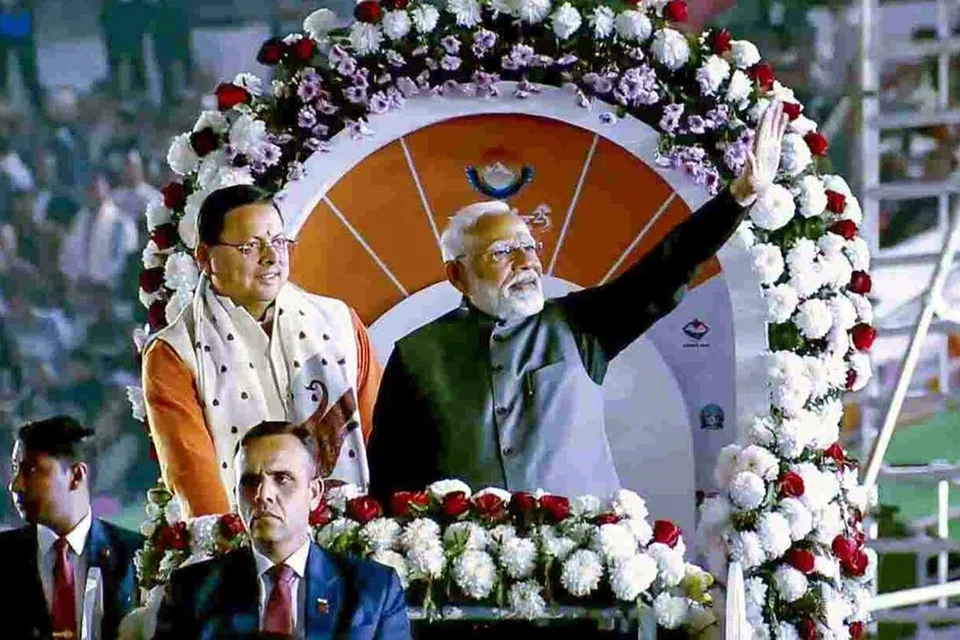

Prime Minister Narendra Modi has once again made it clear that India is keen to host the 2036 Olympics.
While inaugurating the 38th National Games in Dehradun, Uttarkhand, on Tuesday, he said hosting the Olympics will not only improve sports facilities in the country but fuel growth in sectors like construction, transport and tourism.
“The way our athletes aim for bigger goals, India is also moving forward with a great resolution,” said Mr Modi. “India is making a strong push to host the 2036 Olympics. When the Olympics happens in India, it will take India’s sport to new heights.”
India has sent an expression of interest to host the 2036 Olympics and the Indian Olympic Association is in talks with the International Olympics Committee’s Future Hosts Committee. But this is only the first step in a long and competitive bidding process that will pit India against others such as Indonesia, Chile and Turkey. A final decision is expected only after 2025.
India has staged World Cups for cricket and the Asian Games twice, but it has never hosted an event the size of an Olympics. Hence, many are sceptical if India can pull it off.
Sports journalist Sharda Ugra told AFP that India has an underwhelming record in staging mega sporting events – apart from cricket – “because of its governance structure, sporting administrations and paucity of events”.
“So then, is it viable for us to be building large stadiums just because we are going to be holding the Olympics? The answer is definitely no.”
The 2010 Commonwealth Games in New Delhi was the last time India staged a multi-sport international event. But it was marked by construction delays, substandard infrastructure and accusations of corruption.
Some experts believe the country’s hosting bid is more about the personal ambitions of Mr Modi, who will be 86 in 2036, and leaving his mark on the world stage.
“Hosting the Olympics will, in a way, burnish India’s credentials as a global power,” academic Ronojoy Sen told AFP. “The government wants to showcase India’s rise and its place on the global high table, and hosting the Olympic Games is one way to do it.”
No city has yet been identified as the potential 2036 Olympics host, but many expect Ahmedabad and Gandhinagar – two cities near each other in Gujarat – to be the front runners. Gujarat is Mr Modi’s home state.
One of the world’s largest stadiums, the Narendra Modi Stadium – which can accommodate 130,000 people – is situated in Ahmedabad.
In anticipation of 2036, the Gujarat government has already created a Rs60 billion ($958 million) budget to build six sports complexes in the Ahmedabad-Gandhinagar area.
Mr Modi has thrown his political weight behind the Olympic bid, calling it “the dream of 1.4 billion Indians”. He assured the IOC in October 2023 that India “will leave no stone unturned in the preparation for the successful organisation of the Olympics in 2036”.
But critics have warned of the post-Games economic woes of host nations and urged India to instead invest the money in training athletes so they can win more Olympic medals.
Since 1896, when the modern version of the event began, India has won just 10 gold medals at the Summer Olympics; eight of them in hockey alone.
No one knows how much it is going to cost India to host the Olympics, but it is certain the costs will far outstrip the budget – which has been the case in recent Games, including Tokyo 2020 that cost around $17.5 billion.
Even the Commonwealth Games in 2010, one of the most expensive ever, cost India US$4.1 billion, instead of the US$270 million that was first estimated. Revenue from the Games, on the other hand, was only US$38 million.
Mr Jonathan Selvaraj, a senior Indian sports journalist, argues that India’s Olympic bid is a “misplaced priority”, one that focuses more on the public spectacle of hosting the high-profile quadrennial event, rather than actually developing India’s sports ecosystem.
If the latter is what India wants to achieve, the focus, he said, should be on reforming sports governance at the top – where unqualified politicians still hold power and corruption is endemic – as well as developing grassroots sports infrastructure.
“It’s always been the case that the Olympics takes place in a sort of a mature sports ecosystem,” Mr Selvaraj told the Straits Times. “I cannot honestly say that the Indian sports ecosystem is what we consider to be a mature sports ecosystem.
“When you spend a billion dollars on the Games, surely, there’s going to be some impact, but the question is whether the return on investment is justified.”