
Any sport that features horses and human beings arouses curiosity.
Polo is no exception.
Originating in Iran some 2,000 years ago, polo, referred to as the “game of kings”, was initially played by Persian nobility as a training exercise for cavalry units, before it spread to other parts of the world as a sport.
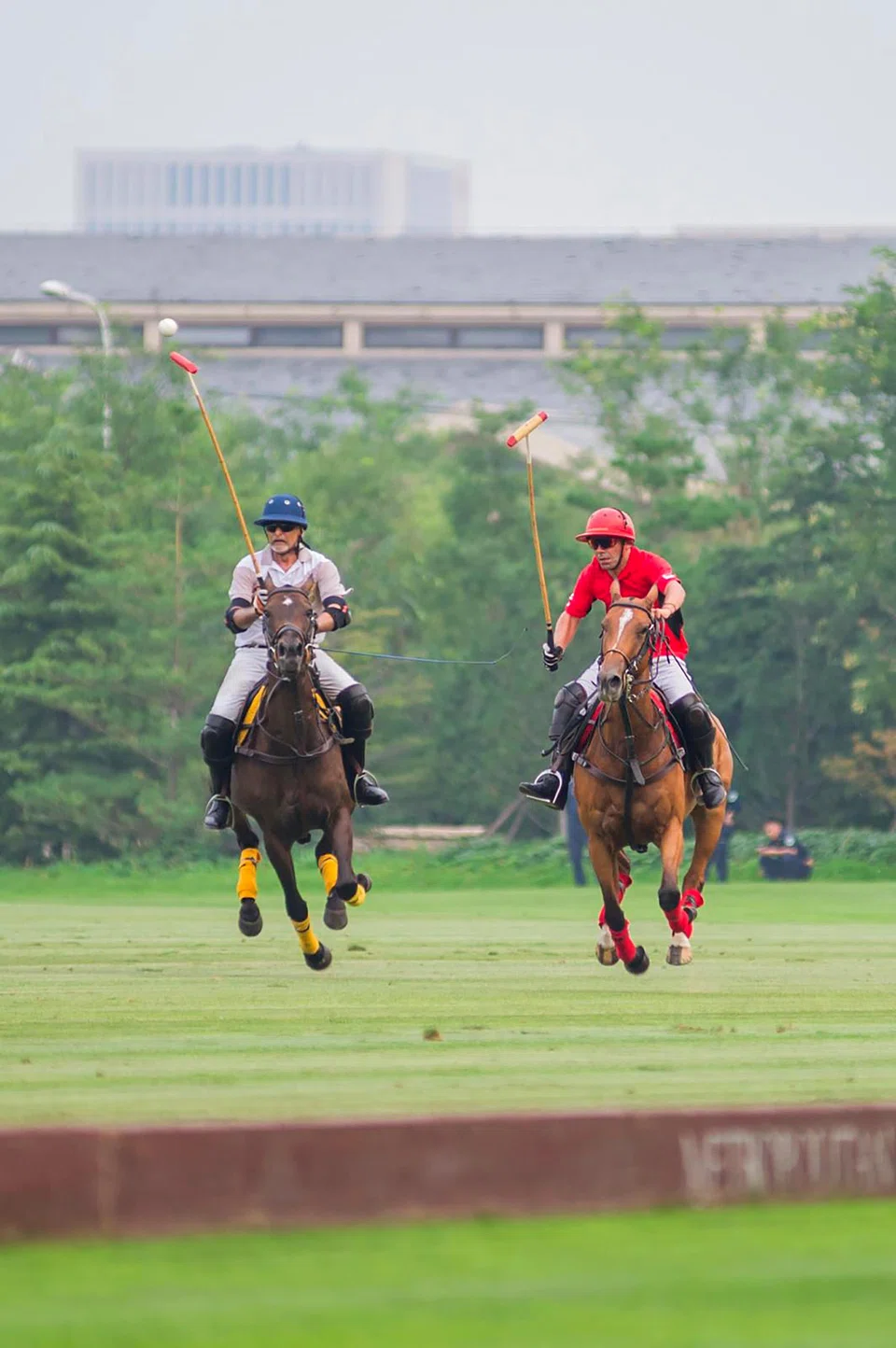
The game, whose modern version originated in Manipur, India, is played by two opposing teams of four horse-mounted players with the objective of scoring using a long-handled wooden mallet. A small, hard ball is used, and a chukka (period of play) lasts about seven minutes. A game usually takes between one and two hours.
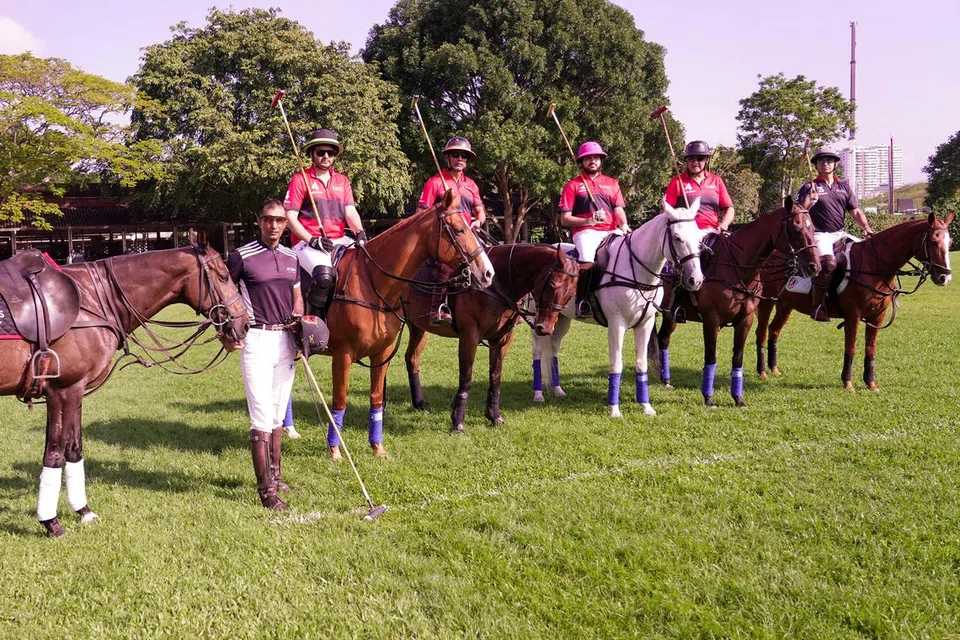
Owning a horse to play the sport was a pre-requisite for most of the last century. Even now, most of the top players have their own horses. But some clubs, like the Singapore Polo Club (SPC), offer horses for anyone to play the sport for a fee.
However, it is an expensive sport, and only the passionate, committed players excel in it.
“All polo players have a touch of madness,” said Iqbal Jumabhoy, a real estate development and hospitality veteran, who is among about 20 Indians who regularly play the sport in Singapore. “Polo is addictive. Once you start to play, you eat, sleep and dream polo. It’s the adrenaline rush, the horses and the camaraderie that keep you going.”
Iqbal, who is in his 60s, took to polo like a duck takes to water as his father Ameerali, a prominent businessman who died in 2020 aged 94, was the first Indian to play polo in Singapore and served as president of the SPC from 1968 to 1978.
His brothers Rafiq and Asad played polo, and now his son Imran and nephews Ali and Ameer play the sport.
“It is almost like if you were born into my family, you had to play polo,” said Iqbal, who was president of the SPC from 2008 to 2011 and again from 2012 to 2014. “But, once you start, there’s so many opportunities to make friends from all over the world as you play against other teams.”
SPC’s polo captain Satinder Garcha, a boutique hotelier and luxury real estate developer, has played polo in almost all major polo-playing countries – India, Argentina, the United States and United Kingdom. The sport came naturally to him as his father, retired colonel Kuldeep Singh Garcha, was the captain of India’s national team for many years.
But for SPC’s other Indian members like Rajiv Menon, who is in the finance business, luck played a prominent part.
“My company had an event at SPC 12 years ago, and the first prize, which I ended up winning, was a temporary membership and 10 polo lessons free,” said the 52-year-old. “After the 10 lessons, the instructor told me I had talent and should pursue polo. That was it. I never looked back.”
To become a good player, one needs to train and play consistently for at least two years, said SPC’s lead instructor and professional player Ravi Rathore, a former colonel in the Indian Army who has played in five World Cups.
“Anyone can learn to mount a horse,” he added. “But to become a good polo player it takes good riding skills and understanding the finer points of the sport. You can never say you are a finished product. You are learning all the time.”
From the outside, polo might appear as a simple sport, with many thinking that only horse-riding skills are essential. But it takes a heavy toll on the body, with falls and injuries quite common.
“Polo is so physical that sometimes it is not easy for people to appreciate,” said banking lawyer Ranbir Singh, 52, who has been playing the sport for 16 years. “The joke in my family is ‘why do you need to be fit?; it’s the horse doing all the work’. It’s true that the horse is the real athlete, but the sport stretches your body to the limit.
“It’s an intensive, quick-paced and team-oriented game. The sport requires a great level of talent, coordination and fitness. The players must be adept at riding their ponies quickly, hitting a little ball with a mallet while maintaining awareness of their surroundings.”
In Singapore, polo was first played in 1886 by a group of British army officers and civilians at the Singapore Sporting Club, the predecessor to today’s Singapore Turf Club, at Farrer Park. Later, the SPC was formed, and it set up playing facilities at Tyersall and Balestier around 1915.
The increasing popularity of the sport prompted the club to search for a new and suitably-sized ground (polo fields have an overall length of 274.32m and width of 146.31m – roughly the size of three football fields). It resulted in the selection of three acres of land (later to be supplemented by a further 24 acres) at the corner of Thomson Road and Mount Pleasant Road.
The SPC opened that land for play in 1941 and built a clubhouse there in 1955.
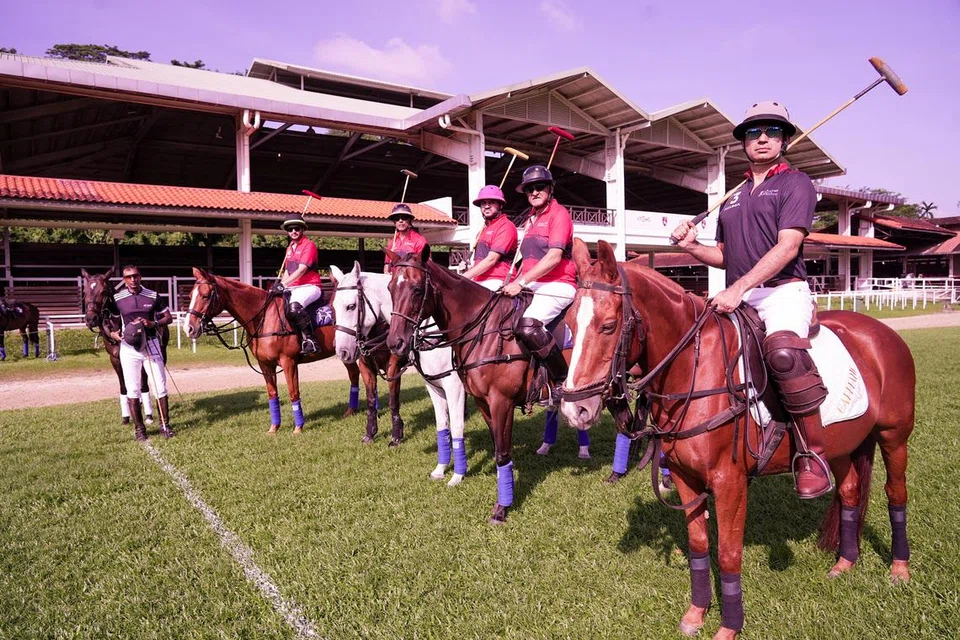
Today, the clubhouse has been replaced by a new multi-million dollar complex comprising changing rooms, a long bar, billiards room, restaurant, tennis and squash courts and a swimming pool.
“The playing and club facilities are absolutely fabulous,” said Iqbal. “But the problem is with the image – people generally associate polo with a bunch of wealthy guys in white pants drinking champagne and enjoying life. Now, that is not the truth.
“Frankly, for the majority of us, it is a hard contact sport. It’s one where you are trying to match your skills and also of your horse with another team. Polo has been democratised hugely in the last 50 years. You don’t need to own a string of horses to play the sport. Clubs offer horses and coaching, and this has allowed a much wider group of people to come in.”
SPC has the Atoms Polo Academy, which anyone from five to 70-years-old can join. Group lessons cost $80 a session, with overall costs depending on how often one plays. The club has a rider and polo player base exceeding 1,500 and promotes inclusivity through public programmes and outreach initiatives.
Around 200 members – mainly Chinese, Indians, British and Americans – actively play polo at SPC, with the club largely contributing players to the Singapore national team, which clinched silver at the 2007 SEA Games and fourth place at the 2017 SEA Games.
“SPC players play matches locally and against international teams at home and away,” said Satinder, a former Singapore captain and president of SPC from 2017 to 2020. “To become a better player, you have to build your handicap, like in golf.”
Ranbir, who has a busy work schedule, said he would not give up polo for any other sport.
“Polo really grows on you,” said Ranbir, who has initiated his son Jansher, 18, and daughter Harnaaz, 16, into the sport. “I thoroughly enjoy it, especially being with the horses who are such noble, courageous and intelligent beings. The partnership with them is primeval; you can’t find this in any other sport.”