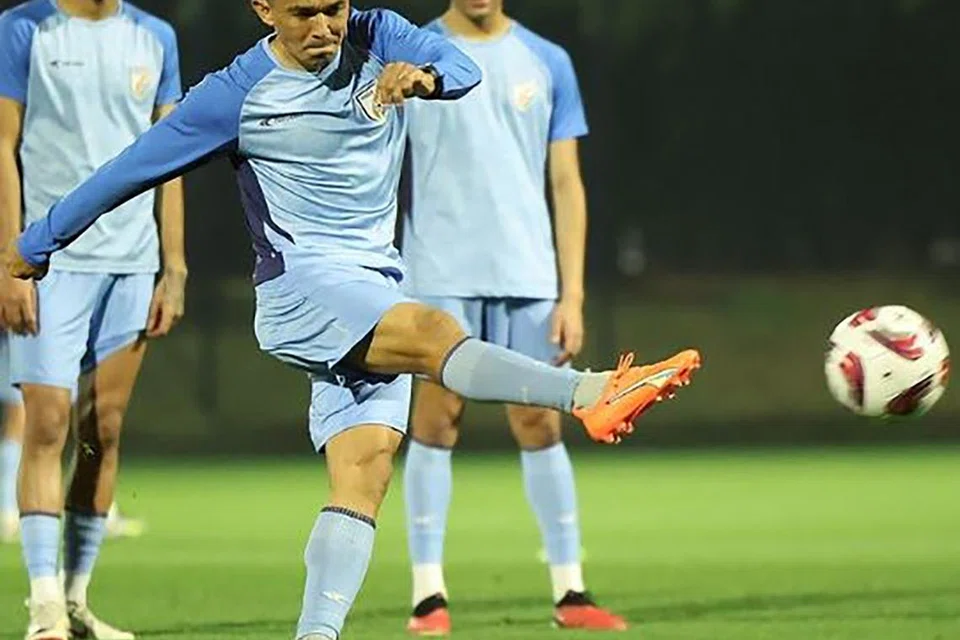
A short video on X, posted by the All India Football Federation shows India captain Sunil Chhetri playing keepy-uppy.
As the striker uses his feet and thighs to keep the ball off the ground, the camera catches the glaring white of floodlights blending with the mellow orange of the setting sun in Doha. The post on the India national team’s official handle is captioned: “What pure joy looks like.”
Chhetri is less than seven months from turning 40, and he will be the oldest outfield player in the 2024 Asian Cup, which kicks off in Qatar tomorrow.
No Indian has ever played in three Asian Cup finals, and no player in this edition has as many goals, 93. Chhetri is also the tournament’s second-most capped player with 145 caps, his international career having begun in 2005.
He is also a new dad. “You want to be with the kid and mother all the time,” he told The Hindustan Times.
But he also “wants to do more” on the football pitch.
India start their campaign against former champions Australia tomorrow. The target has been set.
“We want to have the biggest underdogs’ result in the first game. No one, not even your friends, is giving you a chance. Imagine, if you get a result against Australia, that is something you are going to die with,” said Chhetri.
India began their last Asian Cup campaign in 2019 with a 4-1 win over Thailand, but finished last in the group after narrow losses to the United Arab Emirates and Bahrain.
Coach Igor Stimac has had less than two weeks to prepare the team.
A four-week camp would have been ideal, said Chhetri.
“And a friendly against Iran, or maybe Iraq. If we had played Iran, we would know the tempo expected from Australia.
“Right now, the boys are used to the tempo of the ISL (Indian Super League). Australia are on a different level.”
Croatian Stimac, a former West Ham United defender who was appointed India’s coach in May 2019, warned against big expectations at the Asian Cup.
Under his guidance, India, a country of more than 1.4 billion people, briefly broke into the top 100 of Fifa’s world rankings for only the second time in nearly three decades. They are now 102nd, a spot below Kosovo, and rank 18th in Asia.
“A giant is definitely out of its slumber now,” declared Stimac, before cautioning: “But I reckon it will take us another four years to enter the top 10 in Asia.”
Under Stimac, India qualified for the Asian Cup with three wins from three against Hong Kong, Afghanistan and Cambodia, scoring eight times and conceding once as hosts in the third round.
After 25th-ranked Australia, they play Uzbekistan and Syria in the group stages.
“We are far from happy with the draw, but it is what it is,” said the 56-year-old Stimac, a member of the Croatia team who finished third at the 1998 World Cup.
“With a very short time for preparation, it’s difficult to expect great things, but my even greater concern are the injuries to some of our key players.”
This will be India’s fifth Asian Cup. They were runners-up in 1964 in an event that had only four teams. But, apart from that, they have never advanced from the group phase.
India lost 3-0 at home to reigning Asian champions Qatar in World Cup qualifying in November. They also suffered friendly defeats by Malaysia and Iraq, before beating Kuwait 1-0 away in a World Cup qualifier.
Stimac said more than 20 youngsters have been brought into the squad during his reign “and our supporters are finally enjoying some exciting football”.
But it is an indication of the limitations of his squad that the ageing skipper Chhetri remains India’s biggest star.
Stimac says the forward can bow out at a time of his choosing.
“We are not putting any pressure on him whatsoever; that’s up to him,” said the coach.
“If he keeps enjoying his game with the same hunger and maintaining such brilliant fitness levels, then we are there for him as long as it takes.”
Chhetri believes that India’s last few World Cup qualifiers and international friendlies have kicked out the “fear factor” from within the players.
“With this familiarity (of the top teams), the fear factor goes out,” he said. “But I must admit that they (India’s group stage opponents) are extremely good. They’re a couple of levels above what we play in the ISL, but at least we know what we’re up against.”
Indo-Asian News Service, AFP