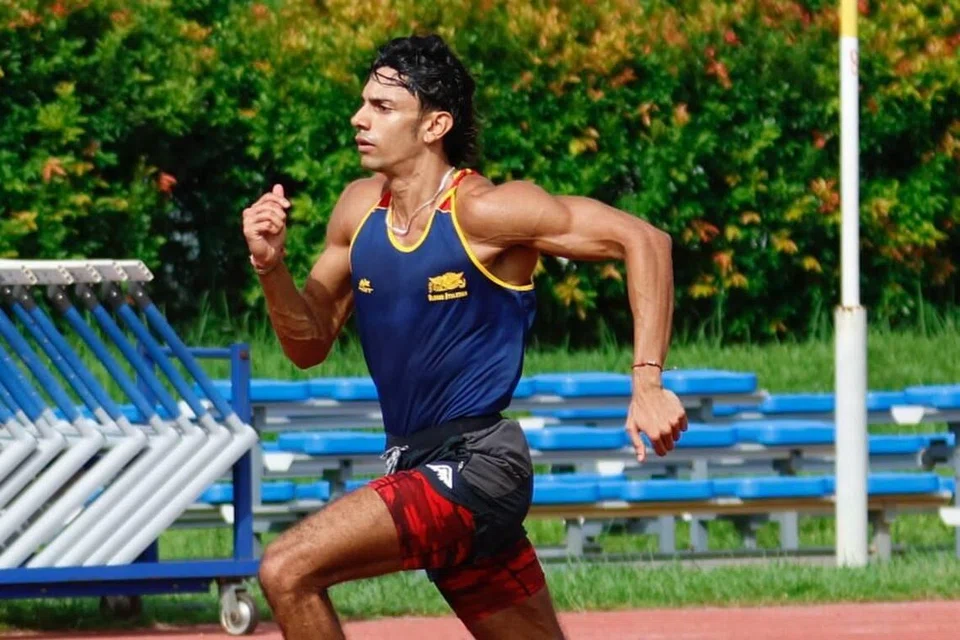


These days, Zubin Muncherji laces up his running shoes without a stopwatch ticking or a coach calling splits. He still runs most days, often longer than he did as a competitive runner, but the urgency is now gone.
“I’m retired,” the 29-year-old Singaporean trackstar said. The word “retired” sits lightly on someone who not long ago stood on the podium at the SEA Games, winning bronze for Singapore in the men’s relay event.
For much of his adolescence and early adulthood, running was a regimented principle. School fit around it, social life negotiated with it and food was measured against it.
“Studies were secondary. If I passed, I was happy. But for track? No matter how fast I ran, I’d ask, what could I have done better?” he said.
He grew up trying other sports – tennis, badminton, even cricket, which runs in the family – but none stuck the way track did.
As a child in India, he remembers racing his father around a temple courtyard. “When I was six or seven, I was outrunning him. That’s where it started,” he said.
He began in the sprints, moved to the 400m, and eventually settled into the 800m. That combination took him to the United States (US) on scholarship and into the machinery of Division I track and field.
In June 2014, aged 17, Zubin broke a 40-year Singapore national record in the 400m at the Asian Junior Championships in Taipei. Four years later, at the Big Ten Championships in Indiana – where he was also pursuing his bachelor’s degree – he reset the national 400m mark again, on a bigger collegiate stage.
“It was eye-opening,” Zubin said of competing in the US. “In Singapore, we live in a bit of a bubble. There, if you’re injured, there’s always someone ready to grab your spot.”
He said that the exposure sharpened him but also caused irretrievable strains. The injuries began early, starting with a serious hamstring tear at 16 that had caused internal bleeding and months of uncertainty, which then continued in cycles. He faced knee issues that flared unpredictably. Finally, a bulging disc in his back marked the final chapter of his running career.
“Injuries have been the most challenging part of my career. “It’s not even about the pain. It’s the fitness you lose. You know how much work it takes to get to prime shape, and suddenly you’re back on a stationary bike,” he said.
Standing on the podium at the SEA Games was monumental for him, having done so after religiously fighting the many injuries his body had sustained. “I crossed the line and just lay on the track. It was more symbolic than anything. It felt like everything I went through meant something,” he recalled.
Speaking about his experience representing Singapore on the international stage, he said that there is pride in wearing national colours, but track remains an individualistic sport at its core.
“The diplomatic answer is you do it for the country,” he said. “But first across the line wins. You’d be lying if you said you weren’t doing it for yourself too.”
He has watched fellow Singaporean athletes navigate the same landscape. He mentions Shanti Pereira, whose rise to continental prominence came after periods of doubt and transition. “People love when you succeed,” he said, “but support should be there on the way up too.”
In the lead-up to his last major competition, he found himself counting down to the end of the season. “If you’re waiting for it to be over, that tells you something,” he noted. Retirement, then, made for a practical choice.
Track, he pointed out, does not reliably pay the bills. He now works in sport management and talks about coaching or perhaps building something of his own.
Post retirement, Zubin is experimenting with new forms of discipline. He trains in the gym with an eye toward building the strength he once avoided as a middle-distance runner. He eats without calculating the next morning’s session. “I still catch myself saying, ‘I don’t feel guilty about this,’” he said, laughing.
Nevertheless, he still misses certain things – the pre-race playlist, the hum of a stadium, and the clarity of a race executed exactly as planned. But he does not miss the constant edge. “I’m at peace,” he said. “I’ll compete for fun if I want to. But it’s not controlling me anymore.”