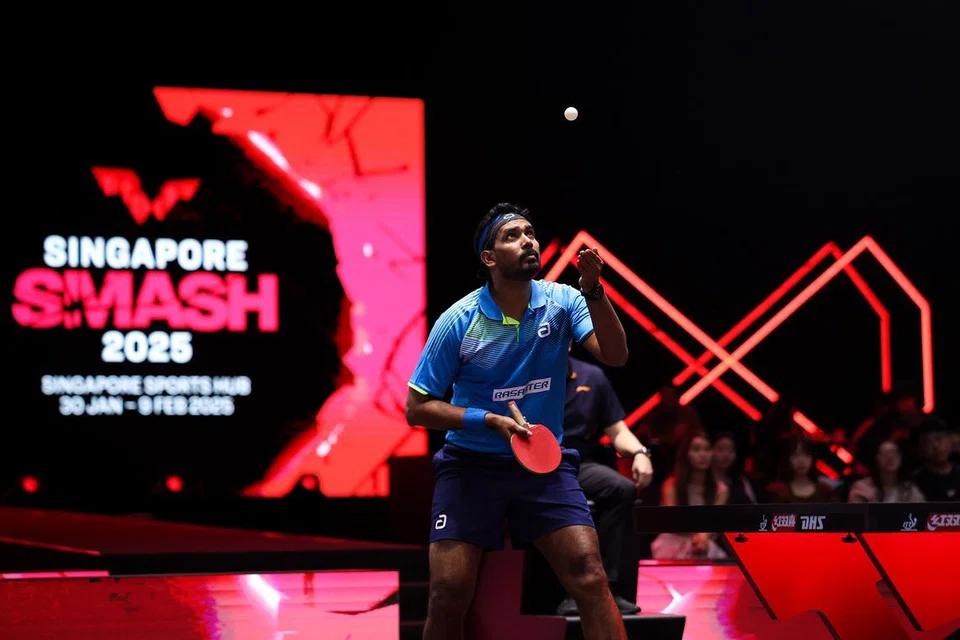
When Achanta Sharath Kamal started playing for his national table tennis team in 2003, India were ranked 36th in the world. Today, he is aged 42, and India’s men’s and women’s teams figure in the top 10.
Over the years, the ageless warrior has seen the steady rise of Indian table tennis in the international arena.
But 2024 was especially spectacular for him. Not only did the Indian men’s and women’s teams qualify for the Olympics for the first time, Manika Batra became the first Indian paddler to reach the last-16 in the women’s singles.
Earlier in the year, the women’s team clinched a groundbreaking bronze at the Asian Table Tennis Championships in Kazakhstan, while Ayhika Mukherjee and Sutirtha Mukherjee won India’s first medal, a bronze, in the women’s doubles at the Asian Games.
“We’ve been having fantastic results in recent years and that is thanks to support from the Table Tennis Federation of India (TTFI), the government, and, of course, the ecosystem that has been built,” said Kamal, who reached the quarter-final of the Singapore Smash in 2024 but was beaten by Taiwan’s Kao Cheng-Jui 2-3 in the first round of this year’s edition last week.
“With sponsors coming in, we’ve come a long way from the time we did not have access to top-level training and tournaments,” said the 10-time national champion. “The most important change is that a player development infrastructure is in place and parents are pushing their children to take up table tennis.
“When I started my career (at age 16), it was predominantly the coach who used to take care of physical and mental fitness, video analysis and everything else. But now, we have different departments and people for these jobs.
“Also, before 2017, only a few players showed promise to reach the top level. Now we can see a bunch of juniors doing well, like Payas Jain (Under-17) and Manav Thakkar (Under-21) reaching world No. 1 in the junior rankings. The Indian league (Ultimate Table Tennis, launched in 2017) has also contributed a lot to our experience and confidence.”
Kamal, who is currently ranked 42, said the turning point came at the Rio Olympics in 2016, when India for the first time had four players in the main draw. “It was a shot in our arm, as the government noticed our abilities, and began to support us better,” he added.
At the same time, the Ultimate Table Tennis league gave Indian players a platform to partner with foreign players.
“They got to practice with and play against better players. It was a fantastic launch pad for the youngsters,” said Kamal. “When they started beating the top players, they began to feel confident. Before that, they would always be scared playing against the stronger Asian and European players.”
Soon after the league was formed, players such as Manika and Sathiyan Gnanasekaran broke the top-25 ceiling and led India to gold medals at the Commonwealth Games and lesser medals at the Asian Games.
The winning mentality was exemplified by Ayhika at the World Team Table Tennis Championships in Busan last year. Then ranked 155th, she stunned world No. 1 Sun Yingsha 3-1. In the same match against China, Sreeja Akula, ranked 49th, trounced world No. 2 Wang Yidi 3-0.
Though India lost the tie 2-3, the two singles wins against the mighty Chinese made TTFI secretary-general Kamlesh Mehta exclaim that it was “the greatest day for Indian table tennis”.
The terrific showing not only helped the women qualify for the Paris Olympics, it also led to more children in India joining the sport.
To Kamal, who plans to become a coach after his playing days are over, table tennis in India may not reach the heights of cricket, but it can become as popular as badminton and tennis, sports which have produced Indian world champions and Grand Slam winners.
“The sport is vastly different from the time I grew up when not many parents wanted their children to play table tennis,” he said.
“Now, the outlook has changed. They are willing to take risks and invest more. And the youngsters are not holding themselves back. They want to win every match, as they feel they may not get a second chance.”