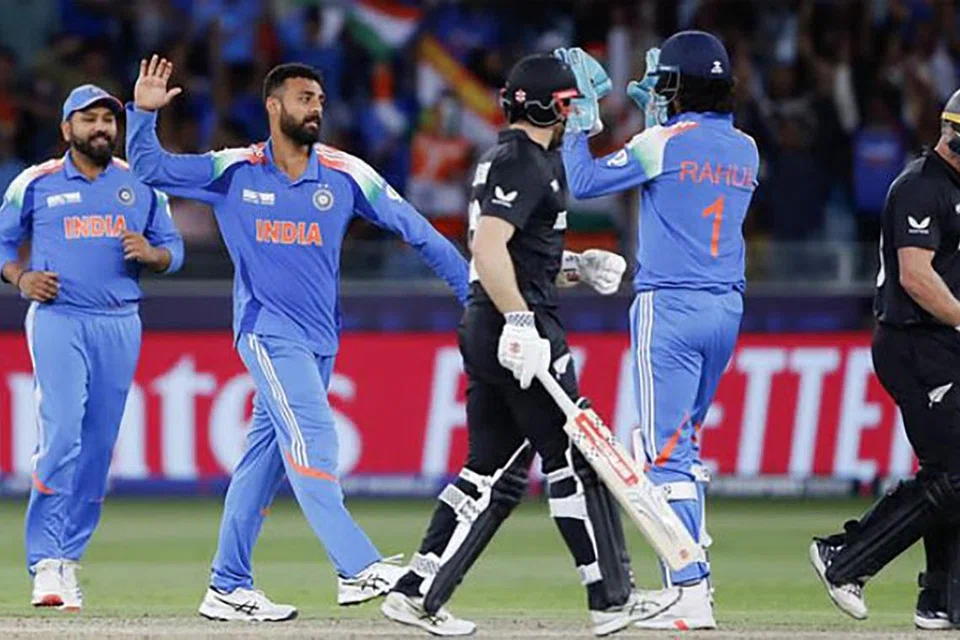


A thrilling cricket showdown awaits as India and New Zealand gear up to play in the Champions Trophy 2025 final on Sunday in Dubai.
This marks the first time in 25 years that the two teams will meet in a white-ball ICC tournament final, with their last encounter dating back to the 2000 ICC Knockout Trophy, where New Zealand defeated India by four wickets to claim their maiden ICC title.
Both teams have taken contrasting paths to the final. India, led by Rohit Sharma, secured their place with a hard-fought four-wicket win over Australia in the semi-final, maintaining an undefeated streak in the tournament.
New Zealand overpowered South Africa in the second semi-final in Lahore, showcasing their adaptability and hunger for a world title. The Black Caps, who lost to India in the group stage, will now have a chance to avenge that defeat and lift their first white-ball ICC trophy since 2000.
India comes into the final as the tournament’s most complete team, boasting a deep batting lineup and a well-rounded bowling attack. Their dominance on Dubai’s dry pitches has been evident, particularly with their spin-heavy approach.
Kuldeep Yadav, Axar Patel, Ravindra Jadeja and Varun Chakravarthy have all played crucial roles, suffocating opposition batting lineups with their precision and variation.
In their group-stage win over New Zealand, Chakravarthy was the outstanding performer, taking five wickets and exposing the Kiwis’ struggles against quality spin. With Shreyas Iyer scoring 79 runs, India managed to defend a total of 249 with ease, bowling out New Zealand for 205.
Batting remains India’s biggest strength, with Virat Kohli, Shubman Gill and Iyer anchoring the top order. The presence of power-hitters like Hardik Pandya and Patel adds depth to their middle order, allowing for aggressive finishes in crucial moments.
Given their dominance on slow pitches, India will likely stick to their spin-heavy strategy, which has proven effective throughout the tournament.
Despite their group-stage loss to India, New Zealand has gained momentum heading into the final, especially after their commanding semi-final win over South Africa.
Rachin Ravindra and Kane Williamson starred with centuries, while the bowlers, led by captain Mitchell Santner, Michael Bracewell and Glenn Phillips, ensured a comfortable victory.
New Zealand’s biggest advantage in the final will be their familiarity with Dubai’s conditions, having played there in the group-stage match.
The pitch, where India recently beat Pakistan, is expected to assist spinners, which could give both teams an equal chance to capitalise on the conditions.
The Kiwis’ batting line-up has shown resilience, with Tom Latham, Daryl Mitchell and Phillips providing stability in the middle order. Their ability to handle spin better than most teams could prove decisive against India’s dominant bowling attack.
Moreover, their tall pace attack, capable of extracting bounce and movement, remains a key factor.
India’s top order has struggled against high-quality swing and seam bowling in recent ICC tournaments, which gives New Zealand an opportunity to exploit early vulnerabilities. In the group-stage match, the Kiwi pacers troubled the Indian openers with lateral movement, something they will look to replicate in the final.
One area where New Zealand consistently outshines most teams is fielding. Their ability to cut off singles, save boundaries, and convert half-chances into wickets could prove crucial in a tight contest.
New Zealand’s batters have struggled against spin, particularly in the group-stage match against India, where Chakravarthy wreaked havoc. If India’s spinners can apply similar pressure, New Zealand will need a solid plan to counter their threat.
India enters the final as the favourites, given their dominant form, balanced squad and past success over New Zealand in this tournament.
However, New Zealand is a team that thrives under pressure, as seen in past ICC tournaments. With their well-rounded attack, strong fielding and adaptability, they will fancy their chances of an upset.