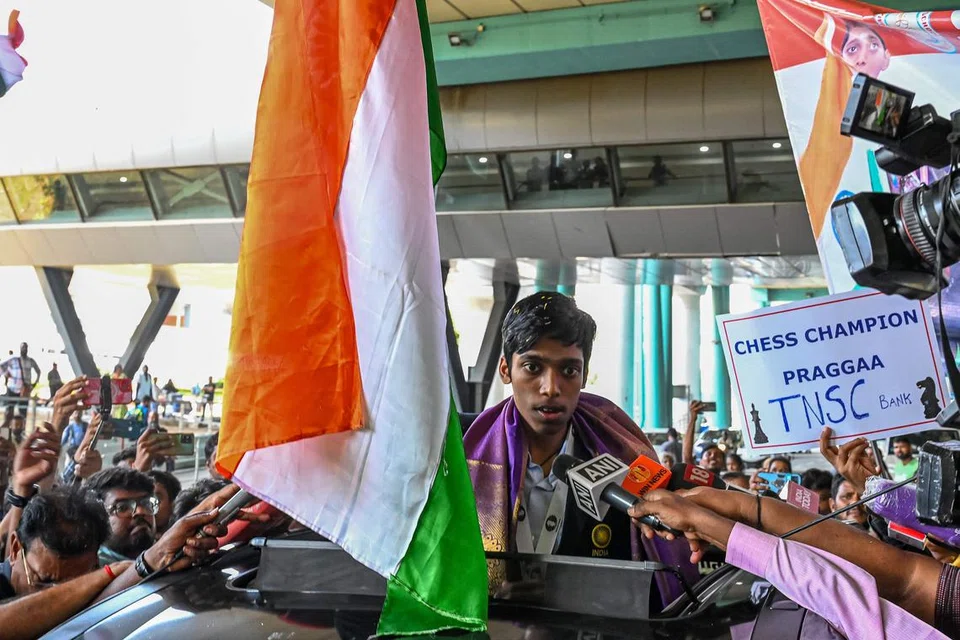
India’s teen chess prodigy Rameshbabu Praggnanandhaa on Wednesday went home to a hero’s welcome, with reporters and camera crew jostling to catch a glimpse of the star who faced international No.1 Magnus Carlsen in the World Cup final.
Popularly known as “Pragg”, the 18-year-old is the youngest player to reach a chess World Cup final, held last week in the Azerbaijani capital Baku.
Pragg lost to Carlsen in a nail-biting tie-break but chess legend Garry Kasparov said Praggthe teen was “very tenacious in difficult positions”.
Indian Prime Minister Narendra Modi congratulated the youngster for his “remarkable” performance and for putting up a “tough fight”. Experts have described his achievement as “tectonic and seminal”.
Pragg defeated the world’s No. 2 and No. 3 to make it to the World Cup final – a remarkable feat in itself, as no other Indian has competed in the finals since chess legend Vishwanathan Anand won the title in 2002.
Pragg also made headlines for becoming the world’s youngest player to play in the finals and the third-youngest to qualify for the Candidates Tournament, putting him in the same league as prodigies like Carlsen and Bobby Fischer.
On Wednesday, Pragg was greeted by hordes of supporters who handed him bouquets of flowers and sweets as he emerged from the airport in his home city of Chennai.
“I am very happy to see so many people have come to receive me... it feels really great,” he said.
Such adulation is usually reserved in India for cricket stars, who enjoy celebrity status.
The son of a bank employee and a housewife, the grandmaster has been playing the sport since he was four.
Pragg’s success has been fuelled by the cooking of his mother Nagalakshmi, who accompanies him on chess tournaments with pots and southern Indian seasonings to make his favourite meal of rice and spicy rasam or sambhar soup.
Nagalakshmi told the ChessBase India news site on Tuesday that she had made rice and sambhar for Pragg at the Fide World Rapid Team Championship in Dusseldorf, Germany.
Pragg’s first coach S. Thiagarajan, who coached him from age four to 10, said his student was always dedicated.
“He was always a bright student and a jovial child,” Mr Thiagarajan told AFP. “He used to be in the academy every day from 10am to 7pm, at times staying longer – and I would give him homework that would take at least three hours to finish.”
In 2018, at age 12, Pragg became the world’s then second-youngest chess grandmaster.
Chess has gained in popularity in India in the past two decades after 18-year-old Anand became the country’s first grandmaster in 1988 and dominated the game in the 2000s. For a long time, he was the lone flag-bearer of Indian chess, taking the world by storm with his exploits.
Things have changed in the last decade or so, with numerous talented players emerging on the Indian chess scene, making the country a formidable force in the world.
Four Indian players – Pragg, Arjun Erigaisi, D. Gukesh and Vidit Santosh Gujrathi – reached the quarter-final of the World Cup in Baku.
Currently, there are 21 Indian players who hold positions within the top 100 junior players in the world, all under 20 years of age, with four ranked in the top 10 and seven in the top 20.
These youngsters “will almost certainly dominate chess for a decade or more,” said columnist and Fide-rated chess player Devangshu Datta.
And the theoryis is plausible because thousands of young Indians are now playing chess.
Smartphones and cheap Internet access have made it easy for children to hone their skills through apps and online tournaments, while basic chess coaching is easily available as well, reported BBC.
Though Pragg had to settle for runner-up in Baku, he will draw hope from the fact that he has qualified for the Fide Candidates tournament.
The 2024 Candidates Tournament will be an eight-player chess tournament from April 2 to 25 in Toronto, Canada.
The winner of the tournament will become the challenger for the 2024 World Chess Championship match.
AFP