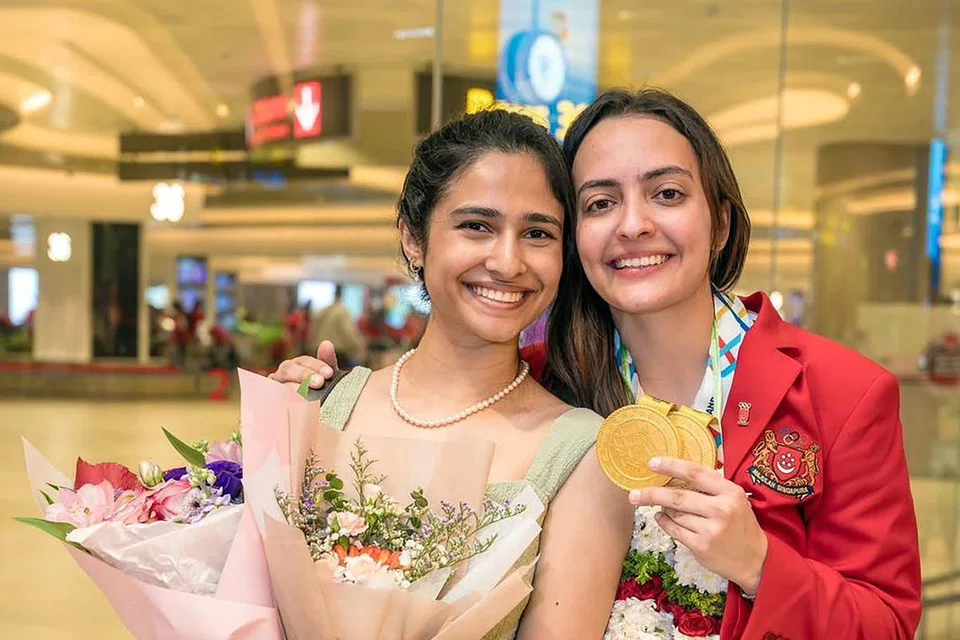

When Singapore’s Amita Berthier stepped onto the fencing piste at the 2025 SEA Games in Thailand, few would have guessed how deeply personal her individual foil gold truly was.
Yes, it added another title to her name – her third after 2017 and 2019 – but this victory was far more than a medal. It was the culmination of a journey defined by self-doubt, rediscovery, and a near-career crossroads.
“Each major Games is a different ball game,” she told tabla!. “Learning how to cope with mental stress is very important. So, I went in there like I wanted to win the gold, and it worked.”
Amita, a two-time Olympian, had struggled after her Olympic appearances – particularly with the mental burden of expectations and the pressure to perform.
Following her participation in the 2024 Paris Olympics, where she narrowly lost 13-15 in the round of 32 to World No. 11 Lauren Scruggs of the United States, she found herself questioning her future in fencing. “I was putting too much pressure on myself,” she admitted. “I doubted myself. I wasn’t sure if I wanted to continue.”
At one point in the middle of this year, Amita took a short break from fencing entirely, choosing not to touch her weapons and instead focus on rest, recovery, and life beyond the sport.
It was a decision that surprised many, but one she describes as crucial: “That time away helped me realise I still have more to give. I wasn’t done with this journey.”
Returning to competition, Amita’s mindset shifted from fixation on results to rediscovering joy in the sport. “I focused on having fun and not putting too much pressure on myself,” she said. That renewed passion became her foundation at the SEA Games.
Her resilience was most vividly on display in the semi-final – a match many expected her to win comfortably. Instead, she found herself down 8-14 against Samantha Catantan of the Philippines.
With one more point needed for elimination, most athletes would have faltered. But Amita, trusting her skill and blocking out the noise, surged back with seven unanswered touches to win 15-14.
“It was one of the biggest comebacks I’ve ever made,” she said, recalling how a voice from the stands – her sister Aarya’s – helped her stay calm and focused, one touch at a time.
National coach Andrea Magro praised her composure: “She didn’t rely on luck. She fought with belief, heart, and technical excellence.”
Buoyed by that dramatic win, Amita carried her momentum into the final, dismantling teammate Maxine Wong 15-4 to reclaim the gold.
Her victory wasn’t simply about dominance on the piste; it was about finding her best fencing again and reinforcing her belief in herself. “This isn’t just another medal,” she reflected. “It’s a reminder of why I started, why I stayed, and why I can keep going.”
Her comeback also highlights a larger narrative in Singapore sport. Amita openly cited inspiration from fellow national athletes like sprint star Shanti Pereira and taekwondo standout Diyanah Aqidah Dian Khudhairi, whose successes motivated her to envision herself atop the podium.
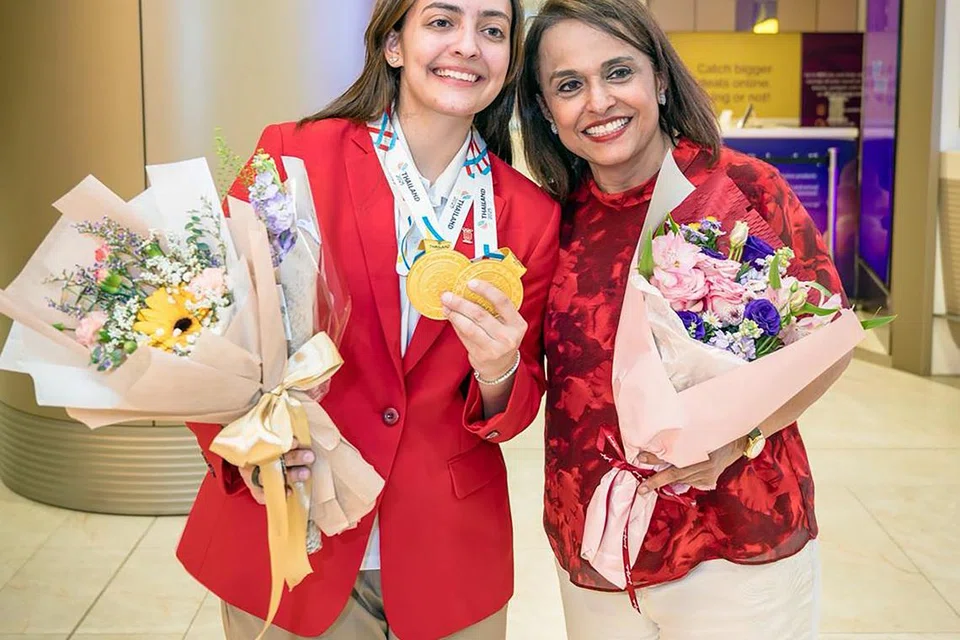
“I had doubts, like during that period this year when I was struggling a little bit, if I could measure up to the competition. But there was always that little part of me which is like, there’s so much more that I can do in this sport. I didn’t want to give it up. And, an athlete’s lifespan is so short, I didn’t want to regret it later.
“So, I’m glad that I made the decision to come back, because for me, that wasn’t an easy decision. I was very grateful because I talked to my mom, and my family was supportive of me, and they just wanted me to do what’s best for me.
“I think that really helped my decision, because nobody forced me to stay or go. I was able to make my own independent decision.”
Now 25, Amita isn’t ready to rest. She spoke about the importance of constant challenge – training with world-class opponents, attending camps abroad, and pushing herself beyond the SEA Games arena.
Once ranked in the world top 20s, she is now at 84. But the full-time fencer remains unfazed, despite having to overcome competitors from Asia itself – with the Japanese and Chinese “super strong”.
“I want to keep improving,” she said. “This sport has more for me. I’m not done.”
santosh@sph.com.sg